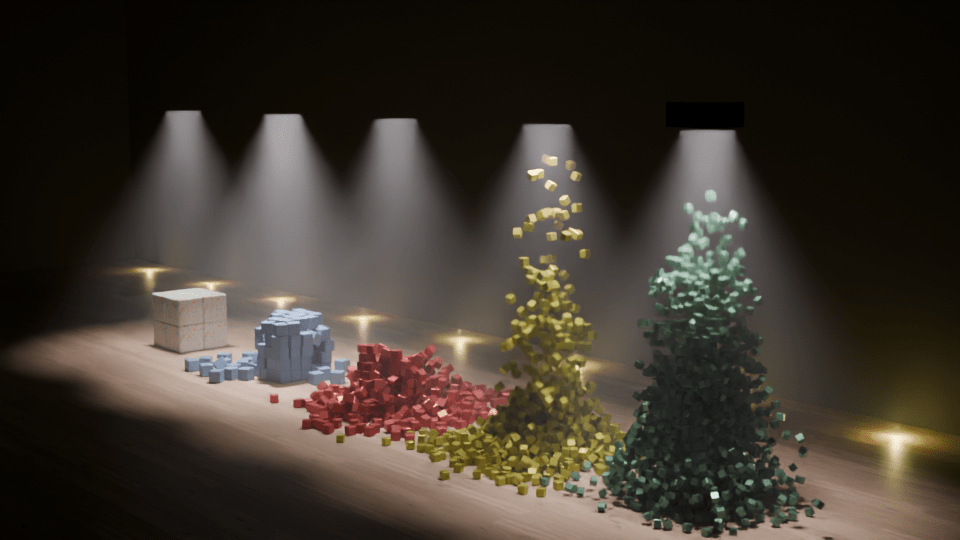
There are a few videos on YouTube (and elsewhere1) of piles cubes being dropped, weights being dropped on cubes and balls hitting piles of cubes. I’ve done one myself, and it’s quite satisfying. Destruction of things without actually wasting resources. I was asked if I was in need of some sort of catharsis. I don’t think so.
I decided to mix it up a bit and have a series of groups of cubes dropping as the camera tracked past. The varying weights video (above) had a static camera. I rendered the different videos separately and spliced them together before adding sound to give it a bit of realism. The final bit where a flying cube hits the camera was the only camera movement I did. The shaking as the blocks hit the ground was done using an add-on called ‘camera shakify’2.
Blocks of cubes
First you make the cubes and then add physics. The easiest way to make a bunch of the same things is using an Array modifier, where you repeat an object a set number of times. So to make an 8 x 8 x 8 cube of cubes, I did three arrays of 8 in the X, Y and Z direction. Then the 1096 block need to be separated and given physics.
‘Physics’ in this sense means that the objects react to gravity and to other objects with physics. The video below shows how objects interact with ‘active’ physics, ‘passive’ physics and no physics. So the green cubes react to gravity and are stopped by the red passive objects. Passive objects don’t react to gravity or other forces but get in the way of active objects. The blue ‘no physics’ cube gets ignored.
Initially I made four blocks of cubes: 2, 5, 8 and the 10-cubed blocks, and then set up the moving camera.
Camera settings
To get a camera to pan while it focuses on a moving spot you need two things. A line for the camera to follow and something for the camera to aim at. For this video, the line is a curve that runs mostly straight past the cubes and then curves around and up to finish with a view of all the fallen blocks. The camera is pointing at an ’empty’, which is an object that will not render in the final image. I animated the movement of the empty so that the camera would arrive just as the blocks started to fall.
The camera itself has several settings, not all of which I understand. The one I do understand is ‘motion blur’, which adds a little realism to the falling blocks. The video below shows the effect in a simple scene. In the final frame of the video below you can see there is blurring of the cubes on the left and the animation looks a bit more realistic.
Lights!
Lights above the cubes turn on as the camera arrives. These are circular area lights, intense and powerful. I also added a ‘fog cube’ so the light beam could be seen. More lights, smaller yellow ones, and a back wall add some shape to the studio that all this is happening in. Getting this timed correctly is relatively easy, keyframes for the light intensity can be edited as needed.
I noticed how high the blocks went for the 10 – cubed block and so I thought I’d see what happens with 12 cubed. And the cubes went everywhere. Drilling down into the narrative3, I thought that the set-up would have overlooked this and so the lights that come on as the camera tracks would be too low for the last pile and this light gets destroyed by the cubes.
I added a cube above the light, did a cell fracture4 (only 20 pieces) and timed it so that the erupting cubes hit the fractured cubes as the physics takes over and the pieces fly everywhere. It just so happened that the end point of the camera track was just to the right of where one of the pieces flew.
Video below is how the Blender screen looks as the final animation is playing. There are random colours added to each object so I can make them out. There is a small three-way axis that travels left to right – that’s the empty that the camera (the pyramid that travels along the black curve) is locked in on.
Sound!
Getting the sounds was difficult, it is usually the part I struggle with. I have various thumps, crashes and loud clicks saved, so they were easy to get. I wanted to have a director saying ‘action’ and then ‘CUT!” but could I find one? Could I bugger. So in the end I recorded myself as the director. The family don’t think it sounds like me, the microphone I used is a bit heavy on the treble.
Two weeks after publishing it on YouTube it’s had about 500 views. The simple destruction videos seem to do a lot better than ones with a narrative. So I guess it’s back to explosions.
- Such as TikTok. I will post these videos there, see if I get any interest. ↩︎
- It shakes the camera. But you probably guessed that. ↩︎
- The narrative being that these demos are for real but the director is a bit hurried with his setting up and is under time and budget pressure to get the videos done. ↩︎
- I’d done a cell fracture demo, showing how a wall breaks with different levels of cell fracture. It’s had over 20,000 views. I guess people like things being destroyed. ↩︎
 Grim up North Heath
Leave a comment