Tag: dailyprompt

  • ‘Tinterweb

    ‘Tinterweb

    The most important invention in your lifetime is…

    I am just older than the internet. The first linked computer system (ARPANET) went live in October to December 1969, when I was a few months old.

    All the trouble started here.

    As a tool for spreading information and knowledge the internet is up there with agriculture, written language and the printing press; I might be old but I post date both those things.

    I first encountered the web (invented in 1989) in 1993 when I worked at Liverpool University. I think I knew of it, probably from Tomorrows World, but had never used a web browser. I used it mainly for research since the original users of the web and internet were academic and military.

    There have been many other great inventions in the last few decades; some of the advances in medicine are frankly astonishing. The invention of MRI and DNA fingerprinting and the continued development of computer storage and quantum computing spring to mind.

    But the fact of the internet and the ease with which ideas can be shared and communication can occur has enabled these advances in the same way that the printing press ushered in The Enlightenment.

  • Food, science & architecture

    Food, science & architecture

    Describe your most ideal day from beginning to end.

    This day is a patchwork of highlights. I don’t know if there is any one place that this could really happen, but ‘ideal’ has to be able to include the impossible.

    Mrs S is with me throughout, the kids join us for lunch then do their own thing after dinner.

    Wake up about seven, in a big hotel room with a massive en suite.

    Full English breakfast – local butcher’s sausages, back bacon, two fried eggs, black pudding, fried potatoes, toast, coffee. Or steak and potatoes if FEB isn’t available.

    Walking tour including local architecture, industrial, religious and civic. A lot of pointing at ceilings and mulling over the fact that we’re lucky we don’t have to work in those conditions at the mill/ mine/ factory/ farm that is now a working museum.

    Lunch is fish and chips by the sea, where the kids have joined us after a morning shopping. There is a magic seagull exclusion zone so we can eat them undisturbed and the chippy has saveloy for Mrs S.

    Afternoon at a bookshop where you can get lost among the shelves, the type Terry Pratchett described as ‘a genteel black hole that can read’. Someone magically comes and takes our books and other purchases back to the hotel for us.

    Coffee and cake (fruit cake or tiffin) to tide us over.

    Evening session at an observatory or other science museum where we will again do a lot of pointing at stuff and talk about science and the like.

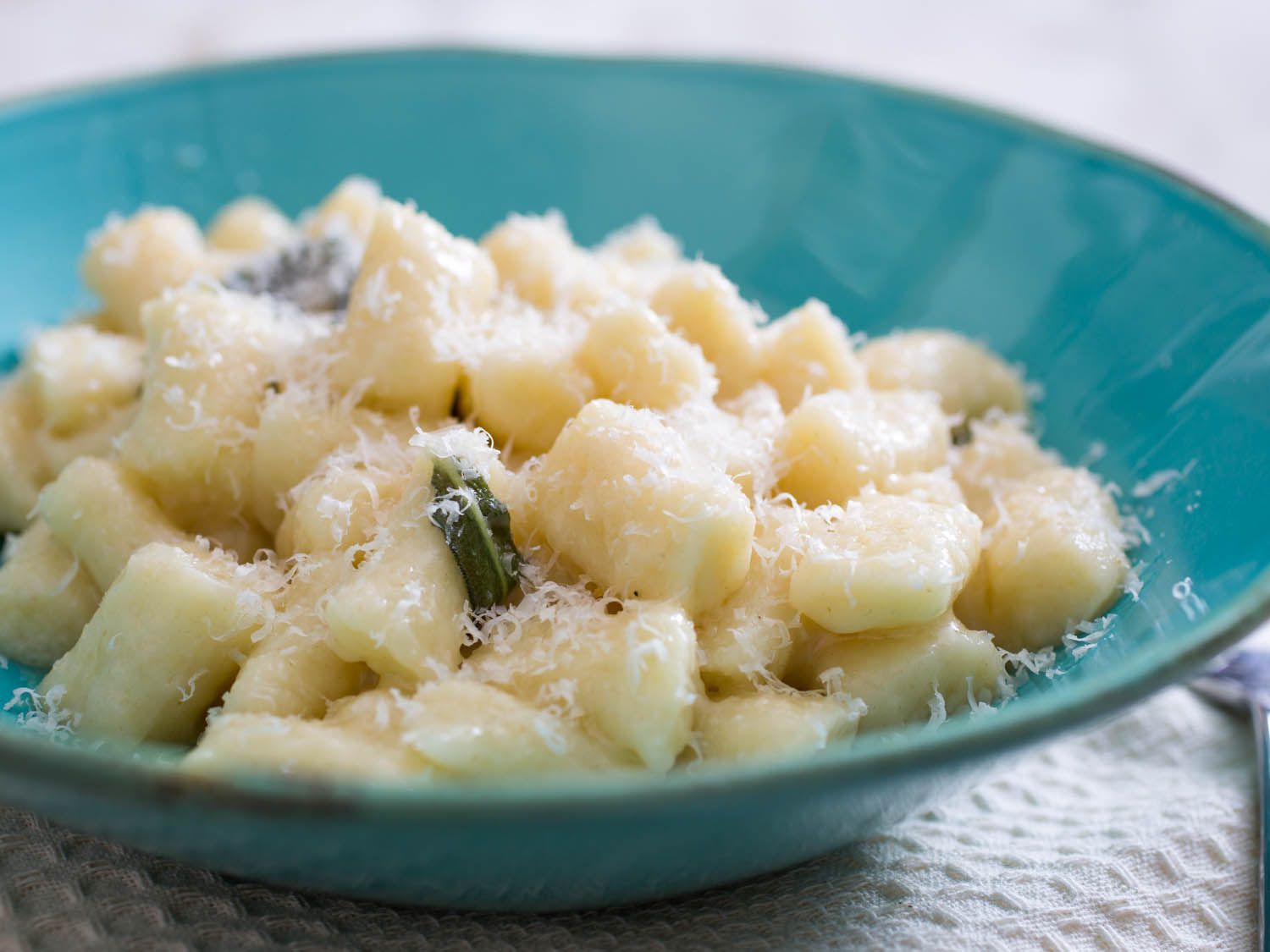
    Late dinner. Italian restaurant overlooking a scorched valley in Tuscany, the evening has cooled enough that we can eat comfortably, but a cold Peroni or three is welcome. I’m not driving, so what the hell. A selection of charcuterie to start, then something involving gnocchi, a spicy pizza and gelato for dessert.

    After dinner, stand up comedy at an upstairs cellar with acts I’ve never seen before but leaving me exhausted with laughter. The fortifying pint of Guinness at the interval will see me through.

    A couple of whiskies as a nightcap. Something floral for preference, a Speyside single malt or a selection of whiskies from around the world.

    Then bed.

  • Beef stew and dumplings

    Beef stew and dumplings

    What’s your favorite thing to cook?

    I love this dish, the smell fills the house when it’s in the oven. It’s also easy to prepare, although it does take a long time to cook.

    We have two versions in this house, I do a slow-cooked version with cannellini beans (recipe here), Mrs S uses a pressure cooker and her recipe features oxtail soup (must be Heinz).

    Both are delicious, with different textures and many common ingredients. Beef, onions, garlic, carrots for starters. I put potatoes in the stew, Mrs S does them separately. But the most important component of the stew is the dumplings.

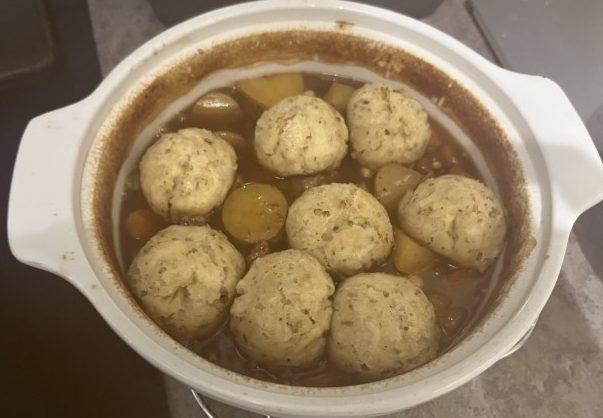
    Uncooked dumplings. You don’t need to be very rigorous getting spherical dumplings, rougher dumplings will fluff up just the same.

    Dumplings are easy enough to make, as long as you use suet and self-raising flour you can’t really go wrong. A generous helping of dried herbs and chilli add some flavour. We give them 20 minutes steaming over the stew. This allows the dumplings time to swell and acquire the required soft texture and some of the flavour of the stew. It also means that some moisture from the stew is lost so the stew thickens a bit.

    Dumplings done, stew ready to serve.

    I’ve just noticed that there’s a very angry-looking dumpling in the middle of the picture. Just as well we ate it before anyone noticed.

  • Pet B

    Pet B

    Write about your first computer.

    There are two ‘first computers’ for me. The first one I used was when I was at Thurso High School. This was the school’s 8K Commodore PET that was available to book for lunchtime use. I was at the school from ‘81 to ‘82 before we moved to England. I don’t know that I learned very much; some programming in BASIC but no guidance, played a text adventure game and perhaps gained an awareness that computers were a thing that would feature in my future.

    Commodore PET from about 1980.

    The second was a BBC B that was a Christmas present to the family in 1983. Transferring data and uploading was a challenge using cassette tape recorder. It could take half an hour to load games, along with the clanking racket of data transfer and you’d come back from your tea to find the load had failed. Jealous of a neighbour (an engineer) who had a floppy disc drive and he could load a game in under a minute! He’d also expanded the BBC B’s 32K RAM to an unbelievable 128K.

    The power!

    Having a BBC C at home was handy, because this was the machine I used for ‘O’ level computer studies. In theory I could have transferred work between school and home, but data transfer wasn’t really viable and we only did a small amount of programming during the course.

    Inevitably games were played on the BBC at home, once we hooked it up to a spare telly. Elite was my favourite, a space adventure game with trading commodities and the occasional space battle. I also have fond memories of my dad playing ‘Estra’, a collect-the-pieces game that took ages to load. But while it loaded, it played ‘Entry of the Gladiators’1, which was fun.

    You can play Estra here, and listen in awe to the theme music.

    After O levels, I didn’t use computers much for a number of years. I first heard about email in 1990, when I was at uni in Loughborough. One of my tutors told us that he could send a message from his computer2 to a friend at Portsmouth and get a reply later that day. Much faster than letters and less intrusive than a phone call.

    Mrs S and I didn’t own a computer at home until about 2000, after we had bought our first flat. The mainly so that I could work at home on my PhD. I had to run an extension line right across the flat to get dial-up internet and it was honestly easier and quicker (and possibly cheaper given the cost of phone calls back then) to take a bus up to the university (from central Bath) and get journal articles from the library than it was to try and download them at home. But I did write my thesis on it, so it served its primary objective.

    I can’t remember the specs, but I do know it was quite an expensive bit of kit for us at the time. Given its cost, we shipped it over to Australia in 2003 and back again in 2005. We still have it in the loft, gathering dust and awaiting possible resurrection so I can play Quake III Arena again.

    1. The circus music. ↩︎
    2. He had a computer in his office! ↩︎
  • Call and response

    Call and response

    Write about a few of your favorite family traditions.

    Most families have in jokes, like most friendship groups. This is why your brother is the funniest person you know, though your sister is a successful stand-up comedian. Well, maybe not your brother, but it’s a tale I’ve heard comedians tell.

    Growing up, we had a few stock phrases in my family, it was usually my dad who used these. Every time someone went to the barbers:

    What’s the difference between a good haircut and a bad haircut? Two weeks.

    Every. Time.

    I do miss him.

    One he borrowed from a work colleague:

    I want to see it on a concrete piece of paper.

    As a family, we find it difficult to say goodbye on phone calls. Mrs S laughs when I talk to my mum, we will say goodbye and it will be another ten minutes before we hang up. When we visit, mum always stands at the door waving until we’re out of sight.

    Now we have a family of our own, we have a few traditions and stock phrases. The most important one is letting people know when you’re finished in the bathroom. Lifted directly from “The Young Ones” episode Nasty.

    Rik letting Neil know that he’d finished in the bathroom. Very socially responsible of him.

    Bathroom’s free!

    Unlike the country under the Thatcherite junta!

    Over the years, the adjective for the junta has changed. It’s currently Starmerite, it has been Sunkakian, Trussite (very briefly), Johnsonian, Mayite, Carmeronion, Brownian and Blairite in its time. But the important thing is that we know the bathroom is free.

  • Crisps. Always, crisps

    Crisps. Always, crisps

    What snack would you eat right now?

    Also known as ‘chips’ in the US and Australia1, crisps are my go to snack.

    Will Self is a fan. In his typical sesquipedalian style he has written about the ‘plangent crepitation’ experienced while consuming these ‘fried and friable foderols’. Basically, it’s the crunchiness that gets you. There’s little more disappointing in this world than a non-crunchy crisp.

    What flavour? I’d rank the standard flavours as salt & vinegar > ready salted > cheese and onion.

    Favourite S&V is Piper’s, a different flavour of vinegar. They claim it’s cider vinegar but whatever it actually is, there’s something a bit more mellow about these than the standard sodium acetate in some crisps.

    Pipers cider vinegar and salt crisps. Emphasising the vinegar first suggests that the vinegar is at the forefront of the flavour, and they are right.

    Ready salted is the vanilla ice cream of the crisp world. Maybe not very exciting, but a crisp manufacturer has to be able to do this right. The crunch, the salt and the fat are a delightful combination that can also be experienced in good pork crackling, but without having to prep a pork roast first.

    So while I’d normally put cheese and onion as third after ready salted, the exception is Fiddler’s Lancashire Cheese and Onion. These are currently my favourite crisps, though they are difficult to get hold of. Mrs S surprised me last Father’s Day with a whole box of them, much to our mutual delight. Hers in finally finding something I want2, mine in having 24 bags of these fantastic crisps all to myself.

    Current favourite crisps, Fiddler’s Lancashire cheese and onion. Distinct flavour compared with other cheese and onion, Lancashire rather than ‘cheese’ makes all the difference.

    Many other flavours are available from Piper’s, Fiddlers, Kettle Chips and others. Mrs S is a fan of Fiddler’s black pudding and mustard. Black pepper is a great addition to any crisp. Pigs in blankets and chorizo get shout outs from some manufacturers. But for me, the ‘big three’ flavours from my childhood will likely never be supplanted.

    1. Where what we call chips are known as ‘hot chips’. The colonials are so disappointing ↩︎
    2. Apparently, I’m impossible to buy for. ↩︎
  • S.I.M.O.F.

    S.I.M.O.F.

    Daily writing prompt
    Come up with a crazy business idea.

    Science Institute, Mainly Old Fogeys.

    Whenever a scientist retires, resigns, is made redundant in their mid-50s, or leaves science for any reason there is a great deal of knowledge, know-how and wisdom lost.

    I’m proposing an institute where these people are paid to come in a few days a month and thrash out their old theories for the benefit of younger scientists and engineers. There will be access to equipment, testing rigs and all sorts of analytical equipment, with free tea, coffee and biscuits. The full-time junior staff will be specially selected for their intelligence and patience.

    One of my theories about innovation is that there are many half-notions in the world, but connecting your half to someone else’s half and making that bridge the gap between problem and solution can be a hit-and-miss affair. If you’ve ever heard something at random that sparks a memory and makes you go “Ah!” then you’ve bridged that gap.

    Comedy writers are excellent at this, a joke is two ideas put together in an unexpected way.

    The SIMOF solution is to have people who spent a lifetime bridging gaps create sparks in ways that nobody – least of all themselves – could anticipate.

    It needs funding, and a site that has good access for public transport. Other than that, the idea’s good to go.

  • Bungle the teddy

    Bungle the teddy

    Describe an item you were incredibly attached to as a youth. What became of it?

    When I was very young I had a teddy bear. Not unique, I know. Mine was a hard-bodied bear that I called ‘Bungle’, after the bear in Rainbow. I have no idea where he came from or who gave him to me.

    Bungle could growl. Hidden inside the body was a device that gave out a ‘Ba-aaa’ sound when you turned him upside down. He wasn’t very cuddly, I may have had other toys to cuddle, but Bungle is the one I remember.

    My memory of him is that he lost an eye at some point and also at least two limbs. He got threadbare and likely very grumpy towards the end. I have no idea what happened to him, he probably got thrown out when we moved from Thurso when I was twelve.

    In the living room of that house there was a big toy box that also served as a window seat. From there we could glimpse the island of Hoy, one of the Orkney Islands. In the box was everything you could wish for to play with. A couple of dozen cars and car tracks, loads of Lego, soft toys, Bungle, some Fisher Technik, wooden building blocks and a tired old red plastic ride-on train.

    I think the box itself was thrown out with the move, but some of the toys are still around. The Lego, my wooden blocks – a present from my ‘new little sister’ in 1973 – and the train are still at my mum’s house and are enjoyed by her grandchildren and great grandchildren.

    Bungle is long gone. Other toys have been lost over the years, but I do love that generations of our family have enjoyed toys we outgrew, but our parents kept hold of, just in case.

  • Confessions of a serial degree taker

    Daily writing prompt
    What colleges have you attended?

    I’m taking ‘college’ to mean ‘university’, since I have only been to one college – a 6th form college (16-18 years old) where I did my A levels.

    In my time I have got degrees from four universities and a diploma from a fifth.

    I did my first degree (Chemistry) at Loughborough University, a mid-range university and high-level pronunciation test for non-natives. This is the most important college/ university because that’s where I met Mrs S.

    After Loughborough I worked at Liverpool University, where I also studied part-time to get a Masters in geosciences. I learned how to use Excel (version 5.1) to model isotope fractionation in carbonate minerals.

    My next job was at Bath University, still a low-level lab tech. After a couple of years there I was offered the chance to do a PhD. Since my career was otherwise stalled (departmental politics) I said ‘yes’. I finished my study of the surface chemistry of pharmaceutical cellulose excipients in 2002, graduating in 2003. More importantly, Mrs S and I got married during my studies.

    2003 was also the year we moved to Australia and in 2004 we became parents. In 2005 we moved back to the UK, where I started work for the company I would be with for 19 years before being laid off in late 2024.

    During that time I did another part-time masters (I’d intended doing a Diploma, but the course was pretty interesting and useful). This one was run by De Montfort University in Leicester, on Quality by Design in the Pharmaceutical Industry. I also found time to do a Diploma in Innovation at the Saïd Business School (Oxford)in early 2024. Both of these were remote, so I don’t know if I can say I ‘attended’ them.

    So lots of pieces of paper and academic experience. I think they’ve been worthwhile, even though I still don’t have a regular job that uses any of them!

  • The year I was born: 1969

    The year I was born: 1969

    One small step…

    The main event in the year I was born was something that I consider the crowning achievement of humanity: man landing on the moon.

    Neil Armstrong on the moon. Not much else to say about it.

    Thousands of genius engineers and scientists worked with one aim: to get people to the moon and back again safely.

    Other events

    The first Jumbo Jet flew in January and the first Concorde flight took place in March. So as far as getting people off the ground, it was quite a good year.

    In music, the Woodstock festival and the first Isle of Wight festival took place. Black Sabbath recorded their first album in October, though it wasn’t released until 1970. The Beatles split up and the disastrous Altamont Free Concert put a lid on the flower power era.

    Moon Landing

    Over the years there have been a lot of crazies who insist that the moon landings didn’t happen. Some of these range from the reasonable – we didn’t have the technology so it must have been faked somehow – to the frankly bonkers.

    A lot of issues from the reasonable end of the spectrum are down to a poor understanding of how cameras work and physics. There are no stars in the pictures because cameras have limited dynamic range. And if they wanted to fake it, wouldn’t they have put stars on the roof of the studio? The flag does act weird, it wobbles for a long time. This has been ascribed to the ventilation in the studio moving the flag. The same ventilation doesn’t affect the dust on the floor, though.

    The bonkers end is more fun, though. We never went to the moon because the moon is a NASA hologram or a government hoax. We know this because spheres can’t reflect light so the moon is flat, if it is real at all.

    The moon is a space station and an artificial satellite brought here 13000 years ago by The Reptilians – the Draco Empire and grey aliens.

    The Moon was made by scooping out the Grand Canyon and filling it with helium.

    The astronauts would have been killed by the van Allen (or van Halen, the name changes) belt radiation. And they can’t live in space anyway because there is no magnetic field for their hearts to work off of.

    I have a file of various conspiracy theories. Whenever I’m feeling down and a bit stupid, I look at these and realise I’m not so daft after all.

Verified by MonsterInsights