Running a design business means thinking ahead. In this case, it’s over two months ahead, with two witchy designs for the Hallowe’en market.
I re-used the ‘witch’ design for these two t-shirts. The red haired witch is a general design, the green haired is hallowe’en only.
Hallowe’en imagery
What makes a Hallowe’en design? The list for the modern designer includes pumpkins, witches, skulls, skeletons, bats, graveyards.. and many more. I decided to go with a witch, since a witch flying on a broomstick is a good image not only for Hallowe’en, but for any time of the year.
Bats, the moon and a graveyard feature in the images above. Links for the shop below.
For the two designs discussed here, I used the same ‘witch’ outline. I traced this in Inkscape, keeping it minimal except for the hair. I changed the hair to green in the design that mentions Hallowe’en, red was fine for the more general witch design.
The basic image used in the two designs.
Final designs
The two legends for the design are based on old tropes.
‘Have gun, will travel’ originated in classified ads, as an advert for a man who was looking for gun-for-hire work. It meant that you had tools and would travel to work, being used as the title for a Western TV series in the late 1950s. This was adapted as ‘Have Tux, Will Travel’ for Bob Hope’s autobiography1. From this, the meme/ trope process changed it to whatever application was needed until it became a snowclone.
‘The Mountains are calling, and I must go’ in another snowclone that I’ve used before for a Murder, She Wrote design.
I used Canva for the final design. Fonts fall under the ‘spooky’ category; Beast is the scratchy font in the “Have Broomstick” design, Beaver Punch, with some manipulation using the TypeCraft app for the “Have Broomstick. I also added some watercolour splashes behind the witch in both design to fill them out a little.
Scottish tradition
I grew up in the north of Scotland, to English parents. The tradition in Scotland is for ‘guising’, where you dress up in a costume and visit the houses of people you know. Once there, you do a wee performance (poem2, joke, dance – whatever) in exchange for sweeties. This is subtly different from ‘trick or treat’, because you feel that you earned the sweets.
To my mind trick or treat is a bit menacing. As Eddie Izzard put it in Definite Article3:
Trick or treat! Give us stuff for no reason!
By the time we moved to England in 1982, I was a bit too old for guising, and anyway nobody knew what that was. Trick or treat was imported some time in the late 80s, though this passed me by. Mrs S had no tradition of demanding sweets from neighbours, but then she grew up in central London.
Also Have Spacesuit, Will Travel, a 1958 Robert A Heinlein novel. ↩︎
One year, our dad made me and my sister owl and cat costumes and we recited The Owl and the Pussycat for everyone who didn’t stay still long enough. ↩︎
I’ve written about my love of Terry Pratchett and my opinion on Michael Sheen as an actor and a human being. The two combine in the TV series based on the book Good Omens, which Pratchett cowrote. The third installment is out now. How did Good Omens 3 shape up?
Not very well.
Good Omens: a personal history
Good Omens was one of the first books I bought in hardback. My £9 gamble paid off, it’s a fantastic book co-authored by two men who were reaching the height of their abilities. The book, published in 1990, came at the beginning of Pratchett’s golden era and not long into Gaiman writing his breakthrough work, the graphic novel Sandman. It was several years in the making as the two men nurtured their solo careers.
My copy of Good Omens. I bought this in 1990 in Liverpool. I hesitated to spend £9 on a book I hadn’t heard anything about, but I loved Pratchett and this Gaiman guy might be worth a try.
The story follows at least three strands. The focus for many is the relationship between the angel Aziraphale and the demon Crowley (né Crawley). Left on Earth at the beginning of time, Aziraphale gives Adam and Eve his flaming sword to keep them warm after they are cast out of the Garden of Eden. Crowley provided the temptation that resulted in their expulsion. Fast forward six thousand years and the two have established a working relationship and something of a friendship. They describe it as being like the relationship of the representatives of two rival companies. Stationed far from head office, they help each other out when it is mutually beneficial.
In the late 1970s Crowley delivers the Antichrist to the hospital at Tadfield Manor, where he will be swapped with the son of an American diplomat. The plan (part of God’s ineffable plan) is for the Antichrist to grow up close to the seat of world power. By the time he turns 14, he will have become a powerful entity and help bring about Armageddon. However, a mix-up with the babies means that the Antichrist, named Adam, is raised in Lower Tadfield, a small village in rural England. In the second strand we follow Adam as the leader of ‘Them’, a group of four kids who get up to all sorts of japes and have a generally wizard time.
The third strand is the story of Newton Pulsifer, an apprentice witchfinder, and Anathema Device, a witch. Device is a direct descendant of Agnes Nutter, whose prophecies are staggeringly accurate, if a little cryptic at times1. Newton is a direct descendant of the man2 who burned Agnes at the stake. Device is in Tadfield looking for the Antichrist. Pulsifer is in Tadfield because there are odd goings-on in the area and there may be witches. They meet, fall in lust, and agree to work together.
The three strands meet at the American airbase near Tadfield, where Armageddon is to be triggered. Pulsifer uses his negative computer skills to prevent the launch of a devastating nuclear weapon release set in motion by Death, War, Famine, and Pollution3. Adam confronts Satan and refuses to let the Earth be destroyed. Satan insists on the destruction of the world – it’s in the Plan. But the question arises: Maybe the world not being destroyed is part of the Plan. How can you know? It’s ineffable.
The first series
After publication there was a lot of discussion about a Good Omens film or TV series. The Pythons Terry Gilliam and Terry Jones were independently linked to film (Johnny Depp and Robin Williams as stars) and TV adaptations, respectively, but it came to nothing. A BBC Radio adaptation in 2014 did a good job, with Mark Heap as Aziraphale Peter Serafinowicz as Crowley, and a cameo from Terry and Neil, recorded in Neil’s car.
Terry Pratchett died in 2015 after a long and public fight with Alzheimer’s disease. After his death, Gaiman received a letter from Terry urging him to see the much-delayed television project through.
The first series came out in 2019. This was the first time that Michael Sheen and David Tennant had worked together. Previously, they had been up for the same roles, given that they are of a similar age and are both among the best character actors in the country. There’s usually only one such role available in any project, so it’s one or the other4. Or maybe Sam West, John Simm, Benedict Cumberbatch5, Ewan McGregor… any reasonably good-looking, high class British actor born in 1970 ± 5 years.
It is the onscreen chemistry of the two leads that shines. They inhabit the characters as any good actors would, adding little touches that distinguish the basic character of the two.
Aziraphale and Crowley arrive at Tadfield Manor. Crowley goes out of his way to walk on the grass, Aziraphale doesn’t stray from the path.
The series follows the book very closely, adding some excellent historical scenes (Crowley getting credit for the French Revolution stands out) and leaves very little out. I think only the lesser Bikers of the Apocalypse are omitted6.
There is a deep friendship offscreen too, as witnessed by their lockdown project Staged. The rest of the cast shine as well. Miranda Richardson, Michael McKean, John Hamm, Doon Mackichan, and Jack Whitehall are just some of those who shine. The Them are also really good – it can be so hard to get decent child actors.
Before and after the body swap. Top: David Tennant as Aziraphale pretending to be Crowley and Michael Sheen as Crowley pretending to be Aziraphale. Bottom: Back to normal and correct body language restored.
So it was a big tick, VG, gold star for this. Like the book, it was lively, funny and engaging. A second series, billed as a bridge between the published book and the grand finale, came out in 2023. Some of the ideas that Pratchett and Gaiman discussed for a follow-up7 were to be included.
Good Omens 2
This was very much a curate’s egg. I loved the ‘minisodes’ that started some episodes. Harking back to one of the highlights of the first series, we see Crowley in an succession of bad wigs and dodgy facial hair (see below) dealing with Job, graverobbers and Nazi zombies.
Crowley with spectacularly silly hair and beard, about to deal with Job’s children.
In the modern day we have a selection of people local to Aziraphale’s bookshop who pursue love in all its various guises. In heaven, the Archangel Gabriel has gone missing. So too has the archdemon Beelzebub.
The modern-day parts felt a bit flat. Gabriel turns up in Aziraphale’s bookshop with his memory wiped. Over the series, we find out what he’s been up to and why Beelzebub is also missing – they have fallen in love. With Gabriel angelus non grata in heaven, Aziraphale is convinced to take over as chief archangel to prepare for the Second Coming.
Crowley pleads with Aziraphale to stay on Earth. They kiss, but Aziraphale leaves anyway. The series ends, teasing the finale and the Second Coming as heaven and hell fight one last battle. Again.
Neil Gaiman leaves the project
In 2024, several news outlets published a series of sexual assault allegations against Gaiman. This inevitably affected the production of anything that he was involved with, including the second series of Sandman, a Disney adaptation of The Graveyard Book, and the third series of Good Omens. Gaiman left the Good Omens project in October 2024. Amazon reduced the planned six episode series to a single film, with Gaiman credited as writing the film, but he was not the show runner as he had been for the first two series.
Without Gaiman at the helm it would be hard to capture the essence of Good Omens. We read the news with great disappointment, mainly directed at Gaiman’s reported behaviour. However great an artist is, misconduct of this type cannot be erased by their works.
Good Omens 3
The bridging season was a bridge to nowhere. While I was watching it, I felt that I was only watching it so that I had watched it, rather than enjoying it. I don’t ever feel the need to complete a series that I’m no longer enjoying. For example, I haven’t watched much Red Dwarf after series 7, because the quality took a dip after Rob Grant left the writing partnership.
It opened with a scene set at the aftermath of the first Great Battle. Michael Sheen – General Aziraphale – appears dressed in a wig and armour that look repurposed from a Game of Thrones/ Highlander crossover. Crowley threatens him, tries to steal the Flaming Sword, but collapses from the injury he sustained in the battle. Aziraphale, being an angel, puts a bandage he had handy on Crowley’s leg about 6 inches above the wound. He then leaves.
This opening didn’t give me a warm, fuzzy feeling about the next 90 minutes.
Michael Sheen as Aziraphale, looking uncomfortable. Could be the wig, the armour, or the unconvincing speech that the archangel Michael just gave.
It is clear that the film was supposed to be a series. We had Jesus, but not much of Him. His disciple, Harry the Fish, could have supported an entire episode but we got a few minutes of three card monte, the miracle of the pizza and not a lot else.
Some of the scenes felt rushed and yet also slow. Michael’s descent to madness just seemed to happen, rather than giving Doon Mackichan a script to show how Michael’s position as a war angel meant she was eager for conflict and Aziraphale thwarted her ambitions. Maybe the clues were there, but I’d have to watch it again to find out and honestly, I don’t think I can.
In keeping with the theme from the second series, the love story between Crowley and Aziraphale gets played out in a coda to the film. We see them as humans who fall in love and have a happy life together. This felt like fan service.
The film’s best bits were when Sheen and Tennant were onscreen together. But even these failed to lift the film, which became the Sheen and Tennant Show, rather than Good Omens. Most disappointing of all, it wasn’t funny.
What we were given was a Temu version of Staged, the hilarious and lively lock-down series where Sheen and Tennant shout at each other8 via video calls. Go and watch it, it’s ace.
In summary
I would heartily recommend the book and the first series. The first series was a rare adaptation that lifted the source material and made it fit the new medium. The second and third installations felt more like fulfilling an obligation, like the second and third Matrix films, rather than completing the arc, as the second and third Lord of the Rings films did.
The book is subtitled “The Nice and Accurate Prophecies of Agnes Nutter, Witch”. ↩︎
Witchfinder General Thou-Shalt-Not-Commit-Adultery Pulsifer. ↩︎
Grievous Body Harm, Cruelty to Animals, Really Cool People and Treading in Dogshit (later renamed People Covered in Fish). They have scenes in the script, but time and budget meant they weren’t included. ↩︎
Tentatively titled 668, the Neighbour of the Beast. ↩︎
And Samuel L Jackson, Judi Dench, Whoopi Goldberg, Ewan McGregor… a lot of huge stars were available. ↩︎
Public Information Films, short films commissioned by the UK government, were often used as filler during advert breaks on telly. Some were memorable for their catchy tunes, others for the catchphrases and others for the sheer terror they induced in us poor kids.
Catchy tunes
I grew up in the north of Scotland. Far north enough for a trip to Inverness to be ‘going down south’. In the summer a PIF that has been stuck in my head for fifty years was shown during every ad break. It’s a two minute mini-epic about how to drive on single track roads. As soon as that jaunty fiddle started up and young Bill Patterson1 sung the words ‘along the roads of the north and west/ you’ll find the scenery is the best’ I knew I had two minutes to dash to the kitchen and get a drink of juice.
I have no idea what sort of accent he’s singing in, though.
The tune is something of an ear worm for me; it’ll lodge in my head and is difficult to shift. But at least I know not to park a caravan in a passing place. It’s a great tip for driving around Sussex.
You wouldn’t steal a handbag
Another catchy if irritating tune was the unskippable advert that preceded films on DVD for many years. Over a jarred, beat-heavy tune we were told we wouldn’t steal a handbag, or a car, or a television2, but why would you steal a film.
Screenshot of the ‘Piracy is Theft’ information film.
No, I wouldn’t steal a car or a handbag. The only time I’ve watch a pirated film was A Clockwork Orange as a fifth-generation knock-off in 1990. It was almost impossible to watch, the quality was so poor. My excuse is that the film was barred from release in the UK by Anthony Burgess.
This was parodied in The IT Crowd and referenced by Ed Byrne in Different Class. Ed is about to watch the horror film Hostel Part 2 and reacts to the ‘You wouldn’t steal a handbag’ bit:
Don’t fucking tell me what I would and wouldn’t do. You don’t know me. I am drunk at two in the afternoon. In my pants. On my own. About to watch women being tortured to death by paying guests in an underground bunker in Eastern Europe. And you’re telling me I wouldn’t nick a poxy handbag?
Ironically enough, it turns out that the company who produced this film didn’t clear the rights for the music.
Charley says…
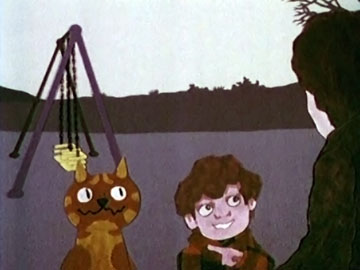
There were six films in this series, all about how to stay safe in the terrifying world of 1970s Britain. After the little boy misses out on going off with friends because his mum was busy, she rewards him with a picnic. The cat Charley (voiced by Kenny Everett) summarised the lesson of the film, miaowing loudly while gobbling a fish. Tony translated for us:
Tony (the boy) and Charley (the cat) give us a lesson in stranger danger.
Charley says: always tell mummy where you’re going so she knows who you are with.
The catchphrase ‘Charley says’ got a minor revival when The Prodigy sampled this phrase for their 1991 hit Charly. The messages were simple warnings about stranger danger, playing with matches and water safety. Water safety is the subject of one of the more chilling PIFs.
I am the spirit of dark and lonely water
Standing proud as the scariest non-graphic PIF3 is this tale of terror, voiced by Donald Pleasance.
Pleasance wasn’t the only big name to lend their voice to PIFs. John Hurt gave a chilling voiceover to the “AIDS – Don’t die of ignorance” campaign, Bernard Cribbins and Brian Wilde voiced a film about the danger of playing near overhead power lines and flying kites near pylons. In front of the camera, David Prowse – the body of Darth Vader – was the Green Cross Code Man.
Lonely Water stands firmly in that genre of PIF known in the trade as “not mucking about.”
Looking at this PIF again, it’s remarkable how much rubbish there could be strewn around the countryside. Old washing machines, bedsteads, cars… It’s a wonder that poor kid at the end didn’t die of tetanus before he drowned.
Who played RP Tyler in Good Omens among many other things. Had to get a Terry Pratchett link in. ↩︎
This was the 2000s, when tellies were enormous. So of course I wouldn’t steal a television, who do you think I am, Geoff Capes? ↩︎
There was one about playing safe on a farm. Very grim. ↩︎
I have a longer introduction to the idea of carrot cake, and how the modern oil-based cake is a relatively recent innovation. Read all about it here.
This is adapted from another blog. It’s a butter cake like you’d expect to make, but there’s less sugar (because of rationing) and carrots are added for sweetness and moisture.
Ingredients
230 g self-raising flour
85 g baking spread/ margerine
85 g sugar
115 g finely grated carrot
55 g mixed dried fruit and peel
1 egg
A splash of milk
Oven at 200 °C (gas mark 7). Prepare a 20 cm cake tin.
Rub the fat into the flour until it looks like fine breadcrumbs.
Add the sugar, grated carrot, dried fruit and the egg.
Mix well, adding milk to make the batter a bit more runny.
Bake for 40 to 45 minutes, then cool in the tin for 15 minutes. Allow to cool before eating.
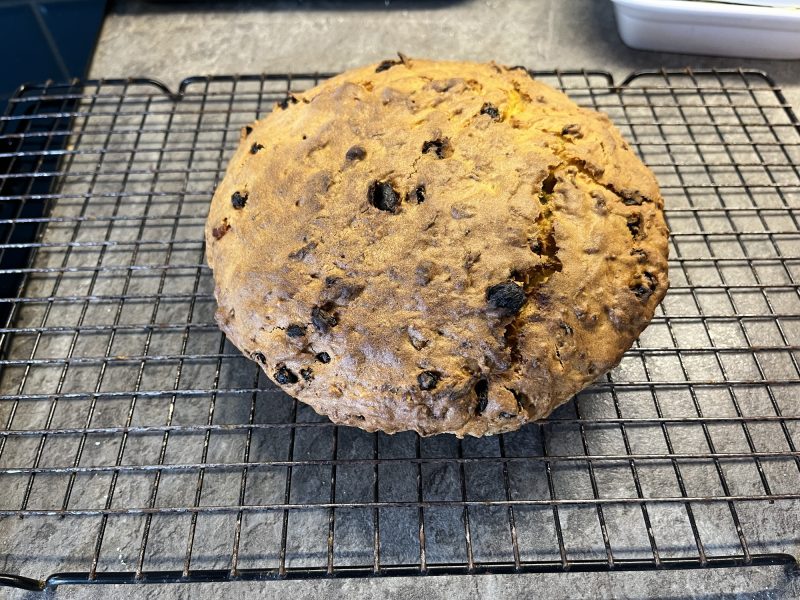
World War 2 style carrot cake.
I didn’t ice this. I don’t think they would ice a cake in the war, what with sugar being in short supply.
Judgement
It’s OK. Not as moist as the oil-based carrot cake I made the other day, but an acceptable cake nonetheless. Younger child asked me to make it again, but we agreed on a couple of adjustments. First, add some cinnamon. Second, add some icing. After a brief discussion, we agreed that an orange icing similar to that used for lemon drizzle cake would be the first thing to try.
All of which means two things: One, I’ll be updating this recipe before too long. Two, I’ll have to do a recipe for lemon drizzle cake.
Rationing
Of the six ingredients in this cake, all were rationed in 1943, except flour.
Dried fruit was part of a points system. Each adult got 16 points per month towards non-essential items such as dried fruit, canned goods and biscuits. In 1943, a pound of currants would take up all 16 points for the month.
Ingredient
Adult ration/ week
Used here
Flour
Not rationed
Margerine
4 oz
3 oz
Sugar
8 oz
3 oz
Egg (fresh)
1
1
Egg (dried)
3
not used
Dried fruit
points based
2 oz
I resisted the urge to use dried egg. This is partly because they didn’t have any at Waitrose1, and mainly because the taste was supposedly revolting2.
Flour wasn’t formally rationed during the war, but it wasn’t always easy to come by. Flour and bread were rationed from July 1946 to July 1948, partly due to a dreadful summer ruining wheat crops.
I’ve only been in my current job for a year. My previous job, science research, changed considerably over the thirty-plus years I did it.
Back in the old days
Science and research relied on manual methods when I started in science, doing my undergraduate degree at Loughborough from 1989 to 1993. In the university library there was a mix of card indexes and a new computer system.
The Pilkington Library, Loughborough University. The unusual inverted pyramid design is not an accident, we were told. I’m not so sure.
Finding the book you wanted meant being familiar with the library layout and knowledge of the Dewey Decimal system. I spent a lot of time in the 540s (Chemistry) and later, in particular, 541.35 (photochemistry) for my final year project.
What neither the card index nor the computer index could help you with was looking for a journal article. If you knew the details of the article, from another article, for example, then it was easy enough. Locate the journal in the library and hope that the volume you want is available. Otherwise it was the dreaded Inter-library loan (ILL), which cost money and took weeks.
If you didn’t know the particulars of the article you wanted, only that it was written in the mid-1970s by PF Morgan in one of the American Academy of Sciences journals, you were pretty stuffed.
Web of Science
With the advent in the 1990s of the Web of Science in the 1990s, you could search for a term. This meant that you could search for Morgan, PF and add search terms ‘silicone dioxide’ and the year range 1972 to 1978. And bingo! You found that article you were looking for five years ago and can no longer remember why you wanted it. Mainly because you were investigating photochemistry in 1992, but in 1997 you are working in a geology lab.
All this seems pretty lame by today’s standards when we are all search-engine savvy. But it was a revelation at the time and exactly what computers are for.
This means you can find a reference in a journal you don’t have in the library. And furthermore, now you can download the journal article often for a hefty fee. Last I looked the top fee was $60 for access to a single article. This does not encourage the flow of knowledge.
The flip side of easier research is that expectations are higher. When I had my PhD viva (in 2002), the external examiner was keen to point out that I’d missed what he considered a vital paper on the subject. He had published it in 1978, and I could only apologise and accept his comment that I shouldn’t have relied on computer searches. I checked afterwards. The article hadn’t been cited since 1985. No wonder I missed it.
Today, there really would be no excuse for missing even a very old article. The web of science is everywhere. However, I don’t know whether non-English articles get pulled into the web of science.
Statistics and computers
One other thing that is now much easier with the use of computers is statistics. In 2019 I completed a Masters in Quality by Design. This technique for improving the quality of manufactured goods relies heavily on a variety of statistical methods. To say this would be difficult, tedious and prone to error without fast computers would be an understatement.
A new reading of the Anglo-Saxon chronicles has cast doubt on one of the most cherished stories from English history. We learned that, in 1066, King Harold marched 200 miles after the Battle of Stamford Bridge to face William of Normandy1, the leader of the invasion force, and was ultimately defeated at the Battle of Hastings. But this may not be the case.
Anglo-Saxon England
The battle of Hastings, fought on the 14th October 1066, was a turning point in English history. The previous Anglo-Saxon monarchy, which had reigned since about 450, was ousted in the Norman Conquest. Replacing the monarch wouldn’t normally have been all that interesting, but the successful conquest had further, lasting repercussions in the monarchy, society, and language.
Why did William invade?
The penultimate Anglo-Saxon king was Edward the Confessor. He died childless, which wasn’t necessarily the crisis that might be expected. The Saxon kings were largely elected, albeit from an upper ruling class, and primogeniture wasn’t established. Harold Godwinson was the second son of Godwin of Wessex. He was also the brother-in-law of Edward and had been named successor. However, William of Normandy also had a claim to the throne. He was the first cousin once removed of Edward and therefore eligible to be king. He also had a witnessed oath made by Harold in 1064 that Harold would support William’s claim to the English throne.
From the Bayeux Tapestry. Harold swears on two altars to support William’s claim to the English throne. the Latin reads ‘Harold sacramentum fecit VVilllelmo Duci’: Harold made an oath to Duke William.
When Harold accepted the throne on Edward’s death in January 1066, trouble was inevitable.
The Battle of Stamford Bridge
William wasn’t the only nobleman with a claim to the English throne. Harald III of Norway’s had a less straighforward claim to the English throne2 . However, Tostig, Harold’s younger brother, encouraged him to invade and take England by right of conquest.
Harald arrived in early September 1066 with about 300 ships and reinforcements from Orkney and Shetland, then under Norse rule. King Harold, based in London and anticipating an invasion by William of Normandy, brought his army north to meet the Norse invaders. The Battle of Stamford Bridge took place on the 25th September and resulted in a decisive English victory. Although the number of casualties remains unclear, the defeated Norsemen needed just 24 ships to return to Orkney. They went without Harald and Tostig, both of whom died in the battle.
13th century depiction of the Battle of Stamford Bridge from The Life of King Edward the Confessor (Matthew Paris).
Meanwhile, in Normandy…
William had been planning to invade England all year. Building an invasion force from scratch in under 9 months, he was ready to invade by mid August. What kept him back was a mix of bad weather and fear of the Saxon navy. He finally landed on the 28th September, rapidly established a beachhead and set about building a wooden fort from which to raid the area.
News of the invasion reached Harold, 200 miles away. The Battle of Hastings took place on the 14th of October. Less than three weeks after victory at Stamford Bridge, King Harold was dead, his army defeated and the Saxon rule of England was over.
Summary of the events of Autumn 1066
What’s new?
The story as told to us in school is that Harold reached Stamford Bridge by forced march from London. He won the battle, then force marched back south to meet William at Hastings. Four hundred miles and two battles in the space of a month would have left any army exhausted. No wonder the Saxons lost.
However, a recent re-evaluation of the Anglo-Saxon Chronicles by Prof Tom Licence of the University of East Anglia casts doubt on this story. The ‘forced march’ story stems from a misreading of the Chronicles. According to the Chronicles, the fleet ‘came home’ after blockade duties in the English Channel. This suggested to Victorian historians that Harold disbanded the Saxon navy in the Summer of 1066. Sending the ships to their home ports around the country and freed the militia to bring in the harvest. A lack of ships meant that there was no alternative for Harold but to march to Yorkshire, fight, then march back.
Licence suggests that this is not the case. His interpretation is that the navy relocated to their home port of London; it’s not only the Chronicles that suggest this, but other contemporary sources say that there was an active navy at the time.
So rather than marching 200 miles, Harold took the more sensible option of loading his men on ships and sailing up the coast. After Stamford Bridge, he would have sailed back, possibly with some Norwegian-build ships as booty, and marched on Hastings from London.
King Harold the general
This version of events casts Harold in a different light. Harold’s loss at Hastings may not have been mainly the result of exhaustion. The battle was hard-fought. The invaders had cavalry while the English were mostly infantry, but the numbers were about even3. Harold had stationed his men behind a shield wall at the top of Senlac Hill, making it difficult to attack on horseback.
According to the history it a feigned retreat by the Normans decided the battle. Poor discipline among the Saxons led to them chasing after the cavalry, breaking the shield wall and making a successful cavalry charge possible. Harold died late in the battle, likely killed by a cavalryman though the ‘arrow in the eye’ story has its adherents. William the Conqueror4, as he is known, was crowned king on 25th December 1066.
Probably the most famous section of embroidery in the world. This depicts the death of King Harold (Harold Rex interfectus est – King Harold is dead). What’s never been clear is whether Harold is the man with the arrow in his eye or the man falling under the horse. Some have suggested he’s both, but the two men are wearing different socks.
And so the Saxon rule was over and the Norman monarchy began. We are still living with the consequences. King Charles III claims the throne as a descendant of William. Our language changed, to become a weird hybrid of a Germanic language with mostly French vocabulary and Celtic grammar.
What might have been
It’s interesting to speculate on what might have happened if Harald’s invasion had been delayed by a month. William invades in late September, Harold meets them with a fresh army before they have established a beachhead and defeats them. Then he has to ship his army up to Yorkshire to fight an established invasion force of Vikings and disaffected locals and loses. Norway and England form a united kingdom and retain Saxon rule until… when? Who knows.
Spoiler: He is known to history as William the Conqueror. ↩︎
There was an agreement reached in 1038 between Magnus, the previous King of Norway, and Harthacnut, the king of Denmark and England, that the other would inherit their lands on their death. Harthacnut’s death led to a split in the monarchy with Magnus taking over as King of Denamrk and Edward as King of England. When Magnus died in 1047 Harald took over the claim, which included one of many promises made by Edward that they would be named his successor. At least three such promises were made by Edward. ↩︎
Some Norman sources later claimed up to a million English soldiers fought at Hastings against 10,000 Normans. Which is impressive, given the population of England was less than 1.5 million at the time. ↩︎
Previously known as William the Bastard. Though not to his face. ↩︎
Mostly I laugh at what has no agenda and is mainly silly. Always punching up, heavy on the puns and wordplay with a side order of deserved frustration.
This will be why I love Taskmaster, Morecambe & Wise, Bob Mortimer, Airplane!, Ghosts, Eddie Izzard, Monty Python and Stewart Lee.
Silly songs, too!
You could include Terry Pratchett, though the elevated level of silly hides sharp commentary and anger.
An inherited sense of humour
I think my sense of humour has remained unchanged since I was a teenager. My dad had a wicked sense of humour, one that four of the five of us1 have inherited. One of my fondest memories is when four of us were sitting at the dining room table with our parents. Someone said something (wish I could remember what) which set dad and three of us off in fits of laughter. My oldest sister had to leave the room. Mum and other child were left bemused.
To get some flavour of his sense of humour, his favourite joke was the Headstone joke.
Does time change a sense of humour?
Things I enjoyed in the 80s are still funny. Red Dwarf, the film Clue, Monty Python’s Life of Brian, the Morecambe & Wise Andrew Preview sketch…
The other day I went down a bit of a rabbithole about George Formby. This triggered the memory of the revelation that Formby – not Bob Dylan – is the original author of Subterranean Homesick Blues. This is from The Day Today, broadcast in 1994, where we also saw Alan Partridge for the first time.
A lot of this is skewed towards older stuff, but that’s not to say there’s nothing new I like. We saw Bill Bailey last year2 and Mrs S was in pain laughing at the ‘cappuccino in Amsterdam’ story.
To finish, here’s an extended dose of silly from Andrew O’Neill in 2023.
If you need the Baker Street joke explained, leave a comment.
I started Duolingo a long time ago, and like most people I stopped. But I’ve committed to this for over six years. First Italian to get the basics when we went to Tuscany in 2018, then Danish because I worked for an Anglo-Danish company. I went to Copenhagen twice a year, I did find my basic grasp useful. But I’ve been concentrating on German for the last few years.
Our youngest started learning German at secondary school, I did an O level back in ‘87, so I thought it would be good to brush up and help her with the language. Like all languages, German has its challenges but Youngest and I can chat in German and annoy Mrs S (whose French is coming along after a few years of Duo).
I’ve yet to test my German in the wild, I’ve not been since 2019 when I went to Frankfurt for a conference. I’ll keep on going since Youngest is doing German A level and I don’t want to be left behind.
Still can’t stand that owl, though. Needy, naggy little prick.