Tag: writing

  • Blender part 9 – GameDev III

    Blender part 9 – GameDev III

    Orc painting!

    Last time, I had made a nice looking orc1.

    The next stage was quite complex and not very visual for blogging purposes, except that the end result was obviously an image. It involved baking textures and it’s why we spent time on getting the musculature and the facial features right. It’s all to do with poly count.

    The number of faces (polygons) in a model is an important factor in 3D modelling. The more faces you have, the better your model will look. The drawback is that these polygons take some time for the computer to calculate. This slows down your work and can result in the computer crashing.

    By way of illustrating this, the face count for the model shown at the end of the last section and below was 14.5 million and a file size of 160 MB. By baking the textures onto a lower poly duplicate of the original, this comes down to 47,000 faces and a 64 MB file.

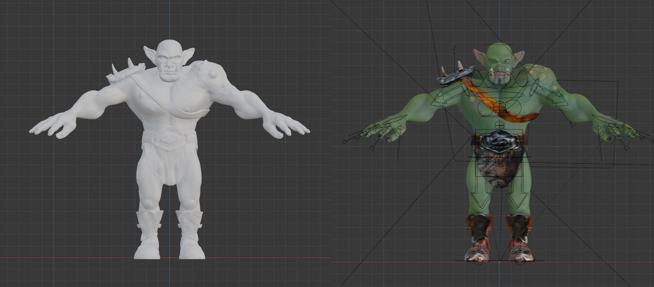
    Two orcs, one white the other painted.
    The unpainted orc on the left as 16 million polygons, the painted one on the right has 47,000 and more detail. The down side is that I can’t easily change anything about this model.

    Baking is the process where details from a highly detailed model, such as shadows from clothes and weird veins and scars, get painted onto a lower poly mesh. The details aren’t there, but look like they are.

    Baking textures allows you to use a low poly mesh that looks like a high poly mesh. The disadvantage is that you can’t change you mind about, for example, the position of the clothes once the bake is done. You can always repeat the bake, which takes a bit of time and isn’t very exciting.

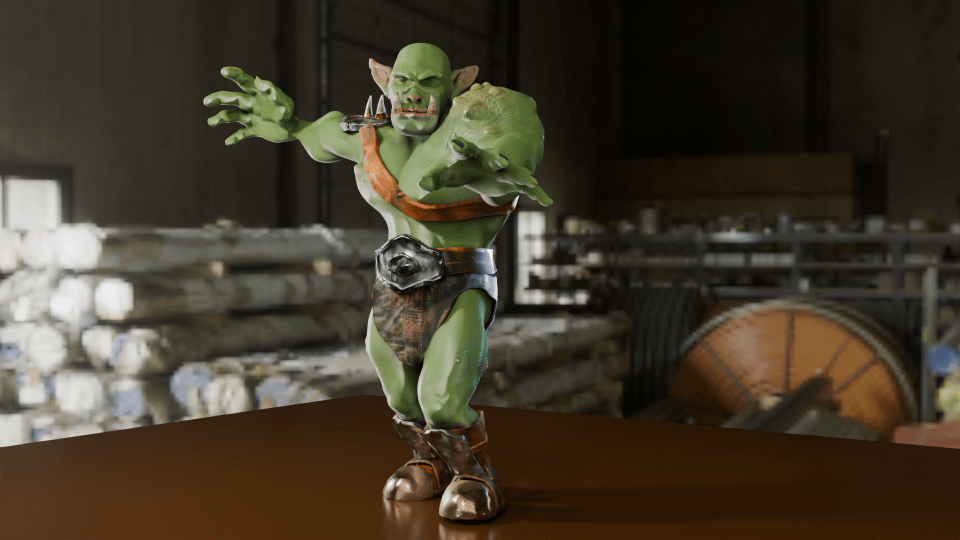
    painted orc figure posed in a grabbing manner against an industrial backdrop.
    Now that the rigging is in place, I can move the orc to give it an action pose. Might need to move the loincloth, it looks like it’s digging into the thigh.

    In the end, I’m happy with how Steve turned out. There are a few mistakes with the painting, but if you can see them keep it to yourself. I should go back and re-do where I went wrong as an exercise.

    So I had an orc with bones that I could manipulate and pose in a threatening manner. But the hands were wrong – the fingers looked awful when I tried to make them grab anything. That was the next thing, because I wanted to make Steve grab things and make a fist. That was for another time, though.

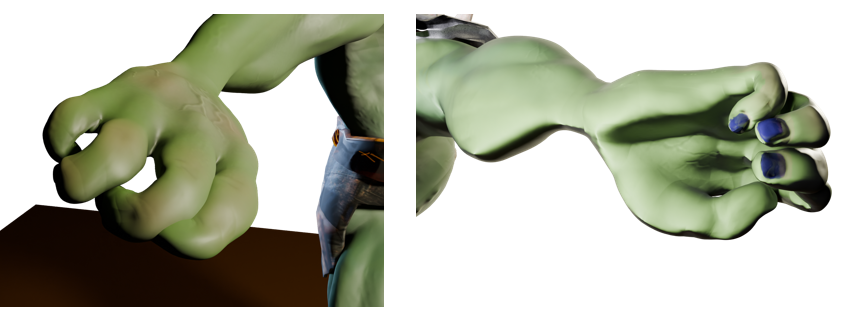
    Two views of the orc’s right hand. The rigging allows you to move body parts and the controls for curling the fingers are simple enough. However, I did something wrong when I set the fingers up because the fingers don’t move properly.

    So that was the course finished. Next up, I’ll have a look at getting realistic textures onto objects and then I’ll try and get those hands looking right so I can pose and animate Steve. And don’t forget to look for science-related opportunities for Blender.

    1. You know what I mean. ↩︎

  • Frank Whittle: The Inventor Behind Modern Jet Engines

    Frank Whittle: The Inventor Behind Modern Jet Engines

    Another T-shirt design, this one based on a patent image.

    Frank Whittle – a summary

    Air Commodore Sir Frank Whittle (1907-1996) was a test pilot and flying instructor, but he is best remembered as a pioneer of jet aircraft. It was he who convinced the British government that the standard propeller engines had speed limitations (based on calculations made while writing his thesis) and that yes, he had a solution.

    The problem was that conventional engines with hundreds of moving parts would inevitably fall apart when pushed beyond what was possible with contemporary materials. The solution was to reduce the power plant to a single moving part. He needed people to believe in his solution. He also needed money, which the government of early 1930’s Britain was reluctant to give him.

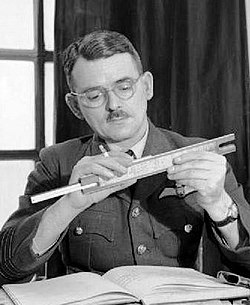
    Sir Frank Whittle with a slide rule.
    Sir Frank Whittle (1907 – 1996), one of the pioneers of jet propulsion.

    He co-founded Power Jets Ltd in 1936, a company which was able to exploit his 1930 patent for a turbojet engine with only one moving part. By the time the Second World War started, he had finally convinced the government that he had a usable and safe design. They bought the experimental engine from Power Jets and lent it back, allowing the company to continue until the company was nationalised in 1943.

    All this effort took its toll on Sir Frank. Nervous exhaustion forced him to retire from the RAF in 1946, but not before a further jet propulsion system could be patented in his name. It is this that forms the basis of the new t-shirt design.

    Discworld connection

    The term ‘Whittle’ came up in the Discworld series. In “Guards! Guards!” we are introduced to Lady Sybill Ramkin, a wealthy resident of Ankh and enthusiastic breeder of swamp dragons (draco vulgaris). She used “whittle” as a term for disappointing dragons such as Goodboy Bindle Featherstone of Quirm (aka Errol), who would never amount to much. Short, stubby wings meant Errol would never fly and would therefore be incapable of mating.

    Sam Vimes, Captain of The Watch, reflects on this dismissive adjective:

    Total Whittle, Vimes thought… It sounded like whatever it was you had left when you had extracted everything of any value whatsoever. Like The Watch.

    As it turns out, Sir Frank was something of a whittle himself. Standing five foot tall and with a small chest measurement, he failed the RAF medical (twice) when he applied. Luckily for him and for the development of the jet engine, he found a way in to the RAF. And it all came good for both Sir Frank and Errol – Sir Frank applied again and rose to be Air Commodore. Errol learned to fly and was last seen flying into the distance with a noble dragon (draco nobilis) which had terrorised the city.

    Errol the dragon takes flight!
    Errol the ‘whittle’ takes flight during the climax of “Guards! Guards!”. This is the book where we meet Sam Vimes, one of the Discworld’s best characters.

    It all ends well for Sam and the rest of the Night Watch. The men get a pay rise and a new dartboard, Sam finds love and companionship with Lady Sybill.

    Whittle’s patent

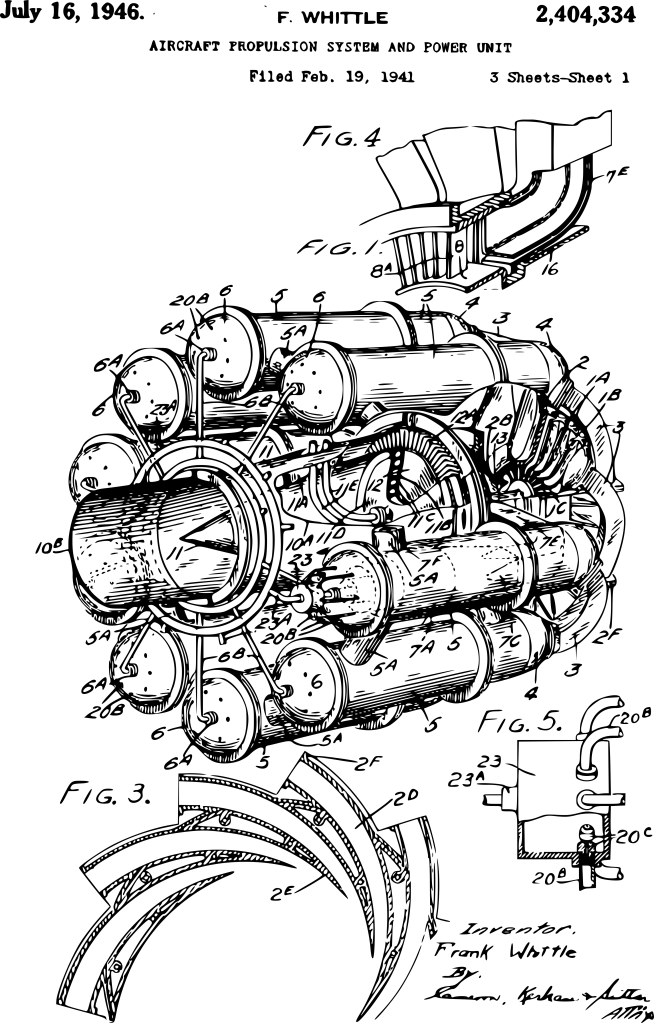
    All of this leads back to the landmark invention by Sir Frank, the jet engine. In 1946, he was granted US patent 2404334 for an aircraft propulsion unit – a jet engine. This wasn’t the first, and wasn’t the last, but it does have the big advantage from my point of view that it has a striking image to go with the patent.

    Frank Whittle's 1948 patent for an 'Aircraft propulsion and power unit'.
    Cleaned-up version of the patent image. I used Inkscape to remove the background, leaving just the black images. I then saved it as a white version to show up on the dark blue t-shirt.

    T-shirt design

    The patent image used started out as shown above. Using Inkscape, I could remove the background and be left with an image of just the text and drawings. Two things need to be done before I can put the design on a t-shirt. First, I need to choose the colour for the printing. Second, I need a fine scale render (high dots per inch (dpi) count) of the image. Inkscape can do both, so I got a 500 dpi image in white (which I won’t reproduce here).

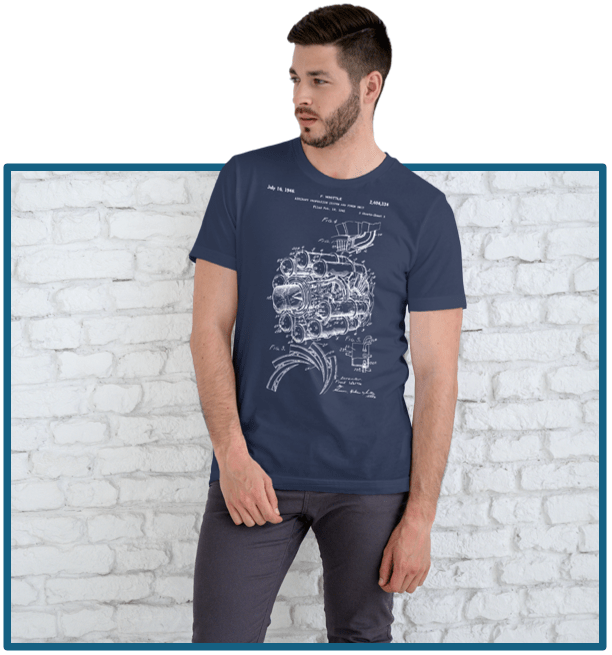
    I chose a dark blue t-shirt so that the image looks like an engineering drawing. Patents are not engineering drawings, but using blue adds a nice aesthetic to the design. Blueprints were so called because they were printed in white on Prussian Blue paper.

    There is a useful website (colordesigner.io) which will give the Hex codes for any colour so that the correct colour can be programmed into a colour rendering app. Gelato, who I use as the print on demand supplier, also give the Hex codes for their t-shirts (or at least the T-shirts I’m using). There is also a colour comparator site so that you can see how close two colours are.

    Prussian blue compared with Navy blue.
    This is a comparison of Prussian Blue (left) and Navy blue (right). Prussian is a bit more purple and lighter, but there’s not a lot of difference.

    Am I going too far with this? Maybe, but it’s best to be correct about these things even if nobody notices.

    The closest blue t shirt available was Gelato’s Navy Blue. I can’t tell the difference unless the colour are next to each other.

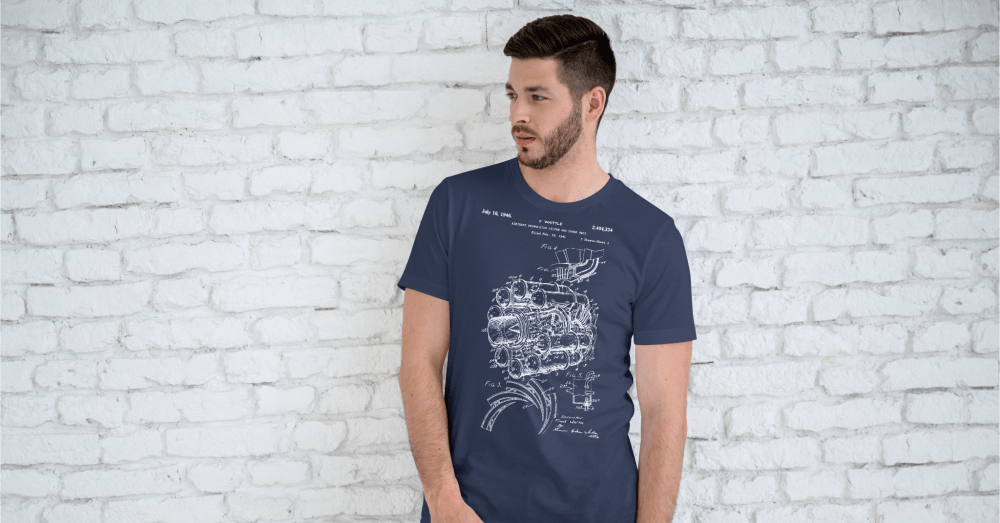
    So, finally, I was able to put a white design on a blue t-shirt. Then it was a matter of getting some virtual models to do virtual cat-walks for me and upload everything to Etsy.

    Another image of the model in his t-shirt. He looks well happy.
  • Good morning, Smithers-Jones

    Good morning, Smithers-Jones

    This song has been going through my head recently, with good reason.

    Smithers-Jones by The Jam. A story of a man getting laid off.

    To summarise, it’s about a man who goes to work on Monday morning and has a meeting with his boss. And, rather than the promotion he’s been hoping for, he gets laid off.

    It’s the refrain that goes through my head when I leave the office (which was once half of the garage) and have a break from what I’m doing.

    Put on your slippers, turn on the TV

    It’s all a part of feeling groovy

    Now, in the song Smithers-Jones has worked his arse off. I doubt anyone would accuse me of that, but the overall feeling of ennui and having been disposed of is one I can understand. I’ve been feeling a bit of that myself. The worst day was when I had to call IT services to be shut off from the work system, over a month before my gardening leave ended. A few days later my email stopped, too. It did feel as if 19 years of my work life had been chucked in the skip.

    Thinking rationally, it hadn’t – all the work is still there, but I’m no longer a part of it.

    Job search

    So I have been looking for work over the last few months, but there isn’t a lot that’s suitable.

    An annoying aspect that wasn’t around when I was last looking for work (1997) is the rise of Data Science as a job. More than three-quarters of the jobs I see or am recommended for as a ‘Principal Scientist’ are actually looking for experienced data scientists. I don’t have at least two years experience in SQL, Python etc or a PhD in Large language Models. Wish I did, the pay is fantastic!

    Training in Excel

    I’m well into a course on Excel supplied by Reed, one of many employment websites. I’ve been using Excel for 30 years, ever since I was working at Liverpool University. We had Excel 5 (I think) and we used this to collate data from the mass spec. I also used it for my Masters as a matrix calculator to estimate isotope fractionation from spectroscopic data1.

    Excel has expanded since then. Like most regular users, I was aware that there are many features that I don’t use and don’t know how to use, or even never knew existed (Format Paint, anyone?) but never had the time or impetus to investigate. But I now have the time and, yes, there are features I wish I had known about earlier that would have made some things easier.

    The course also has an introduction to VBA, which I was aware of but never explored. I’d always wondered how to make Entry Forms, and now I know.

    Still, this might stand me in good stead to get a job as an admin somewhere. Or I might design an Excel course and see if I can make money from that.

    Applications

    So far the table for applications is:

    Applied for13
    Rejections4
    Heard nothing9

    It’s this last one that’s the most galling. When I was in charge of recruitment I made sure to respond to every applicant and let them know when they would expect to hear from us.

    I’ve applied for jobs in London as well as more local to Horsham. I’d be willing to work for less than I was on if it means I don’t have the hour long2 commute each way. London would mean taking the train and perhaps two hours total travel, which would not be great, but at least I’m not driving.

    More jobs seem to be coming, though. One I was rejected from (overqualified) was in formulation, which is what I was doing before I was laid off. Today I saw another formulation position, this one in Finsbury Park (1hr 30m by train) but I’d be spending all my wages on train fares.

    So I will keep going. It’s not like I don’t have anything to do, what with the Excel training and learning Blender and, now that the weather is improving, garden and home maintenance to do.

    Maybe I’ll turn the TV on and feel groovy instead.

    1. I can do a blog post on this if anyone’s interested. ↩︎
    2. Mrs S still works for the company. It took her three hours to get home the other day. Two hours to do about a mile because Guildford was gridlocked. ↩︎

  • Blender part 2

    Blender part 2

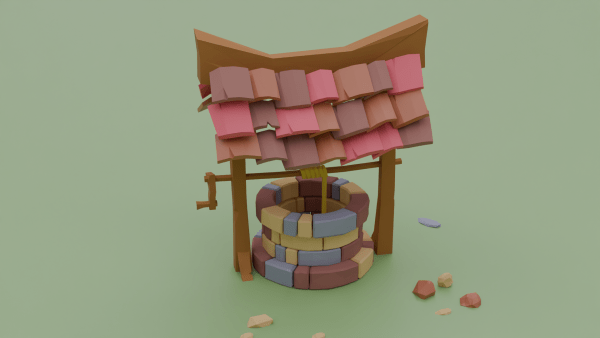
    I started a course and, unusually for me, I paid actual money for it. It’s presented by Grant Abbitt, some of whose free video tutorials I’ve seen. I did finish the low poly well, it took me a few days (no idea how many hours) and I was pleased with the result.

    Not sure where such low poly work would find a home, but it’s good to do something creative that I think will lead to better 3D prints. I just need access to a 3D printer.

    Learned quickly how to change materials and do lighting so that you get these great effects with transparent materials. This was done on the second day of the course, maybe four hours to get this far.

    What’s so good about this course is that Grant takes you through the steps to make a thing. This isn’t unique, but I see a lot of courses that show you how to use tools in Blender and other programs (Excel, for example), but there is no context.

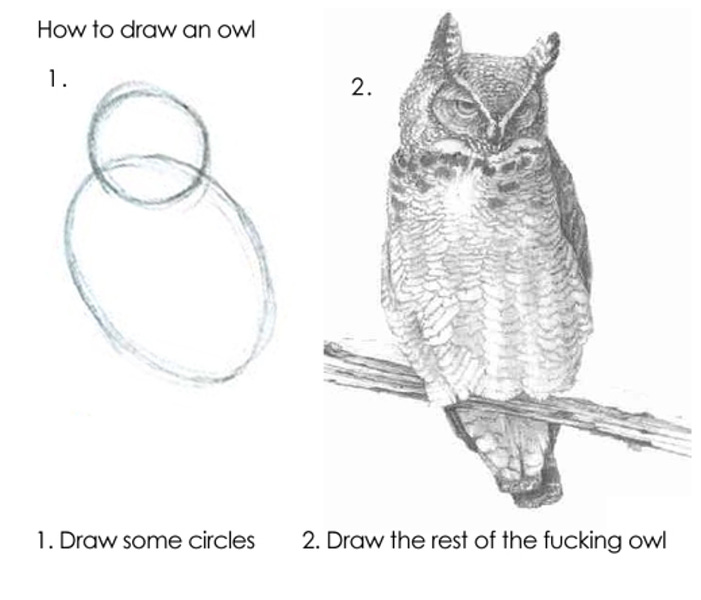
    What he also avoids is the “Draw the rest of the fucking owl” trap that I see so often. You’ll be shown how to design something, then magically it’s all lit with a background, multiple lights and a camera fly-round.

    The original “Draw the rest of the fucking owl” meme. Original artist unknown, but it’s been around since 2010. Which is medieval by internet standards.

    I got the course through Udemy, it may be available elsewhere. It’s called “Complete Blender Creator” and I reckon it’s been worth the £15. If I was making stuff in real life it would cost me at least that much to buy some clay or paper and paints.

    More to follow. There’s a lot to learn, but I’ve got time while I’m on gardening leave. I can’t spend all day looking for work when there’s no suitable jobs.