Tag: whiskey

  • Bourbon and Japanese Whisky

    Bourbon and Japanese Whisky

    An experiment with bourbon may explain the high reputation of Japan’s whiskies

    During my research for an earlier chemistry of whisky article, I came across an account of an experiment on how transporting barrels impacts the flavour of bourbon. Bourbon barrels are commonly used to age whisky not only in Scotland, but in England, Ireland, Japan and India.
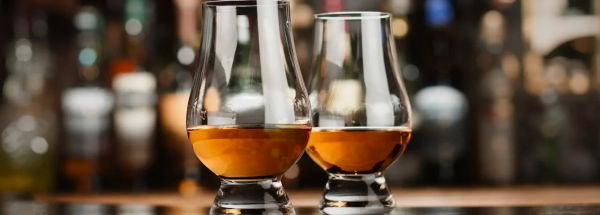
    Whisky in Glencairn glasses. These glasses were developed in the early 2000s, inspired by the shape of the whisky blender’s glass.

    I’d been looking at how the flavours of charred oak affect the character of bourbon. This article in Wine Enthusiast drew my interest. It described a fascinating experiment by Trey Zoeller, the founder of Jefferson’s bourbon distillery in Kentucky, USA. I originally put it in a footnote, but the whole thing became a bit extended and so I decided to convert it into an article.

    Barrel aging bourbon

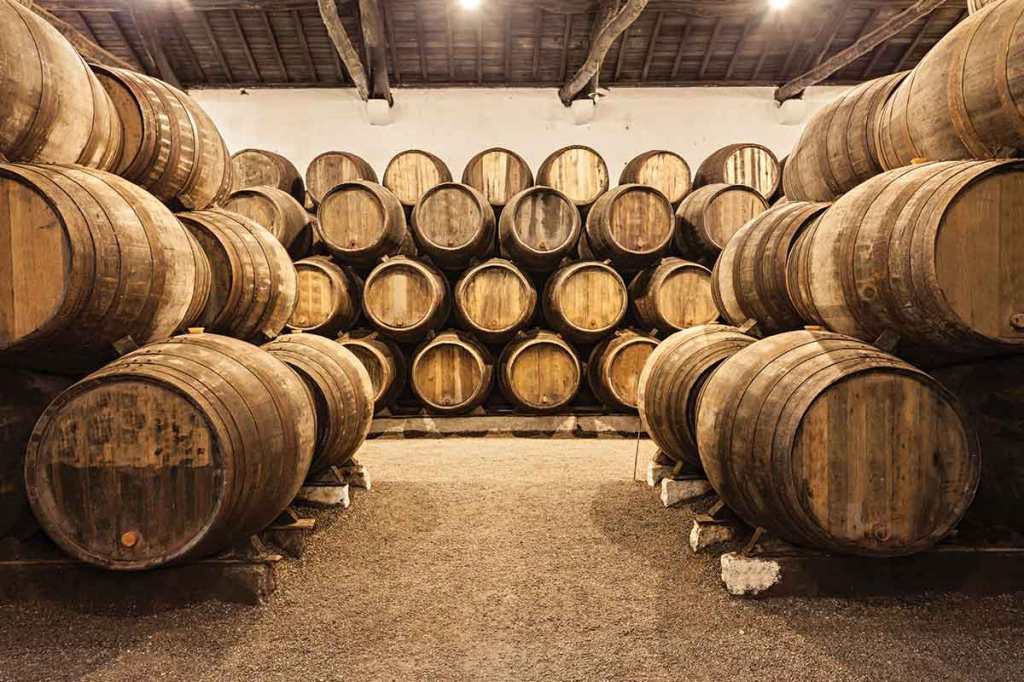
    The usual practice when aging whisky/ whiskey1 is to have the barrels stacked in a warehouse holding maybe 60,000 barrels with 200 litres in each and let nature take its course.

    Since 2012 Jefferson’s, based in Kentucky, has offered a limited ‘Ocean Cask’ expression. They send the barrels on six-month voyages at sea, where they are heated, chilled and shaken about before coming back to Kentucky to be bottled. Exact numbers of barrels aren’t available, but multiple shipping containers with 200 barrels each are now sent on these voyages. The 200-300 bottles that are filled from each barrel retail at $83 (about £60)2 for a 750 ml bottle, more than double their standard bourbon ($31).

    Without good roads, the best option was for distillers to send barrels down the Mississippi with the spring flood, then by ship from New Orleans to New York for bottling. In 2022, Jefferson’s sent two barrels of bourbon on a replica journey down the Mississippi and then to New York to see if this process was the source of Kentucky bourbon’s high reputation.

    A barge on the Mississippi.

    The agitation of the spirit in the barrel during transit did change the flavour, both chemical analysis and blind tasting showed a distinct variation. This could explain the good reputation that Kentucky bourbon enjoyed in New York.

    Relevance to whisky

    Bourbon is similar to whisky, in that you take a grain-derived spirit and age it in wooden barrels until it has absorbed flavours from the barrels and the environment. The difference is the type of grain you use. Malt whisky is made using barley. By law, bourbon must contain over 51% corn grain spirit. Anything else is grain whisky3.

    As my previous blog discussed, a lot of whisky is aged in used bourbon barrels. The environment in which the whisky aging takes place influences the flavours extracted from the wood. Bourbon is produced in the generally temperate continental climate of Kentucky, so the mix of grains (the ‘mash bill’), the type of still used and the cut of the spirit are more important in determining the particular flavour4 of the bourbon.

    The flavours extracted from used bourbon barrels by the maturing whisky will be representative of the original spirit. The mix of flavour molecules extracted will also vary depending on several factors including the ethanol content of the whisky, temperature, humidity, and time.

    Scotland is a cool, damp country and produces characteristic whisky. By law whisky must be aged for at least three years to be sold as Scottish whisky. Age adds to the flavour, smoothness and cost of a whisky. The oldest whisky I’ve ever has is a 20 year old Highland Park – a slightly peaty but incredibly smooth drink that cost about £25 for a double5.

    Japan and the getting back to the point

    All this is fine, but what does the Jefferson bourbon experiment have to do with whisky? After all, shipping or moving thousands of heavy barrels isn’t a commercially viable option unless you’re going to add a premium to an already expensive product.

    Japan has a well-established whisky manufacturing culture, with the first whisky distillery – Suntory – opening near Kyoto in 1923. Following a disagreement between the founders, a second distillery, Nikka, was opened near Sapporo on the north island of Hokkaido. This site was chosen because the climate was more like Scotland than the sub-tropical Kyoto.
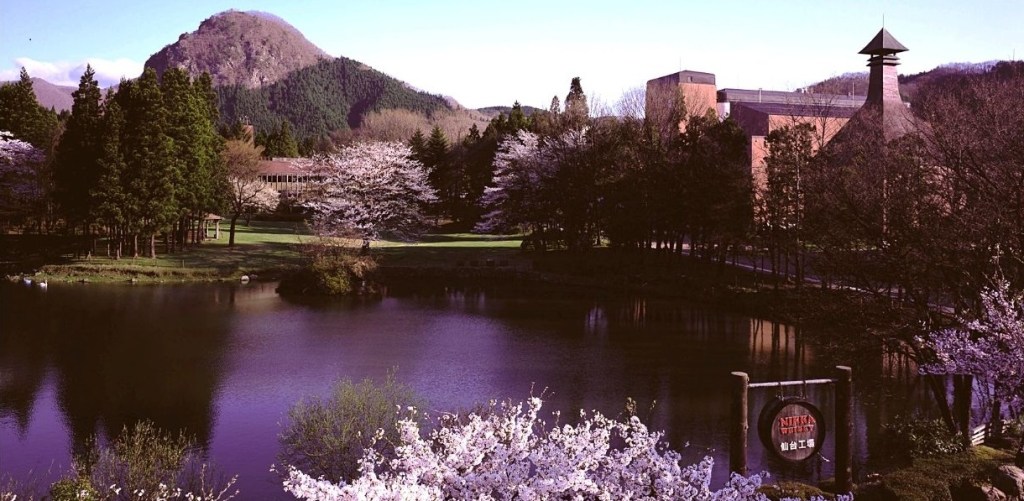
    The Nikka distillery near Sapporo. A new place I want to visit, it looks lovely.

    Japan’s whisky industry was established after thoroughly researching the Scottish methods and equipment, even buying old stills from distilleries and, in places, a climate that mimics that of Scottish. From those beginning decades ago, Japanese distilleries have developed the craft to produce a distinct drink that has its own place in the world of whisky.

    What is perhaps unique in Japan is that is a whisky-producing country that also sits on a tectonically active region, at the junction of at least three active geological faults. Low intensity tremors are frequent throughout the islands with major quakes occurring annually.

    So, while shipping thousands of barrels by sea to enhance the extraction of flavours isn’t economically feasible, it could be that the character of Japanese whisky is changed through frequent shaking by earthquakes. It could be that, in their quest to create a Scottish whisky with a Japanese feel, the geology of their country has gifted the Japanese whisky industry an added influence that the distillers of other countries will find it difficult to emulate.

    1. Traditionally, whisky is from Scotland, whiskey isn’t. Though some Japanese distilleries use ‘whisky’. ↩︎
    2. I had to enter an address in the USA to get this price. I picked 1060 West Addison St, Chicago. ↩︎
    3. Quinoa can be used to make whisky, even though it’s not technically a grain. ↩︎
    4. Or flavor. ↩︎
    5. This was at a work event where I’d seen £200 bottles of wine being bought, so I didn’t feel guilty about this small extravagance. ↩︎
  • Whisky chemistry

    Whisky chemistry

    I don’t think of myself as a whisky aficionado or expert in any way. As far as I’m concerned, I know what sort of whisky I like but I don’t think I have sensitive enough taste buds to distinguish and separate different flavours within a drink. The divide in whisky for me is between peated and unpeated. I find that peat in whisky overwhelms any other flavour; I know others disagree (having had a few discussions on this topic at work) but if we all liked the same thing then it would always be sold out.

    But where does the flavour of peat in whisky come from?

    Why write this article if you don’t like peaty whisky?

    Good question. This article was stimulated by an email I got from Wolfburn Distillery1. They were advertising new, peated expressions of their whiskies. Not much to interest me there; as I said I’m not a fan of peaty whiskies. I prefer the floral and fruity whiskies of Speyside and I’m also partial to Old Pulteney’s (Wick, Caithness) slightly salty ‘Maritime Malt’ output. What triggered my interest and sent me down a rabbithole was that they included a ‘ppm’ in the description of the peatiness.

    With a career in science, I knew that ppm means ‘parts per million’ and is a unit of concentration. But concentration of what? A quick Google revealed that this is the level of cresols in the barley. Since ‘cresols’ covers a wide range of chemicals and there aren’t normally cresols in barley, the further questions were – what cresols are there in the barley, and how do they get there?

    Peat and whisky

    To answer the questions we need to understand how and where whisky is produced. The ‘how’ is not a mystery, though there is a lot of chemistry and craftsmanship involved. You start with barley and several years later, you have whisky. The ‘where’ is Scotland for the purposes of this article. But where in Scotland?

    For the purposes of answering the question of ‘how do cresols get into the barley?’, the processes of malting and kilning are the important parts. Malting involves soaking the barley for three days to start germination and trigger the enzymatic conversion of starches into sugars for later fermentation. Kilning heats the barley, stops the germination and dries the grain before the milling stage. It’s the kilning that introduces the cresols.

    The fuel used in the kilning is where the peatiness is added. Traditionally2, if you’re producing whisky in the Lowlands or your distillery is near a railway line, then the fuel of choice would be coal. It’s cheap, efficient and doesn’t alter the flavour of your product. If you’re producing whisky on an island off the coast of Scotland, you don’t have coal. What you do have is peat, and this is a useful resource for heating homes and kilning your barley. This, then, is the reason why island whiskies such as Laphroaig (Islay, Inner Hebrides), Torabhaig (Skye) and Highland Park (Orkney) tend to have a characteristic peatiness.

    The cresols from the peat adsorb onto the barley, and the grain acts as a vehicle to carry these alcohol-soluble chemicals into the next stage and ensure they remain until the drink is drunk.

    Cresols

    Cresols as a group are based around phenol (hydroxy benzene). Chemically, they are all classed as ‘aromatic’, a name that was applied to a range of chemicals that were strong smelling, often coloured, had some unique chemistry and were sometimes carcinogenic.

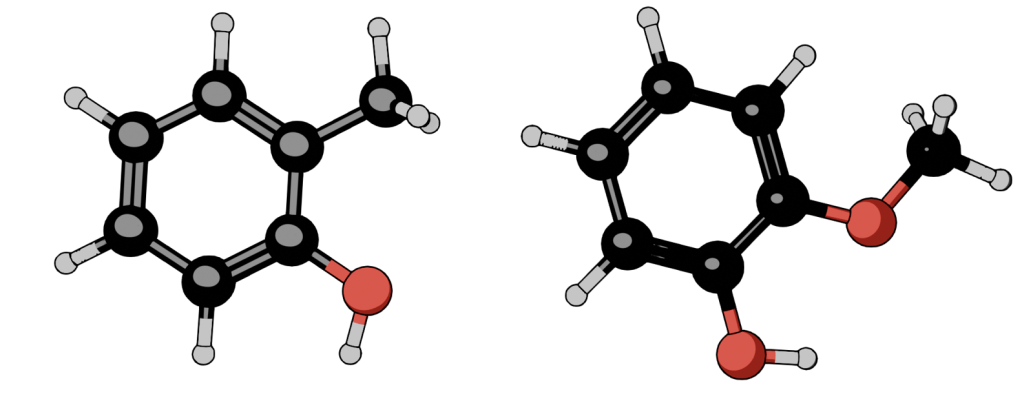
    The main cresols in peated whisky are guaiacol and the ortho-, meta- and paracresols. The tarry and smoky characteristics are given by these molecules. Other cresols add different flavours. How such similar molecules can give such different flavours is still not fully understood3.

    Two of the main cresols in whisky. Orthocresol (left), as well as the isomers meta- and paracresol, and guaiacol (right) are the most common. These add smoky and tarry flavours to whisky.

    The cresols found in peats have a range of boiling points which means that they are carried over and separated at different times. Higher molecular weight cresols tends to be distilled off later and these are the strongest tasting chemicals.

    The concentration of cresols in the barley is what whisky producers quote. This isn’t necessarily the level in the final whisky, though. As previously said, the cut taken will affect the range and type of cresols in the final whisky. The ‘cut’ of the distillate will capture different cresols, giving the final whisky a variety of flavours derived from the peat.

    A good example of how the cut affects the flavour is to compare the Islay whiskies Lagavulin, an exemplar of peaty whiskies, and Caol Ila, a lighter, peppery whisky, used as part of the Johnny Walker Black Label blended whisky. Both start with about 35 ppm phenols (including cresols) in the barley they source from the same maltings in Port Ellen. However, the Caol Ila distillation is an early cut using a reflux still, taking in the lower boiling-point cresols and fewer total cresols. Lagavulin uses a more traditional still and a longer, slower distillation which captures more of the high molecular weight cresols and gives the whisky its celebrated medicinal character.

    Other flavours – barrel aging

    The spirit that comes out of the still at the end of the distillation process is a sharp, barely palatable liquid with a 70% ethanol content. Pure ethanol isn’t pleasant, as I know from getting some splashed in my face when I was a chemistry student. So this liquid needs to have flavour, and the flavour needs to be developed. This is done by barrel-aging the spirit to get whisky.

    Barrel-aging can be envisaged as a very slow extraction process where the alcohol absorbs the chemicals in the wood over three to fifty or more years. As industrial processes go it’s not very speedy, but the end product is fantastic.

    History of barrel-aging

    In the 15th century, there was a need to store and transport whisky and used wooden barrels were handy. As a side effect it was found that the stored spirit had a more pleasant flavour as the flavours of the wood and the liquid previously stored were absorbed into the whisky.

    By the mid-19th century the standard practice was to age whisky in used sherry barrels. Sherry was transported to the British market in barrels and bottled locally to save money on the transport of glass and reduce the risk of breakage. These used barrels could be bought cheaply by the distilleries since the Spanish sherry makers didn’t want them back.

    In the 1950s the opportunity to buy used bourbon barrels from the USA meant that there was an alternative to sherry casks. Bourbon barrels can only be used once; by law bourbon must be matured in first-use charred American oak. The flavours of the bourbon and the charring as well as notes from the oak wood itself impart flavours to whisky during the aging.

    The availability of bourbon casks was fortunate – in 1986 the supply of sherry casks dried up when the Spanish government decreed that all sherry must be bottled in Spain.

    Alternative barrels

    Other casks have been used for a different flavour profile: rum, cognac, red wine and white wine. One of my favourites is a port-casked whisky (Tamnavulin Port Cask, a Speyside distillery). This is somewhat ironic, since port and all red wine make me ill; clearly whatever I react to is not present in the barrels to be extracted by the whisky.

    Barrel aging means that alcohol is lost to the atmosphere and the local air also imparts its character. The above-mentioned Old Pulteney has a slight saltiness, in part due to the warehouses being situated by the sea. This isn’t a unique occurrence – many of the island distilleries have seaside warehousing. I don’t know why Old Pulteney has this consistent saltiness that other malts lack.

    In summary

    This was an interesting rabbithole to dive down. I’ve ignored the chemistry of peated whiskies, mainly because my tastes are not for these drinks. But to learn how the flavours are built in to the whisky and also how the barrel storage adds the main characteristic flavours of my own preferred whiskies has been fascinating.

    1. Wolfburn (Thurso, Caithness, where I was born) isn’t the only distillery to offer peaty expressions. Aerstone (Ayrshire) have a ‘legacy’ expression with peaty notes to complement the ‘sea cask’ that is one of my favourites. It’s similar to the Old Pulteney I mentioned in the Introduction. ↩︎
    2. Modern distilleries use oil or gas to kiln the malt. ↩︎
    3. If I do a post on the quantum biological explanation of the sense of smell, I’ll try to remember to link back to this article. ↩︎