An experiment with bourbon may explain the high reputation of Japan’s whiskies
During my research for an earlier chemistry of whisky article, I came across an account of an experiment on how transporting barrels impacts the flavour of bourbon. Bourbon barrels are commonly used to age whisky not only in Scotland, but in England, Ireland, Japan and India.
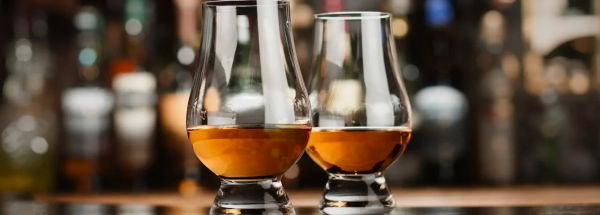
Whisky in Glencairn glasses. These glasses were developed in the early 2000s, inspired by the shape of the whisky blender’s glass.
I’d been looking at how the flavours of charred oak affect the character of bourbon. This article in Wine Enthusiast drew my interest. It described a fascinating experiment by Trey Zoeller, the founder of Jefferson’s bourbon distillery in Kentucky, USA. I originally put it in a footnote, but the whole thing became a bit extended and so I decided to convert it into an article.
Barrel aging bourbon
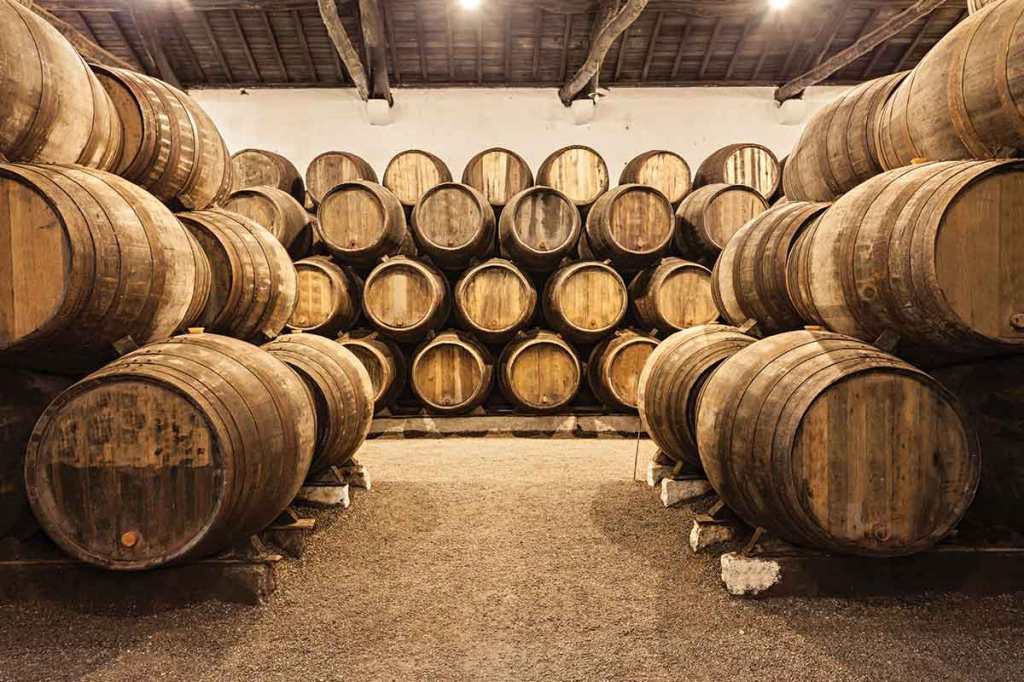
The usual practice when aging whisky/ whiskey1 is to have the barrels stacked in a warehouse holding maybe 60,000 barrels with 200 litres in each and let nature take its course.
Since 2012 Jefferson’s, based in Kentucky, has offered a limited ‘Ocean Cask’ expression. They send the barrels on six-month voyages at sea, where they are heated, chilled and shaken about before coming back to Kentucky to be bottled. Exact numbers of barrels aren’t available, but multiple shipping containers with 200 barrels each are now sent on these voyages. The 200-300 bottles that are filled from each barrel retail at $83 (about £60)2 for a 750 ml bottle, more than double their standard bourbon ($31).
Without good roads, the best option was for distillers to send barrels down the Mississippi with the spring flood, then by ship from New Orleans to New York for bottling. In 2022, Jefferson’s sent two barrels of bourbon on a replica journey down the Mississippi and then to New York to see if this process was the source of Kentucky bourbon’s high reputation.
A barge on the Mississippi.
The agitation of the spirit in the barrel during transit did change the flavour, both chemical analysis and blind tasting showed a distinct variation. This could explain the good reputation that Kentucky bourbon enjoyed in New York.
Relevance to whisky
Bourbon is similar to whisky, in that you take a grain-derived spirit and age it in wooden barrels until it has absorbed flavours from the barrels and the environment. The difference is the type of grain you use. Malt whisky is made using barley. By law, bourbon must contain over 51% corn grain spirit. Anything else is grain whisky3.
As my previous blog discussed, a lot of whisky is aged in used bourbon barrels. The environment in which the whisky aging takes place influences the flavours extracted from the wood. Bourbon is produced in the generally temperate continental climate of Kentucky, so the mix of grains (the ‘mash bill’), the type of still used and the cut of the spirit are more important in determining the particular flavour4 of the bourbon.
The flavours extracted from used bourbon barrels by the maturing whisky will be representative of the original spirit. The mix of flavour molecules extracted will also vary depending on several factors including the ethanol content of the whisky, temperature, humidity, and time.
Scotland is a cool, damp country and produces characteristic whisky. By law whisky must be aged for at least three years to be sold as Scottish whisky. Age adds to the flavour, smoothness and cost of a whisky. The oldest whisky I’ve ever has is a 20 year old Highland Park – a slightly peaty but incredibly smooth drink that cost about £25 for a double5.
Japan and the getting back to the point
All this is fine, but what does the Jefferson bourbon experiment have to do with whisky? After all, shipping or moving thousands of heavy barrels isn’t a commercially viable option unless you’re going to add a premium to an already expensive product.
Japan has a well-established whisky manufacturing culture, with the first whisky distillery – Suntory – opening near Kyoto in 1923. Following a disagreement between the founders, a second distillery, Nikka, was opened near Sapporo on the north island of Hokkaido. This site was chosen because the climate was more like Scotland than the sub-tropical Kyoto.
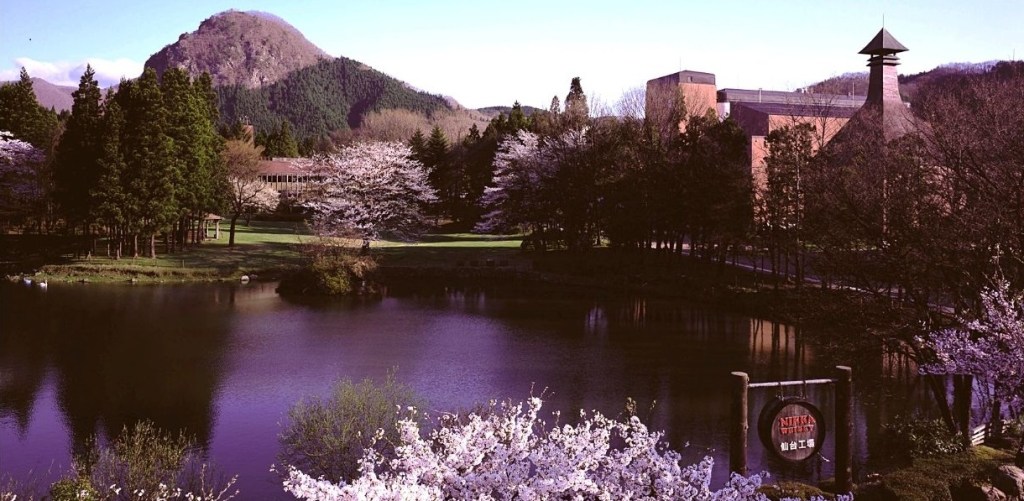
The Nikka distillery near Sapporo. A new place I want to visit, it looks lovely.
Japan’s whisky industry was established after thoroughly researching the Scottish methods and equipment, even buying old stills from distilleries and, in places, a climate that mimics that of Scottish. From those beginning decades ago, Japanese distilleries have developed the craft to produce a distinct drink that has its own place in the world of whisky.
What is perhaps unique in Japan is that is a whisky-producing country that also sits on a tectonically active region, at the junction of at least three active geological faults. Low intensity tremors are frequent throughout the islands with major quakes occurring annually.
So, while shipping thousands of barrels by sea to enhance the extraction of flavours isn’t economically feasible, it could be that the character of Japanese whisky is changed through frequent shaking by earthquakes. It could be that, in their quest to create a Scottish whisky with a Japanese feel, the geology of their country has gifted the Japanese whisky industry an added influence that the distillers of other countries will find it difficult to emulate.
Traditionally, whisky is from Scotland, whiskey isn’t. Though some Japanese distilleries use ‘whisky’. ↩︎
I had to enter an address in the USA to get this price. I picked 1060 West Addison St, Chicago. ↩︎
Quinoa can be used to make whisky, even though it’s not technically a grain. ↩︎
Western Australia’s capital has a wealth of public art, both street art and sculptures commissioned by the city council. Here’s a taster.
Three weeks in Australia
Back in 2019, we booked a holiday to Australia. We planned to go back to Melbourne (where we lived from 2003 to 2005), then take a week to travel to Sydney (where my brother lives) seeing parts of Victoria and New South Wales we hadn’t had the chance to see. I was working and our first child was born while we were there, so we were rather busy. But we had saved and planned for this big trip and were looking forward to the adventure.
Then 2020 happened.
So in September 2024 we booked to go again and hoped there wouldn’t be another global pandemic to crimp our plans. This time, we had a wedding to go to and we were going to celebrate older child graduating, younger child finishing GCSEs, Mrs S getting her first accountancy qualification and me reaching 20 years with the same company.
One of those things didn’t happen – I fell about 6 months short of 20 years at my job. However, we had paid for the flights and accommodation, so we went anyway, with a mind to reducing the number of extravagances we might otherwise have been able to do. And we had a blast.
Sydney and Melbourne
The focus of the trip was my brother’s wedding in Sydney, then a few days to revisit Melbourne, where we lived for two and a half years. Finally, we decided to go to Perth for a long weekend at the end of the holiday, mostly because we hadn’t been there and so many Australians haven’t made the trip either.
Perth
We didn’t know what to expect in Perth. We knew it was remote (thousands of miles from the next place of comparable size) but not a lot else. One of the feelings we got was that it was quite self-sufficient. A lot of locally produced food and drink, which makes sense when Adelaide is two days train ride away.
Taking advice from Australians about what to do, one suggestion that came up was a visit to Rottnest Island. It seemed odd that we should travel so far (four hours by plane from Melbourne) only to spend a day away from the city. So we settled on looking around Perth and spending a chunk of one day in Fremantle, the suburb of Perth that is on the Indian Ocean at the mouth of the Swan River.
We arrived on Friday afternoon, got some food in and watched the footy that was taking place a few kilometres from our apartment1. A Ramen dinner, an early-ish night – we were two hours ahead of Perth time – and up and about on Saturday morning. So our first full day in Perth, what do we do? We go on an art trail, of course!
Perth Art Trail
This was a free, self-guided trail that we found online (link). The city of Perth has a public art strategy dating back to 2009 with over 100 works distributed around the CBD and suburbs around the centre of the city.
Our hotel was close to Elizabeth Quay, where the trail officially started, but we decided that we had better get some breakfast in us before starting. It took us a while to find a place that was serving food at 11 am, but we settled on having brunch in the bar of the Ibis hotel on Murray St. This was fortunate because we were able to kick off the trail on Wolf Lane.
Wolf Lane
There are other streets in Perth with a lot of art, but this is the one that was highlighted in the tour guide. Most of the buildings in this back street have some art on them, a lot from a 2012-2016 effort to brighten the inner city. The move to have fresh street art was revived in 2024 and we were lucky enough to see two new additions. Well, one addition and one revival.
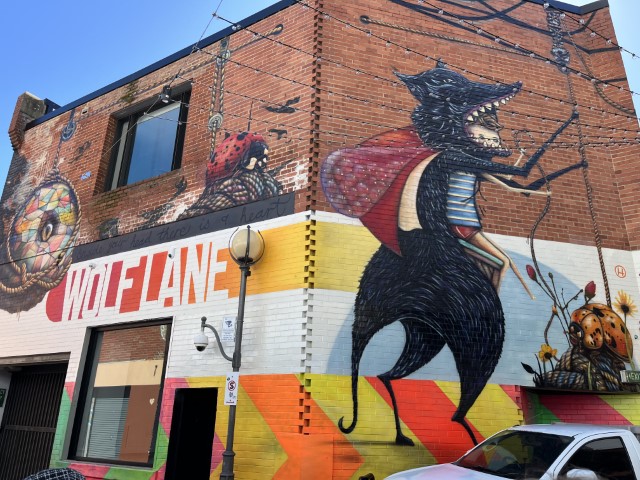
This was painted in 2024 as part of an initiative to revive some of the forgotten places in Perth city centre. This is actually an update of an original wolf mural, with red cloak and a ladybird added by the original artist, done in about 2014. As a street artist, Buckles also goes by the tag ‘Hurben’ and you can see his circled H to the right of the picture.
The titular ‘wolf’ or Inside Your Head, There’s a Heart, was altered by the artist (Steve Buckles) in 2024 to a slightly brighter image, but in the same style. The original can be found on some websites, such as this Facebook post. There is also a blog that discusses the original commission of street art in 2014.2
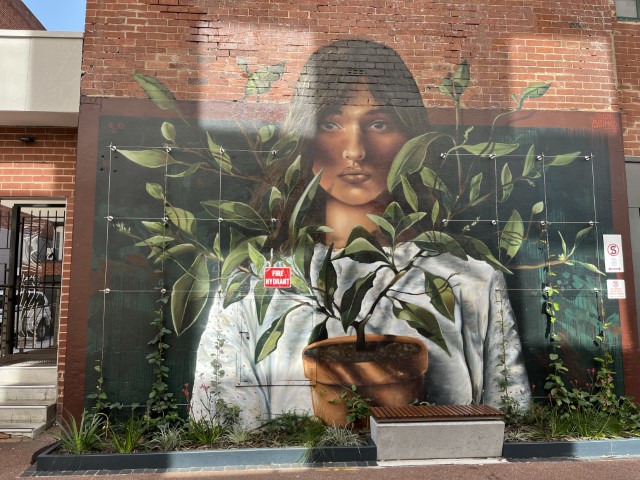
An untitled piece caught Mrs S’s imagination. By Dan Bianco, it was only painted in January 2025. She loved the way the painting was incorporating and would be incorporated by the living plants that were being trained on the wire trellises. It would be nice to be able to keep abreast of the changes in this work.
Untitled (Dan Bianco). Installed in early 2025 on Wolf Lane. It’s not obvious in the photo, but there are trellises around the painting of the woman. Over time the plants will partially obscure but ultimately enhance the mural.
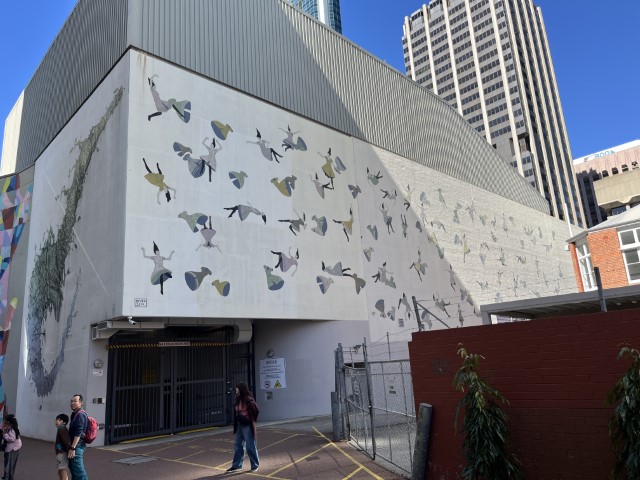
Two of my favourites were on the same building. Untitled by Spanish artist Hyuro (tumbling women) and Seahorse by Alexis Díaz .
Untitled (tumbling women) by Spanish artist Hyuro, I like the kinetic energy of the women and empty dresses tumbling across the side of the building.
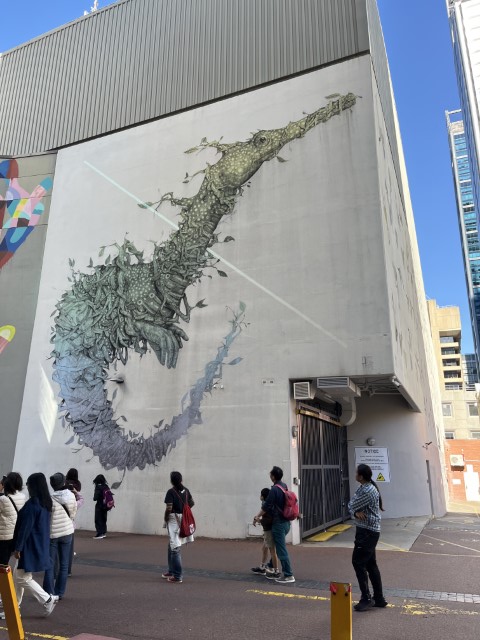
The seahorse – which I thought was a dragon at first – was the work of Puerto Rican artist Alexis Díaz.
Seahorse by Puerto Rican artist Alexis Díaz. It’s a complex composition, a sort of collage of various sea-related items and what look like hands to make a seahorse.
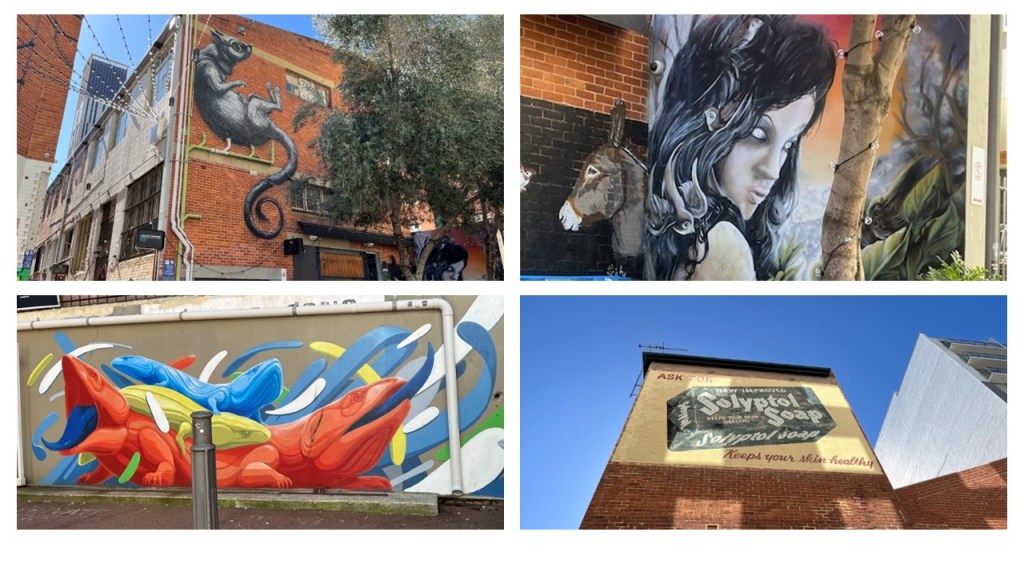
I lost count of how many murals there were on Wolf Lane, but there’s a selection below. Also an old advert for Solyptol Soap – I do like old adverts, they don’t muck around.
Selection of murals from Wolf Lane.
Beyond Wolf Lane
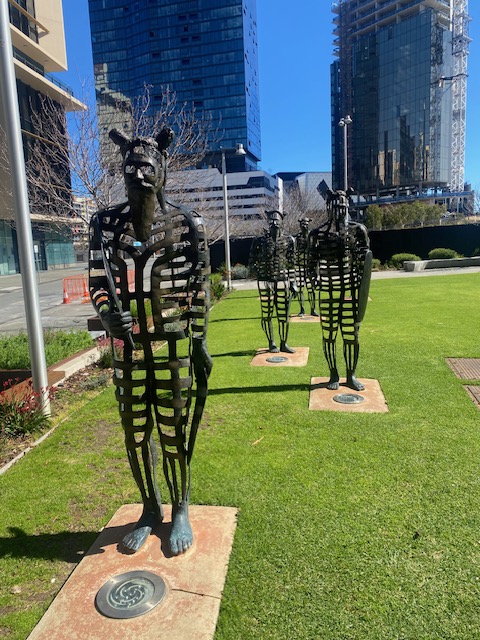
From there we were directed to Telethon Gardens, where a striking collection of wrought iron figures seemed to stand guard on the lawn.
Koorden (Rob Garlett, Fred Chaney, Rochie Kuhaupt). Three local Noorgar artists collaborated on these sculptures.
The Noorgar are the traditional guardians of the land where Perth now stands. These figures represent the Noorgar leaders who represented Aboriginal communities at Perth’s commemoration of Federation in 1900. There is also an ecological significance to the work, the latticework representing the layers of social, environmental and cultural heritage of the area.
From there we walked towards Perth train station. This is where the Indian Pacific train terminates; this is a bucket list item for us, though we will wait until we can afford (a) to come over again, (b) to travel in a private cabin and (c) have done some other things on the bucket list3.
Anyway, back to the art trail.
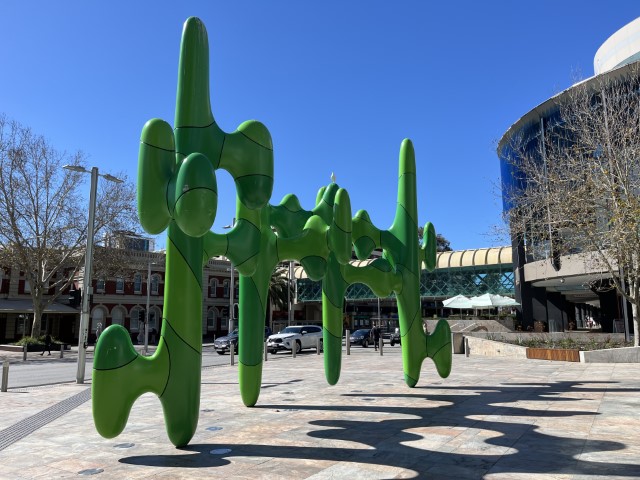
Opposite the train station was Grow Your Own, an abstract by James Angus. Inspired by the growth of organic farming, this is sometimes referred to as ‘the cactus ‘ by locals.
“Grow Your Own” by James Angus. Inspired by the organic farming movement, this was installed in Forrest Place in 2011. It’s at the edge of the main shopping area, with Perth train station in the background. More importantly for us, we stumbled upon The White Dwarf bookshop, a shop specialising in SciFi and Fantasy books. The owner was great, chatted with us for a while about England and science fiction.
Right by this artwork was the White Dwarf bookshop. Feeling the need to have a rest we got some water from the shop next door and spent a pleasant half hour or more in the bookshop. The owner was friendly; he said he was familiar with Forbidden Planet in London and we recommended he go to the branch in Liverpool – he was surprised that there is more than one. We didn’t buy anything, mainly because we didn’t want to have to carry books with us on the rest of the walk, but we promised to come back.4
St George’s Cathedral
After walking through the shopping district we arrived at the precinct of St George’s Anglican Cathedral. Built using local jarrah wood, Rottnest limestone and bricks from local sources it was consecrated in 1888 and is one of the oldest buildings in Perth.
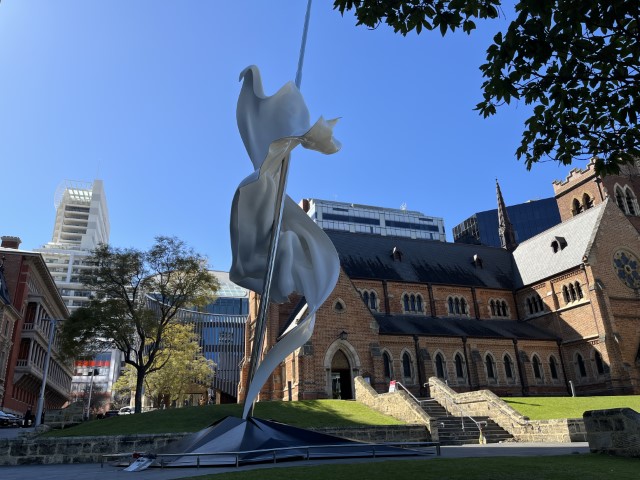
To the southwest of the cathedral was the most confusing piece we saw on the trail. Ascalon looked like a broken sail5, but it is intended to portray St George slaying the dragon and seeks “to evoke a sense of righteous power and victory over a force of darkness and oppression”6; Ascalon is the name of his lance (or sword), which I didn’t know.
Ascalon (Marcus Canning, Christian de Vietri). Named after the lance that St George used to slay the dragon, standing in the grounds of St George’s cathedral. This was easily the most confusing piece on the trail. We wondered why they were commemorating putting a hankie on a car aerial, until we read the description. It’s a representation of St George slaying the dragon, with the white billow representing St George’s cloak and steed and the black base representing the defeated dragon. I always say that the best art is art that needs a glossary.
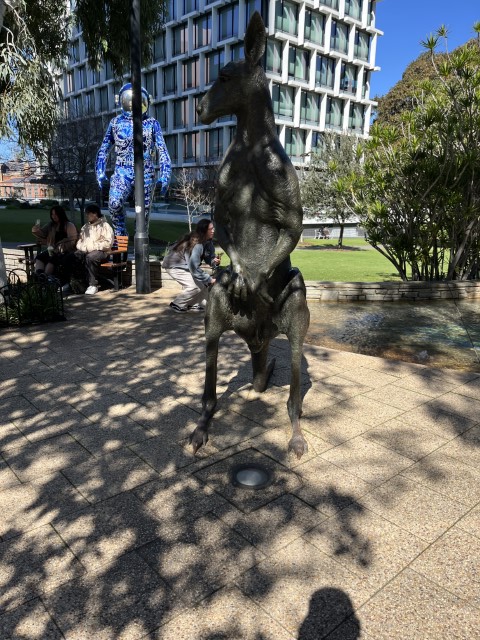
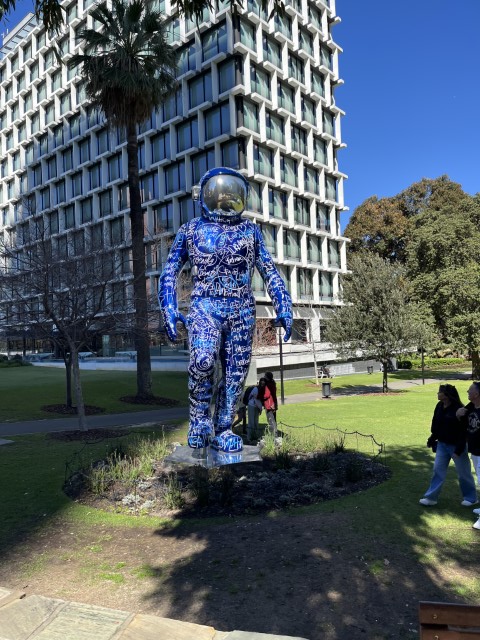
Further down towards the river is the precinct by the Council House. This is a rather plain 60s building, enlivened by a collection of kangaroo sculptures called ‘The Mob’ and the Boonji Spaceman.
One of a number of kangaroo sculptures on this terrace outside the City Council offices. Boonji Spaceman ‘Lightning’ (Brendan Murphy). This is a temporary installation celebrating Perth’s identity as the City of Light. In 1962 when John Glenn orbited the Earth, Perth residents and businesses were encouraged to turn their lights on so Glenn could see the city from space. Glenn commented on the bright lights as he passed over, all the while in conversation with a technician from the local Muchea tracking station.
The Boonji Spaceman was installed in May 2025, on the site of a popular artwork dubbed ‘The Kebab’7 (removed in 2021) which was built in 1971 to celebrate Perth’s population reaching 1 million. The new installation was not without controversy.
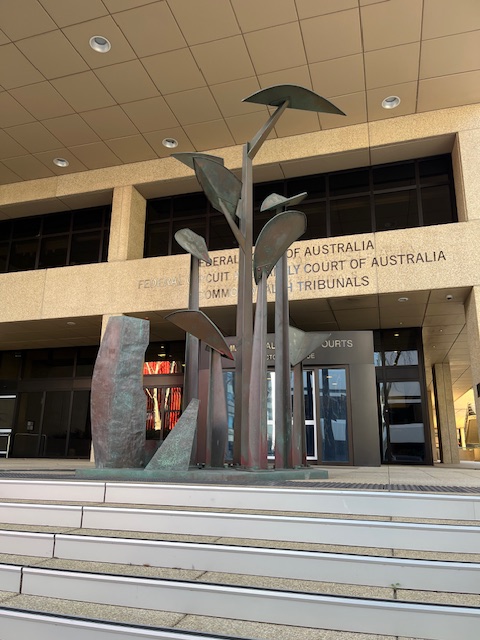
The final work on the trail, but not the last piece we saw, was in the entrance of the Federal Court of Australia. A very 1970s piece, I have spent rather more time than I care to think about trying to find the name and artist of this piece. If you know, tell me.
This was the last item on the art trail, though we carried on to the ‘proper’ start before going back to our apartment. I have tried to find the name and sculptor, but can’t. If you know, tell me and I’ll update the blog and credit you.
The beginning and the end
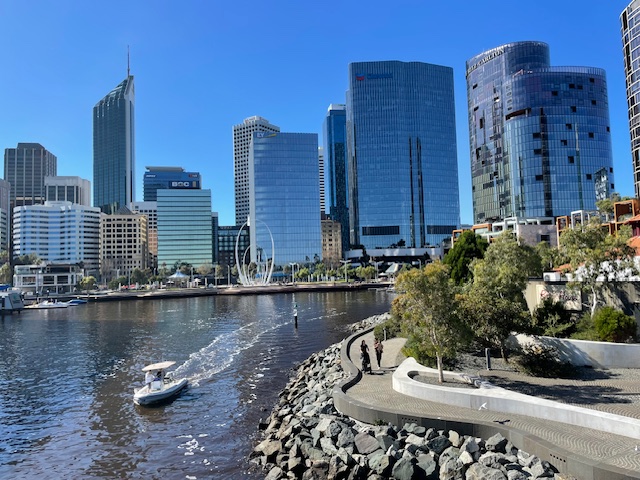
After a walk along the prom by the Swan River we ended up at Elizabeth Quay, where the trail is supposed to start. There are two artworks here – First Contact and Spanda.
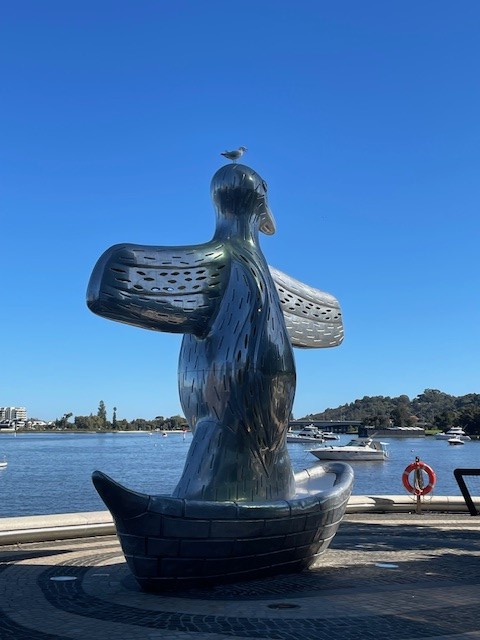
First Contact , the work of Noongar artist Laurel Nannup, stands on the banks of the Swan River. It’s 5 metres tall and cast in aluminium and represents the shared legacy of the Stolen Generation, of which group Nannup is a member. The piece lights up at night, as we discovered later that day when we had a very nice dinner at The Island on Elizabeth Quay. More information on the building of this piece is available here.
First Contact by Noongar artist Laurel Nannup, a five-metre cast aluminium sculpture that we later discovered lights from within. This is the first piece of the Perth Art trail, though we came to it last. It’s beside Elizabeth Quay and not far from where we stayed in Perth.
Spanda was the result of a competition to create a signature artwork for Elizabeth Quay, won by Christian de Vietri (who also co-created Ascalon).
Installed in 2016, this is something of a symbol for Western Australia, though we didn’t know it at the time. Six white arches are intended to trigger the viewers inner experience of their own resonance with the world (‘Spanda’ is Sanskrit for pulse or divine vibration).
The whole walk took us a couple of hours. There was a great deal to ponder, looking at all the different styles of art and the media used by artists to celebrate their culture, make a statement, commemorate an event, or just to amuse the viewer. As with any art collection, not everything speaks to everyone. There is also a lot of art we missed8, so a return trip may be necessary.
The Dockers were well beaten by reigning champions and 2025 finalists, Brisbane Lions. ↩︎
Including the line “leaving a cold wet 17 degrees in Melbourne”. That’s 17 Celcius. ↩︎
Which includes a Nile cruise, May blossom in Japan, Hawaii, and a longer return trip to Malta ↩︎
We did, on the Monday, and spent about $70 there. We needed books for the return flight. ↩︎
Including the Bon Scott memorial statue in Fremantle. We were about 100 metres from it at one point, but I didn’t know it existed until we got back to the UK. ↩︎
I’ve not ridden a bike for over 30 years (last one was stolen in 1993) so I’ve missed out on a lot of the developments in bicycle technology. I do enjoy watching the Tour de France, though, and one thing I was well aware of is the use of derailleur gears – they’ve been around since before I was born.
I was maybe 13 when I got my first multi-gear (10 speed, as I recall) bike after I’d outgrown the 3-speed one I got when I was 81. We’d moved to England by then, and where we lived wasn’t very hilly but also not so busy that I was in danger when out on the roads.
The rear wheel of a bike is probably not considered much by non-riders. It’s the wheel that turns when you turn the pedals. But the mechanism that controls the gears is the subject of much debate and engineering over the years.
Rear gear bit of a bike. The derailleur is the black Z-shaped thing which controls the chain as it hops between the spoke wheels on the axle and also maintains chain tension as the gear size changes.
Back in the old days (very old days) bikes didn’t have gears. The penny-farthing had a huge wheel and, if you found the hill was too steep, you hopped off and pushed.
Variable gearing initially involved having two gear spokes on either side of the back wheel and then getting off and turning your wheel around to go uphill (or downhill). I don’t know if there’s any footage of Tour de France competitors doing this, but your skills in fixing a bike were at least as important as your riding ability2.
The derailleur is a remarkably old invention, with the first rod-based systems being invented in the late 19th century. There is a book on this called ‘The Dancing Chain’ by Frank Berto, but it’s at least £75 and I’m not that into cycling.
Never an organisation to rush into making things easy for competitors, the Tour de France resisted such new-fangled innovations for many decades. Finally, in 1937, competitors in the Tour were allowed to use derailleur gearing. The effect this had on the average speed of the cyclists was minimal – an increase from 31.1 kph to 31.8 kph was about average for the speed year-on-year speed increase at the time (BikeRaceInfo.com).
Shimano gears
Founded in 1921 by Shozaburo Shimano, Shimano is one of the watch-words in the bike community. Their gears and groupsets (gears, gear changers, etc) are regarded as the best by many riders.
Pro teams currently using Shimano gears include fourteen of the eighteen UCI men’s World Tour (the top ranking pro teams) and four of the fifteen UCI Women’s World Tour teams.
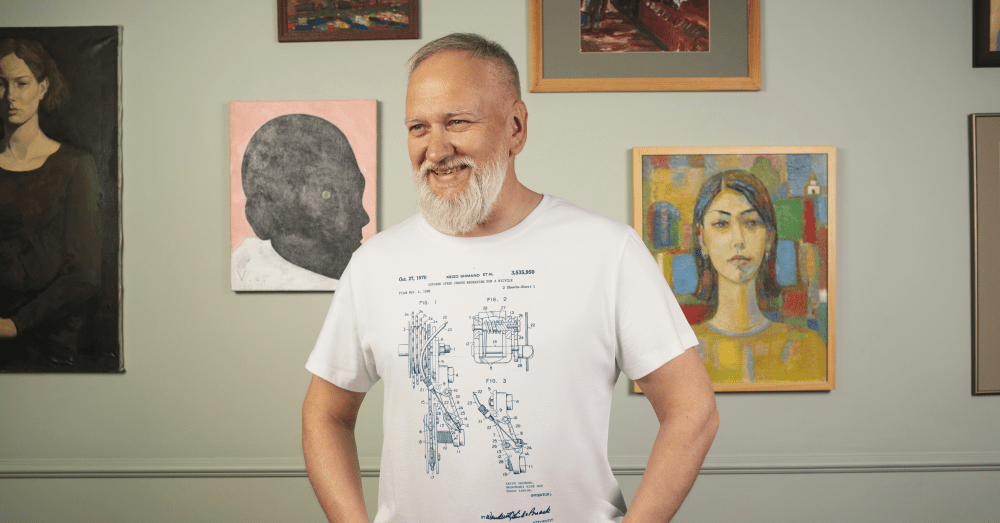
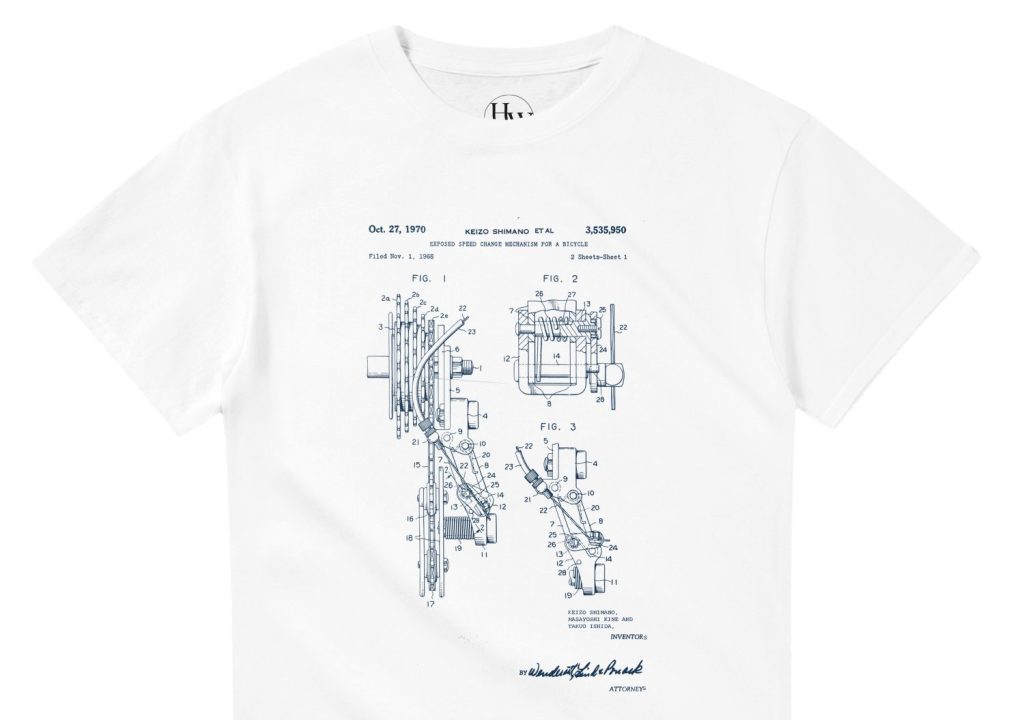
So in honour of this, I researched the early stages of derailleur gears and found the 1970 patent co-authored by Shozaburo’s son, Keizo Shimano. I think this was the basis of the Dura-Ace gear set that remained popular for a couple of decades.
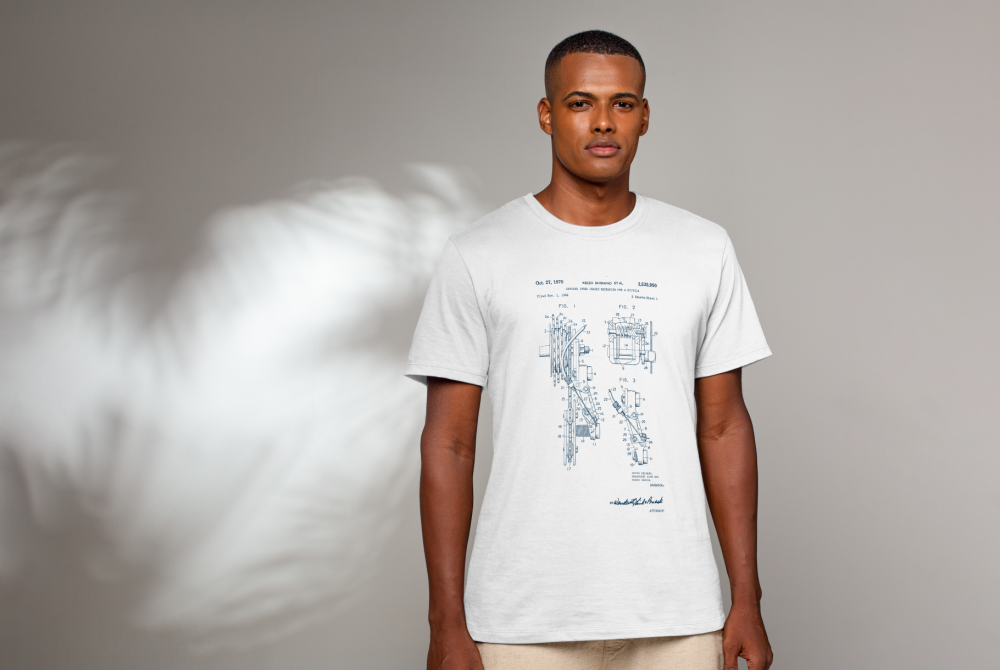
Shimano derailleur gearing patent, blue on a white t-shirt.
The patent design is now available as blue on white or white on blue or black in my RedBubble3 shop.
As I said at the top derailleurs have been around since before I was born. Indeed, Cream’s 1967 album Disraeli Gears was so called when one of the group’s roadies dropped this malapropism when he heard that Eric Clapton was buying a racing bike.
Let’s listen to one of their songs from that album.
This had hub gears, which I never worked out the mechanism for, there’s just a chain that disappears into the axle. It’s probably magic. ↩︎
The spirit of the individual cyclist riding the Tour is typified by the story of Eugène Christophe from the 1913 Tour. He was leading by 18 minutes and descending the Tourmalet when his front forks broke. It took him two hours to reach the village at the foot of the mountain. He found a blacksmith who would let him use his forge – the rules stated he had to make repairs alone – and, after three more hours he set off with a mended bike. Race officials gave him a 10 minute penalty because a local boy pumped the bellows of the forge for him. He eventually finished seventh overall. ↩︎
I gave up on Etsy, the shop is too fiddly for the type of goods I want to sell and having to front up 20p per item for three months on the shop started to get a bit too much. I’ll keep it open though, since I may want to sell individually made items in the future. ↩︎



 Grim up North Heath