Have you ever liked a villain more than the hero? Who and why?
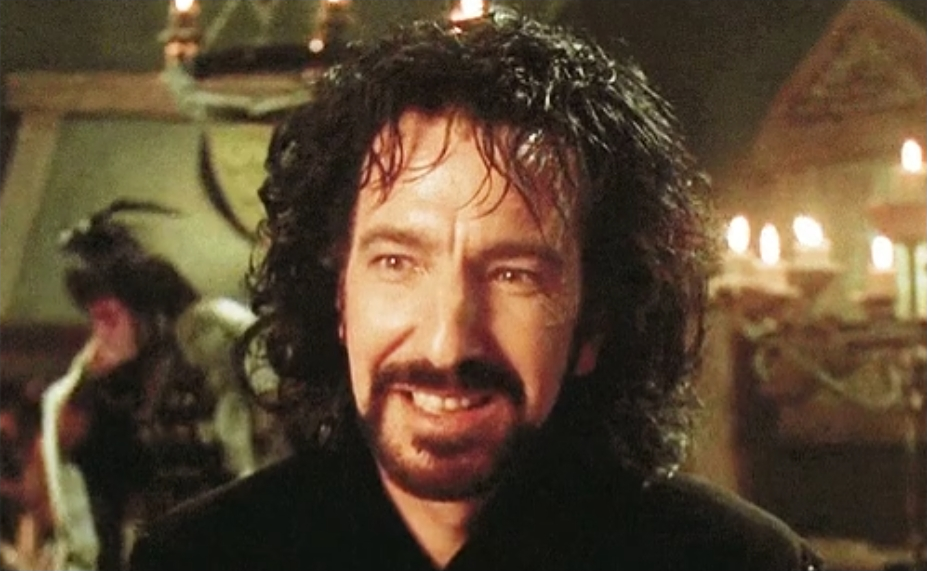
Rumour has it that Alan Rickman gave such a commanding performance as the Sheriff of Nottingham in Robin Hood, Prince of Thieves (1991), that Kevin Costner cut many of his scenes to avoid being completely upstaged. This role was early in Rickman’s film career. His screen debut was as the villain Hans Gruber in Die Hard (1988)1 a scene-chewing villain but up against Bruce Willis in one his first action roles as the reluctant hero John McClane. So here, villain and hero are equal. But in Robin Hood, the sheriff is such a colourful pantomime villain that Kostner’s anaemic goody is wise to limit shared screen time.

Rickman gets all the best lines. He threatens to cancel Christmas; to cut Robin Hood’s heart out with a spoon (because it’ll hurt more); and tells a wench to ‘bring a friend’ when she comes to his room. Kostner is there, which is just as well, or the film title wouldn’t work.
Other villains and anti-heroes
A good anti-hero is one thing (Deadpool, for example) but a good villain is always worth watching. Ricardo Montalban is commanding as Khan in Star Trek II: The Wrath of Khan. The combination of David Prowse and James Earl Jones as Darth Vader in the first three Star Wars films gave the character iconic baddie status. Cruella de Ville (101 Dalmations) is probably as evil as any character in children’s literature, though in her case I blame the parents for calling her ‘Cruella’. And the baddie doesn’t even need to be a person: Skynet is the villain in the Terminator series; the various Terminator cyborgs are just machines, not an artificial intelligence.
Awful characters
The BBC sitcom Ghosts doesn’t really have a villain, but the once-a-season appearance of their awful neighbour Barclay Beg-Chetwynd (played with more relish than an entire Branstons factory by Geoffrey McGivern) was always a highlight. He gets introduced thus:
Barclay: Barclay Beg-Chetwynd. From next door.
Mike: We have a next door?
Barclay: It’s about a mile that way. I own the… you know the village?
Alison & Mike: Yeah.
Barclay. Yes, I own that.
He’s not really a villain, just rich, uncaring and pretty awful. The only true villain in Ghosts is ‘Lucy’, played by Jessica Knappett, who tries to con Alison and Mike out of thousands of pounds.
Barclay is a type of awful character that I love to see on screen, but would hate to deal with in real life. Father Jack in Father Ted is hilarious onscreen, but could you imagine living with him? I mean, the smell alone! And yet, they outdid Jack with the menacing, softly spoken sociopath Father Fintan Stack, who was malicious in his awfulness – getting Dougal drunk, drilling the walls at 2 am and driving Father Ted’s car ‘into a big wall’.
I’m not sure why the size of the wall is important.
Literature
Going Postal (2004) gives us Reacher Gilt. He is one of Terry Pratchett’s few proper villains (though not a patch on Carcer from Night Watch), a flamboyant character up against an antihero in Moist von Lipwig. Both men are confidence tricksters; Gilt dresses as a pirate, complete with eyepatch and parrot2. Moist relies on being unremarkable for his cons to work, his golden uniform as Postmaster is a distraction from the man in the suit. However, Moist is in awe when they meet. They immediately recognise each other for what they are, Moist realises that Gilt is a master fraud to whom he would give everything to be apprenticed to. Gilt, for his part, is shocked that Moist is also a fraud.