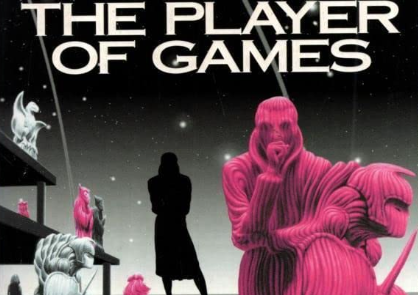
What book could you read over and over again?
There are a lot of books I’ve read several times. I’m pretty sure I’ve read most of Terry Pratchett’s books at least three times (exceptions), all the Flashman books a couple of time, too. Another author I am very fond of, who isn’t Pratchett, is Iain M. Banks (1954 – 2013).
The ‘M’ (For Menzies1) is important. Mr Banks wrote literary fiction as Iain Banks and added the M for science fiction.
The Culture
Most of his SF books are part of The Culture series. The Culture is a post-scarcity civilisation spanning many star systems in the Milky Way. Its living inhabitants are mainly humanoid (Earth features in one short story) and are effectively immortal. Minds, hyper-intelligent artificial intelligences, oversee the civilisation.
A common problem for the people of The Culture is boredom. Many people have drug glands implanted to provide sexual stimulation, speed up neural processes, improve memory, enhance concentration or help you wake up after a night of overindulgence. You can change gender as often as you wish. You can acquire a new body2 in any form. You can indulge in any fantasy with a virtual reality that indistinguishable from reality. How tedious. One way to avoid boredom is to play board games.
Player of Games (1988)
In Player of Games, the main character, Gurgeh, is one of the elite games players of The Culture. A rogue drone, acting for the Minds, blackmails him into accepting a mission for which he is uniquely qualified: to win a game called Azad.
This is no ordinary game, though. The Empire of Azad is built around the game. The champion becomes Emperor, your performance in the championships determines your career progression. The game is the empire, the empire is the game. The boards fill huge rooms, semi-sentient game pieces add unpredictability to the game and competitors spice up play with side bets that range from loss of money to radical surgery for the loser.

Gurgeh spends the months it takes to reach Azad learning the game. He arrives in good time to join the tournament and is shocked to find a society with rigid gender ideas (albeit there are three genders) and a strict caste system. This goes counter to the free-wheeling, (almost) anything goes anarchy that Gurgeh knows. But if anyone knows how important rules are in a game, it’s Gurgeh.
How he copes with a society he can’t understand without understanding the game that underpins the society is the core of the book.
Why do I come back to it?
This and the next in the series, Use of Weapons show Banks expanding The Culture into the bedrock of the following series. He wrote nine novels and one short story collection about The Culture.
I love the inventiveness of the society that Banks created. The Culture is a paradise, and for most of the trillions of people who live in it their only concern is what party to go to and who they next have sex with. For some, this is not enough. The game players all feel the need to reduce the tech level of their lives. Having real, visceral objects to play with against an opponent who is your intellectual equal is an ideal that replaces the virtual that is freely available. We see this now, where people want lower-tech phones, seek early gaming consoles and, indeed, play board games.
I saw a criticism of The Player of Games that held the position that Banks, writing in 1988, couldn’t have predicted the rise of computer games where you can play against people in different countries. I’d say Banks was spot-on. People surrounded by tech want to be able to switch off, to play chess, to carve things from wood, to learn a musical instrument3.
So the well-realised society that is explored is a pull. But the character of Gurgeh, his journey, and the mystery of the game and civilisation of Azad get expanded upon in every reading. That’s what brings me back to this, of all the Culture books.
- Pronounced ‘ming-iss’ or ‘ming-eez’. ↩︎
- In Excession one character does both. They become female to have a baby and end the book with the body of an alien species. The Hydrogen Sonanta, the last Culture book, features a 10,000 year old man who once spent five years as a whale. ↩︎
- There’s an aspect of this in The Hydrogen Sonata. The protagonist has spent years learning how to play a particular musical instrument. She even had major surgery to enable her to play properly. An AI controlled robot could play it perfectly. But that wasn’t the point. ↩︎