Online shop I set up to learn about ebusiness and generate income using such creativity as I have. This is where links to the shop on RedBubble can be found and a discussion of the creative process.
French is supposedly the language of love. Certainly to the ears of someone who grew up only hearing English and the occasional Scots Gaelic, the words “Je t’aime” sound more pleasing than “Ich liebe dich”. But to German ears, what does “I love you” sound like? Do they prefer “Te Amo” or would the Dutch “Ik houd van je” sound exotic?
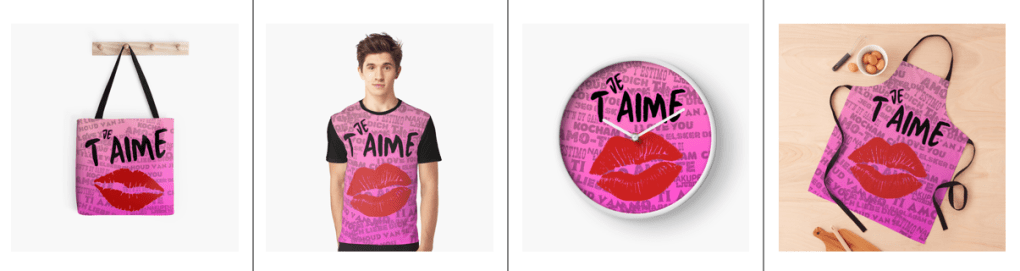
Background text for the design. Fourteen languages, mainly European because I couldn’t work out how to get other alphabets.
This design was done in Canva. I only made it a week ago and I have forgotten which languages I used. I think there’s German, Spanish, Dutch, Danish, Welsh, Scots Gaelic, Swahili and Polish. Oh, and English (thanks to Mrs S for reminding me about that one!).
To make the final design I repeated the background text at random angles and set the opacity down. Then a nice pink gradient as background and it was ready for the main image.
The main text was done in TC Milo, black with a light pink outline. The massive kiss is one of the graphics that Canva supplies.
Summary of fonts used for this design.
This design looked better on some items than on others. I only did one item of clothing, the black sleeved t-shirt. And the apron, if that counts as clothing. Buttons below link to the products.
The “je t’aime” design on tote bag, t shirt, clock and apron.
I’ve not ridden a bike for over 30 years (last one was stolen in 1993) so I’ve missed out on a lot of the developments in bicycle technology. I do enjoy watching the Tour de France, though, and one thing I was well aware of is the use of derailleur gears – they’ve been around since before I was born.
I was maybe 13 when I got my first multi-gear (10 speed, as I recall) bike after I’d outgrown the 3-speed one I got when I was 81. We’d moved to England by then, and where we lived wasn’t very hilly but also not so busy that I was in danger when out on the roads.
The rear wheel of a bike is probably not considered much by non-riders. It’s the wheel that turns when you turn the pedals. But the mechanism that controls the gears is the subject of much debate and engineering over the years.
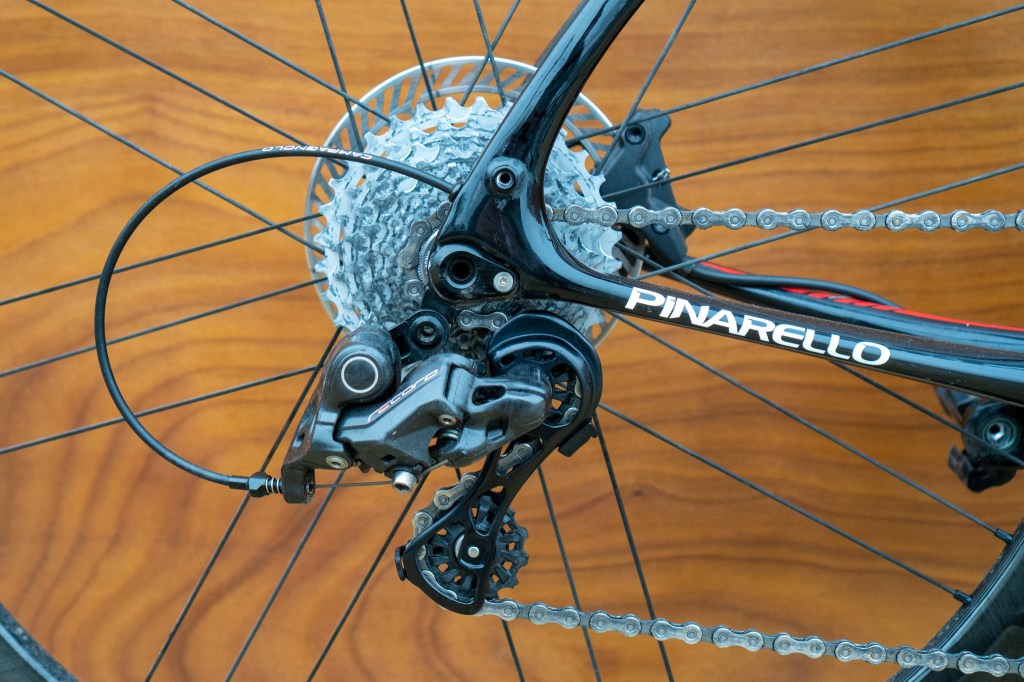
Rear gear bit of a bike. The derailleur is the black Z-shaped thing which controls the chain as it hops between the spoke wheels on the axle and also maintains chain tension as the gear size changes.
Back in the old days (very old days) bikes didn’t have gears. The penny-farthing had a huge wheel and, if you found the hill was too steep, you hopped off and pushed.
Variable gearing initially involved having two gear spokes on either side of the back wheel and then getting off and turning your wheel around to go uphill (or downhill). I don’t know if there’s any footage of Tour de France competitors doing this, but your skills in fixing a bike were at least as important as your riding ability2.
The derailleur is a remarkably old invention, with the first rod-based systems being invented in the late 19th century. There is a book on this called ‘The Dancing Chain’ by Frank Berto, but it’s at least £75 and I’m not that into cycling.
Never an organisation to rush into making things easy for competitors, the Tour de France resisted such new-fangled innovations for many decades. Finally, in 1937, competitors in the Tour were allowed to use derailleur gearing. The effect this had on the average speed of the cyclists was minimal – an increase from 31.1 kph to 31.8 kph was about average for the speed year-on-year speed increase at the time (BikeRaceInfo.com).
Shimano gears
Founded in 1921 by Shozaburo Shimano, Shimano is one of the watch-words in the bike community. Their gears and groupsets (gears, gear changers, etc) are regarded as the best by many riders.
Pro teams currently using Shimano gears include fourteen of the eighteen UCI men’s World Tour (the top ranking pro teams) and four of the fifteen UCI Women’s World Tour teams.
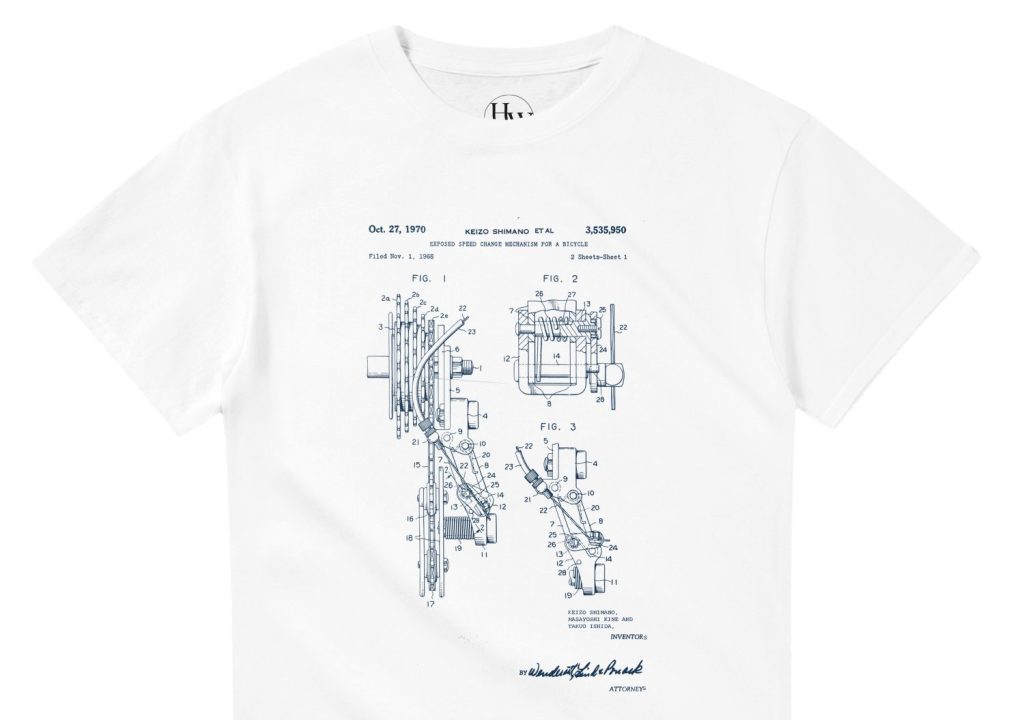
So in honour of this, I researched the early stages of derailleur gears and found the 1970 patent co-authored by Shozaburo’s son, Keizo Shimano. I think this was the basis of the Dura-Ace gear set that remained popular for a couple of decades.
Shimano derailleur gearing patent, blue on a white t-shirt.
The patent design is now available as blue on white or white on blue or black in my RedBubble3 shop.
As I said at the top derailleurs have been around since before I was born. Indeed, Cream’s 1967 album Disraeli Gears was so called when one of the group’s roadies dropped this malapropism when he heard that Eric Clapton was buying a racing bike.
Let’s listen to one of their songs from that album.
This had hub gears, which I never worked out the mechanism for, there’s just a chain that disappears into the axle. It’s probably magic. ↩︎
The spirit of the individual cyclist riding the Tour is typified by the story of Eugène Christophe from the 1913 Tour. He was leading by 18 minutes and descending the Tourmalet when his front forks broke. It took him two hours to reach the village at the foot of the mountain. He found a blacksmith who would let him use his forge – the rules stated he had to make repairs alone – and, after three more hours he set off with a mended bike. Race officials gave him a 10 minute penalty because a local boy pumped the bellows of the forge for him. He eventually finished seventh overall. ↩︎
I gave up on Etsy, the shop is too fiddly for the type of goods I want to sell and having to front up 20p per item for three months on the shop started to get a bit too much. I’ll keep it open though, since I may want to sell individually made items in the future. ↩︎





 Grim up North Heath