How important is it, really?
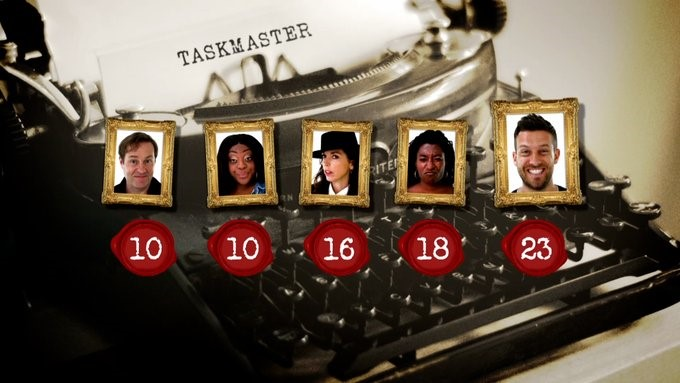
A recent publication by David Silver1 discusses the scoring in Taskmaster and how this impacts on the enjoyment of the series. It also looks at other metrics, such as the use of Large Language Model (LLM, a sort-of primitive AI) to analyse the script and detect sarcasm, among other things2.
The Abstract was enough for me to be sceptical about the study. Of all the metrics that were applied, the one that Little Alex Horne thinks is the most important was missed (from the abstract). It is the mix of people that’s the crucial element. I’ll come onto Silver’s treatment of that later.
What struck me was that if you wanted to know why we enjoy the show, a survey would do the trick. From what I’ve seen on the Taskmaster subreddit, most people see the scores as one of the many parts of the show. If anyone wants to win too much, it can be bad – John Robins strayed close to the ‘too needy’ zone. If they don’t care and do well (Jo Brand, Sarah Millican3, Sam Campbell4) that’s even better.
Sometimes you get the joy of a contestant such as Julian Clarey, who clearly didn’t care until towards the end. There was more sitting forward in his seat as scores were given out in the later episodes. He lost by a few points, sacrificing the win for a gloriously calm meltdown in the road-sweeper task.
The main attraction for winning is likely to be the chance to do it all again in Champion of Champions.
Whose win is it anyway?
Contestants are comedians (or comedy-adjacent) and they have different ideas about what winning is. Getting a laugh is the win and it’s this instant, honest feedback that many of them crave. That, and being paid on time.
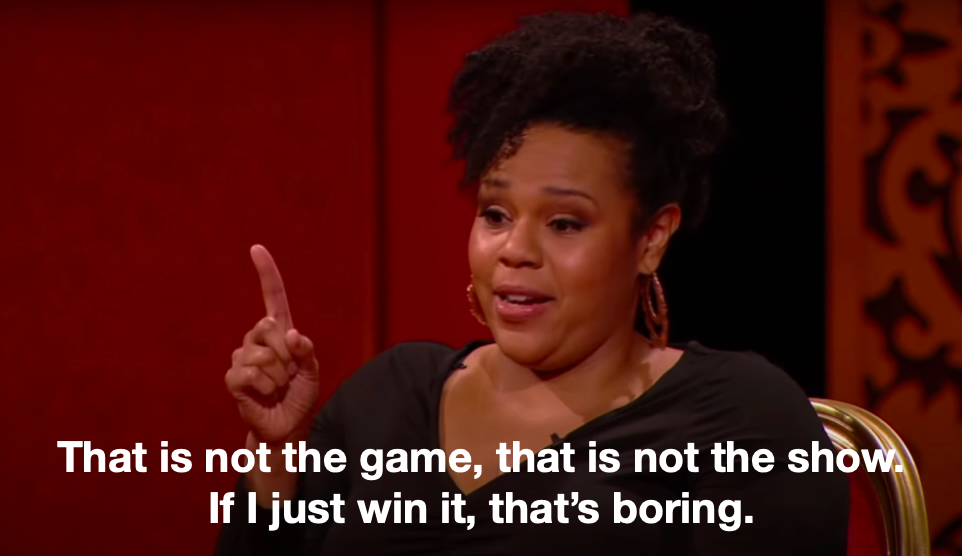
Desiree Burch epitomises this attitude. There was a balloon-popping task in Series 12. She knew that the ‘correct’ way to do the task was to get the scissors, cut the string and release the portcullis. But she also knew the funny thing was to throw pebbles, rubber ducks, a bucket-load of forks and eventually the bucket itself at the balloon until finally taking the scissors.
Who? Who?
So we come back to what I think is the most important of the many factors in Taskmaster – the cast and the cast mix.
I’ve usually known a couple of the contestants, but then I’m a fan of comedy5. These tend to be well-established figures from stand-up (Dara Ó Briain, Mel Giedroyc, Sue Perkins) or related areas (Charlotte Ritchie, Steve Pemberton, Lisa Tarbuck). Add in some that I am not familiar with (Fern Brady6, Rose Matafeo), some I might have seen a couple of times on other things (Rosie Jones, John Kearns, Katie Wix) plus unknowns and we have a cast.
Eventually I get to know them all and their interaction is a major factor in the enjoyment. Seeing how the different minds complete the set-up that LAH has written is the principal draw, that is the meat of the sandwich.
In Silver’s paper he assigns five ‘types’ to the contestants based on how well they do points-wise, and then tries to fit each contestant in each season into these types. He tries to force his five types into every cast, like Cinderella’s sisters trying to force their feet into the glass slipper.
Assigning character types may be a better approach, but it gets very complex and I’m not a fan of assigning personality types7. There may be ten (or a different number) character traits that are needed in a cast, where each panellist has two or more components. Jack Dee is surly and competent. Julian Clary is sarcastic and insouciant. Kerry Godliman and Lisa Tarbuck were both straightforward ‘Bosh!’ merchants, but Godliman was competitive and Turbuck was laid back.
It’s a parody, innit?
The main reason for the points is that the show is a parody of competition. In his book ‘Be Funny or Die’, Joel Morris points out that a good parody has to look and feel like the thing it’s parodying. Spinal Tap only works because the music is professional quality and it looks like a documentary8. Airplane! works so well because there is a real aeroplane disaster plot thrumming away in the background and the cast play this straight. We follow the events of Galaxy Quest because the Thermians are facing extinction at the hands of the genocidal Sarris and their only hope is a bunch of shop-soiled actors.
There are points scored, so the show behaves like a panel show, the rhythms and beats are there to hang the chaos on. How the panellist behave is another matter and this is where the joy truly lies.
- https://doi.org/10.48550/arXiv.2505.02886
↩︎ - Artificial intelligence is really good at detecting sarcasm. ↩︎
- Who would have walked away with the win in any other series (except maybe John Robins’), all the while not really caring. ↩︎
- Sam won the most heart-warming series, with the two Sues forming an eternal friendship over a packet of NikNaks. ↩︎
- That term suggests that there are people who don’t like comedy. I think the phrase in this case means people who go out of their way to find out about comedy and comedians, and go so far as to occasionally blog about comedy. ↩︎
- Me Fern Brady! Me Fern Brady! I’m the rightful queen! ↩︎
- Maybe there are people who are fans and I should be designing Myers-Briggs t-shirts for my shop. ↩︎
- The, if you will, ‘rockumentary’. ↩︎
 Grim up North Heath