His most satisfying novel is now a Penguin Modern Classic
As long-term fans of Terry Pratchett (see previous post), the publication of his 29th Discworld novel “for adults of all ages”, Night Watch, was eagerly anticipated in the Steele household. It was published in 2002, a year of changes for us. I finished my PhD that year and secured a placement at Monash University as a post-doc researcher in the Victorian College of Pharmacy1. Mrs S had been headhunted by a mortgage company late in the year, but had to turn it down to move to Australia. We also had our kitchen re-done that year. We completed the work the day before we left the country.
By the time Night Watch was released we had got into the habit of buying the hardbacks for each other on birthdays and Christmases. If Mrs S bought one for me she would be impatiently waiting for me to finish. I’m a slow reader.
All the little angels rise up, rise up…
Twenty-three years down the line I’ve no idea who bought who our copy. But from the first line, we knew it was a good ‘un.
Sam Vimes sighed when he heard the scream, but finished shaving before he did anything about it.
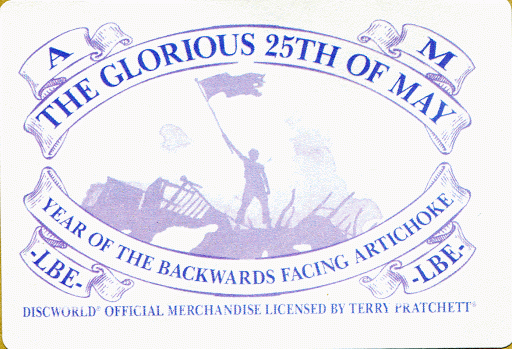
After a brief interview with an apprentice assassin who’s fallen into a cesspit (the source of the scream), flowering lilac reminds Sam of the date – 25th May – the day when the Republic of Treacle Mine Road is commemorated. It went out of his head, what with his wife, Lady Sybil, due to give birth any time soon.
We get reacquainted with The Watch in this, the sixth novel in the sub-series. The fortunes of the watch have improved beyond recognition since “Guards! Guards!”2. We meet the main players at a graveyard where they privately remember the fallen of the Glorious 25th May. One of the gravestones bears the name ‘John Keel’, which sits among five other graves (one of which is normally empty, but Reg Shoe, now a zombie and officer of The Watch, buries himself in solidarity with the other fallen).
But official remembrance of the fallen has to wait. A serial cop-killer, Carcer Dun, has been spotted. A rooftop chase ends by the library of the Unseen University, the most concentrated region of magic in the Discworld. Lightning strikes Vimes and Carcer, sending them back in time 30 years.
Faced with being unknown and out of time, Vimes adopts the identity of John Keel, the sergeant who trained Vimes as a young watchman. The real Keel has been murdered by Carcer, the first change to the timeline and an event that the History Monk Lu-Tze3 spends the novel trying to rectify. Carcer, having falling in with pre-Guild thieves, is soon established as a sergeant in the city’s secret police, the Cable Street Particulars (aka The Unmentionables).
What follows is a mix of social commentary, Les Misérables, philosophical musings on what to do if you meet your younger self (other than be shocked at what a twerp you were), fun with an ox and a piece of ginger, a new spin on the expression ‘Look after yourself’, and, finally, the way home.
How do they rise up, rise up?
This isn’t his funniest book. That’s a toss up between Witches Abroad and Last Continent4. Too much humour would have been out of place in a book where political corruption culminates in the assassination of the city Patrician, where we witness the intense loneliness of Sam in his home city but 30 years away from his current life, and where a torture chamber is unearthed that makes watchmen vomit.
We also get a timely reminder of an earlier Pratchett aphorism that it’s not only the cream that rises to the top in society.
But there is gallows humour and the sort of social observation we love in Pratchett’s work. The use of old ladies as psychological warfare, the topology of a revolutionary state (if there’s more of the city inside our barricades than outside, that makes us the majority) and how seamstresses differ from needlewomen.
They rise up arse up, arse up high!
Eleven years after his death and just after what would have been his 77th birthday, Night Watch has been published as a Penguin Modern Classic. As such, it joins the ranks of Brideshead Revisited, The IPCRESS File and Nineteen Eighty Four.
This new edition has a new cover – rather than Paul Kidby’s pastiche of Rembrandt’s Night Watch5, we get a black and white version of the original. This is a rare example of the cover art determining the title. The working title was “The Nature of the Beast”, but when Kidby visited Pratchett and showed him the painting (Kidby’s first for the series), Terry changed the title to reflect this wonderful artwork.
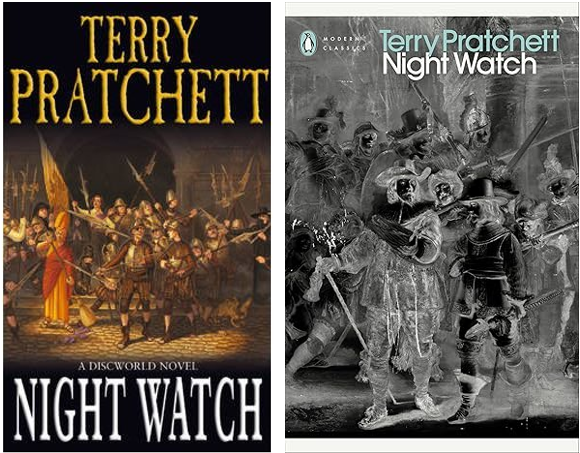
The cynical part of me suggests that this cover art is more fitting for serious readers to be seen with. It must be a proper book because it has a black and white image on the cover. Either that or a bold abstract design, because one can’t be seen reading fantasy, can one?
The new edition has notes and annotations to contextualise the novel. I’ve not seen a copy yet, but the authors of the notes are known Pratchett fans. One even nominated Terry for an honorary doctorate at the University of Dublin.
I don’t know how many new Pratchett readers this new edition with generate. It is a rare author who can blend satire, fantasy and properly good jokes. And despite – or perhaps because – Sir Terry was, for a time, the best selling author in the UK, there is still an element of sneering at fantasy and science fiction from some quarters, especially when it’s funny. It may be that Pratchett is seen as putting a hat on a hat – he should have written fantasy, or comedy, not both.
I don’t really care. I’ve never been personally mocked or attacked for reading Pratchett, and it’s likely that I would never have got to know Mrs S were I not a fan. All praise to the Republic of Treacle Mine Road!

- ‘Victorian’ as in the Australian state Victoria. Not ‘Victorian’ as in men in tweeds with handlebar moustaches riding penny-farthings. Though that remains the image I have in my mind whenever I hear the phrase ‘Victorian Police’. ↩︎
- This includes the presence of the troll Detritus, who we first met in “Guards! Guards!” working as a splatter (“like a bouncer, but trolls use more force.”) then in “Moving Pictures” as hired muscle. His transformation from animate rock to respected Sergeant in the City Watch is the most remarkable character growth in the series. He’s truly a renaissance troll. ↩︎
- Six thousand year old monk, practitioner of déjà fu, devotee of The Way of Mrs Cosmopolite. He was a main character in Thief of Time; first seen in Small Gods. ↩︎
- Inevitably, this is a personal opinion and subject to change depending on how recently I’ve read them and which bits Mrs S and I have quoted to each other. ↩︎
- Officially, the painting is called The Company of Frans Banning Cocq and Willem van Ruytenburch, but that’s much harder to fit on the cover of a novel. ↩︎
 Grim up North Heath