Tag: books

  • Night Watch by Terry Pratchett

    Night Watch by Terry Pratchett

    His most satisfying novel is now a Penguin Modern Classic

    As long-term fans of Terry Pratchett (see previous post), the publication of his 29th Discworld novel “for adults of all ages”, Night Watch, was eagerly anticipated in the Steele household. It was published in 2002, a year of changes for us. I finished my PhD that year and secured a placement at Monash University as a post-doc researcher in the Victorian College of Pharmacy1. Mrs S had been headhunted by a mortgage company late in the year, but had to turn it down to move to Australia. We also had our kitchen re-done that year. We completed the work the day before we left the country.

    By the time Night Watch was released we had got into the habit of buying the hardbacks for each other on birthdays and Christmases. If Mrs S bought one for me she would be impatiently waiting for me to finish. I’m a slow reader.

    All the little angels rise up, rise up…

    Twenty-three years down the line I’ve no idea who bought who our copy. But from the first line, we knew it was a good ‘un.

    Sam Vimes sighed when he heard the scream, but finished shaving before he did anything about it.

    After a brief interview with an apprentice assassin who’s fallen into a cesspit (the source of the scream), flowering lilac reminds Sam of the date – 25th May – the day when the Republic of Treacle Mine Road is commemorated. It went out of his head, what with his wife, Lady Sybil, due to give birth any time soon.

    We get reacquainted with The Watch in this, the sixth novel in the sub-series. The fortunes of the watch have improved beyond recognition since “Guards! Guards!”2. We meet the main players at a graveyard where they privately remember the fallen of the Glorious 25th May. One of the gravestones bears the name ‘John Keel’, which sits among five other graves (one of which is normally empty, but Reg Shoe, now a zombie and officer of The Watch, buries himself in solidarity with the other fallen).

    But official remembrance of the fallen has to wait. A serial cop-killer, Carcer Dun, has been spotted. A rooftop chase ends by the library of the Unseen University, the most concentrated region of magic in the Discworld. Lightning strikes Vimes and Carcer, sending them back in time 30 years.

    Faced with being unknown and out of time, Vimes adopts the identity of John Keel, the sergeant who trained Vimes as a young watchman. The real Keel has been murdered by Carcer, the first change to the timeline and an event that the History Monk Lu-Tze3 spends the novel trying to rectify. Carcer, having falling in with pre-Guild thieves, is soon established as a sergeant in the city’s secret police, the Cable Street Particulars (aka The Unmentionables).

    What follows is a mix of social commentary, Les Misérables, philosophical musings on what to do if you meet your younger self (other than be shocked at what a twerp you were), fun with an ox and a piece of ginger, a new spin on the expression ‘Look after yourself’, and, finally, the way home.

    How do they rise up, rise up?

    This isn’t his funniest book. That’s a toss up between Witches Abroad and Last Continent4. Too much humour would have been out of place in a book where political corruption culminates in the assassination of the city Patrician, where we witness the intense loneliness of Sam in his home city but 30 years away from his current life, and where a torture chamber is unearthed that makes watchmen vomit.

    We also get a timely reminder of an earlier Pratchett aphorism that it’s not only the cream that rises to the top in society.

    But there is gallows humour and the sort of social observation we love in Pratchett’s work. The use of old ladies as psychological warfare, the topology of a revolutionary state (if there’s more of the city inside our barricades than outside, that makes us the majority) and how seamstresses differ from needlewomen.

    They rise up arse up, arse up high!

    Eleven years after his death and just after what would have been his 77th birthday, Night Watch has been published as a Penguin Modern Classic. As such, it joins the ranks of Brideshead Revisited, The IPCRESS File and Nineteen Eighty Four.

    This new edition has a new cover – rather than Paul Kidby’s pastiche of Rembrandt’s Night Watch5, we get a black and white version of the original. This is a rare example of the cover art determining the title. The working title was “The Nature of the Beast”, but when Kidby visited Pratchett and showed him the painting (Kidby’s first for the series), Terry changed the title to reflect this wonderful artwork.
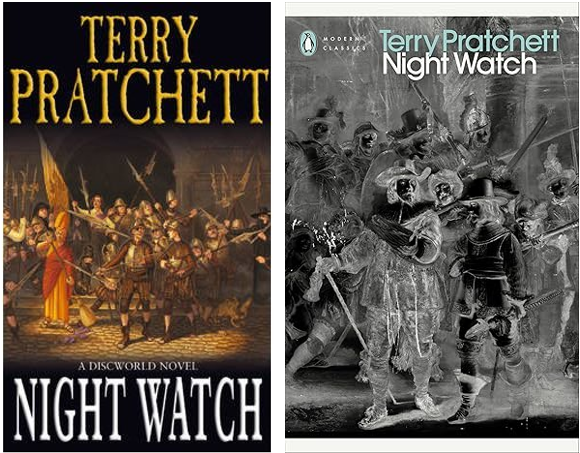
    Comparison of the original cover (left) and the cover for the Penguin Modern Classic edition of Night Watch.
    Comparison of the original Paul Kidby cover (left) and the cover for the Penguin Modern Classic edition of Night Watch. Kidby’s original features characters from the book, including Sam Vimes, Sam Vimes, Nobby, Lu-Tze, Havelock Vetinari and Reg Shoe (pre-zombie).

    The cynical part of me suggests that this cover art is more fitting for serious readers to be seen with. It must be a proper book because it has a black and white image on the cover. Either that or a bold abstract design, because one can’t be seen reading fantasy, can one?

    The new edition has notes and annotations to contextualise the novel. I’ve not seen a copy yet, but the authors of the notes are known Pratchett fans. One even nominated Terry for an honorary doctorate at the University of Dublin.

    I don’t know how many new Pratchett readers this new edition with generate. It is a rare author who can blend satire, fantasy and properly good jokes. And despite – or perhaps because – Sir Terry was, for a time, the best selling author in the UK, there is still an element of sneering at fantasy and science fiction from some quarters, especially when it’s funny. It may be that Pratchett is seen as putting a hat on a hat – he should have written fantasy, or comedy, not both.

    I don’t really care. I’ve never been personally mocked or attacked for reading Pratchett, and it’s likely that I would never have got to know Mrs S were I not a fan. All praise to the Republic of Treacle Mine Road!

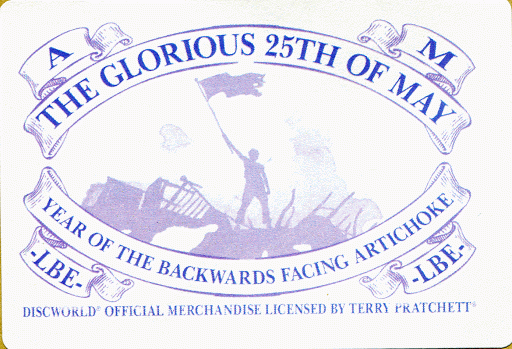
    Tea towel from The Discworld Emporium commemorating the main event of the novel Night Watch
    The motto of the Republic of Treacle Mine Road: Truth, Justice, Freedom, Reasonably Priced Love and a Hard-Boiled Egg.

    1. ‘Victorian’ as in the Australian state Victoria. Not ‘Victorian’ as in men in tweeds with handlebar moustaches riding penny-farthings. Though that remains the image I have in my mind whenever I hear the phrase ‘Victorian Police’. ↩︎
    2. This includes the presence of the troll Detritus, who we first met in “Guards! Guards!” working as a splatter (“like a bouncer, but trolls use more force.”) then in “Moving Pictures” as hired muscle. His transformation from animate rock to respected Sergeant in the City Watch is the most remarkable character growth in the series. He’s truly a renaissance troll. ↩︎
    3. Six thousand year old monk, practitioner of déjà fu, devotee of The Way of Mrs Cosmopolite. He was a main character in Thief of Time; first seen in Small Gods. ↩︎
    4. Inevitably, this is a personal opinion and subject to change depending on how recently I’ve read them and which bits Mrs S and I have quoted to each other. ↩︎
    5. Officially, the painting is called The Company of Frans Banning Cocq and Willem van Ruytenburch, but that’s much harder to fit on the cover of a novel. ↩︎

  • Frank Whittle: The Inventor Behind Modern Jet Engines

    Frank Whittle: The Inventor Behind Modern Jet Engines

    Another T-shirt design, this one based on a patent image.

    Frank Whittle – a summary

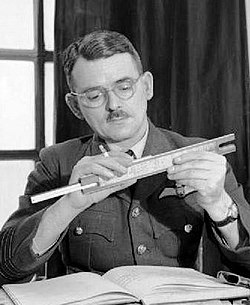
    Air Commodore Sir Frank Whittle (1907-1996) was a test pilot and flying instructor, but he is best remembered as a pioneer of jet aircraft. It was he who convinced the British government that the standard propeller engines had speed limitations (based on calculations made while writing his thesis) and that yes, he had a solution.

    The problem was that conventional engines with hundreds of moving parts would inevitably fall apart when pushed beyond what was possible with contemporary materials. The solution was to reduce the power plant to a single moving part. He needed people to believe in his solution. He also needed money, which the government of early 1930’s Britain was reluctant to give him.

    Sir Frank Whittle with a slide rule.
    Sir Frank Whittle (1907 – 1996), one of the pioneers of jet propulsion.

    He co-founded Power Jets Ltd in 1936, a company which was able to exploit his 1930 patent for a turbojet engine with only one moving part. By the time the Second World War started, he had finally convinced the government that he had a usable and safe design. They bought the experimental engine from Power Jets and lent it back, allowing the company to continue until the company was nationalised in 1943.

    All this effort took its toll on Sir Frank. Nervous exhaustion forced him to retire from the RAF in 1946, but not before a further jet propulsion system could be patented in his name. It is this that forms the basis of the new t-shirt design.

    Discworld connection

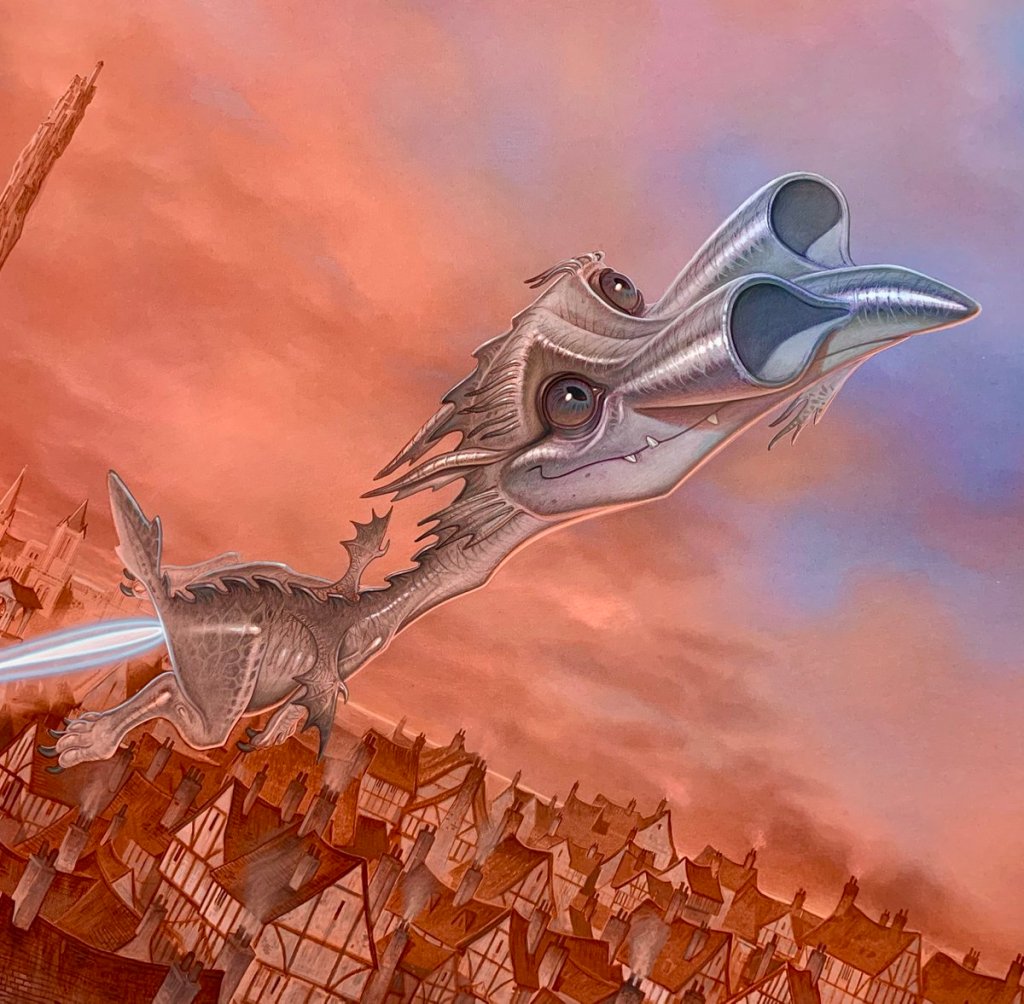
    The term ‘Whittle’ came up in the Discworld series. In “Guards! Guards!” we are introduced to Lady Sybill Ramkin, a wealthy resident of Ankh and enthusiastic breeder of swamp dragons (draco vulgaris). She used “whittle” as a term for disappointing dragons such as Goodboy Bindle Featherstone of Quirm (aka Errol), who would never amount to much. Short, stubby wings meant Errol would never fly and would therefore be incapable of mating.

    Sam Vimes, Captain of The Watch, reflects on this dismissive adjective:

    Total Whittle, Vimes thought… It sounded like whatever it was you had left when you had extracted everything of any value whatsoever. Like The Watch.

    As it turns out, Sir Frank was something of a whittle himself. Standing five foot tall and with a small chest measurement, he failed the RAF medical (twice) when he applied. Luckily for him and for the development of the jet engine, he found a way in to the RAF. And it all came good for both Sir Frank and Errol – Sir Frank applied again and rose to be Air Commodore. Errol learned to fly and was last seen flying into the distance with a noble dragon (draco nobilis) which had terrorised the city.

    Errol the dragon takes flight!
    Errol the ‘whittle’ takes flight during the climax of “Guards! Guards!”. This is the book where we meet Sam Vimes, one of the Discworld’s best characters.

    It all ends well for Sam and the rest of the Night Watch. The men get a pay rise and a new dartboard, Sam finds love and companionship with Lady Sybill.

    Whittle’s patent

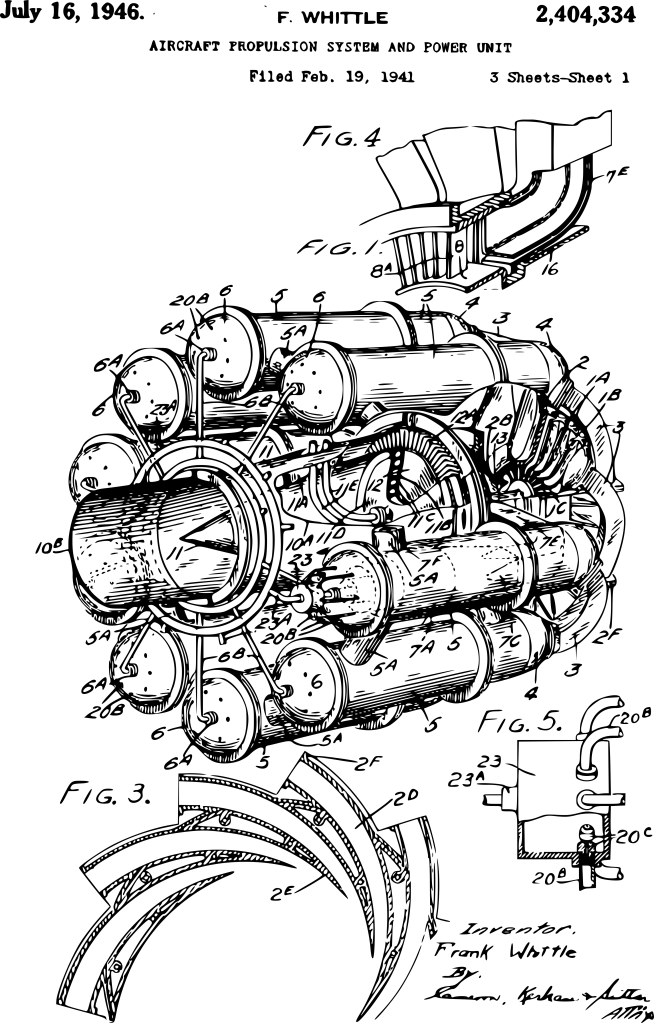
    All of this leads back to the landmark invention by Sir Frank, the jet engine. In 1946, he was granted US patent 2404334 for an aircraft propulsion unit – a jet engine. This wasn’t the first, and wasn’t the last, but it does have the big advantage from my point of view that it has a striking image to go with the patent.

    Frank Whittle's 1948 patent for an 'Aircraft propulsion and power unit'.
    Cleaned-up version of the patent image. I used Inkscape to remove the background, leaving just the black images. I then saved it as a white version to show up on the dark blue t-shirt.

    T-shirt design

    The patent image used started out as shown above. Using Inkscape, I could remove the background and be left with an image of just the text and drawings. Two things need to be done before I can put the design on a t-shirt. First, I need to choose the colour for the printing. Second, I need a fine scale render (high dots per inch (dpi) count) of the image. Inkscape can do both, so I got a 500 dpi image in white (which I won’t reproduce here).

    I chose a dark blue t-shirt so that the image looks like an engineering drawing. Patents are not engineering drawings, but using blue adds a nice aesthetic to the design. Blueprints were so called because they were printed in white on Prussian Blue paper.

    There is a useful website (colordesigner.io) which will give the Hex codes for any colour so that the correct colour can be programmed into a colour rendering app. Gelato, who I use as the print on demand supplier, also give the Hex codes for their t-shirts (or at least the T-shirts I’m using). There is also a colour comparator site so that you can see how close two colours are.

    Prussian blue compared with Navy blue.
    This is a comparison of Prussian Blue (left) and Navy blue (right). Prussian is a bit more purple and lighter, but there’s not a lot of difference.

    Am I going too far with this? Maybe, but it’s best to be correct about these things even if nobody notices.

    The closest blue t shirt available was Gelato’s Navy Blue. I can’t tell the difference unless the colour are next to each other.

    So, finally, I was able to put a white design on a blue t-shirt. Then it was a matter of getting some virtual models to do virtual cat-walks for me and upload everything to Etsy.

    Another image of the model in his t-shirt. He looks well happy.
  • Terry Pratchett GNU

    Terry Pratchett GNU

    Today is the tenth anniversary of Terry Pratchett’s death.

    We knew it was coming, but it wasn’t any easier.

    I read The Colour of Magic just after it came out in paperback in 1985. There was a very favourable review in White Dwarf, I may have borrowed my brother’s copy before splashing out a few quid on my own copy. I’d enjoyed Anne McCaffrey’s Pern series (lightly parodied in CoM) and read the Fafhrd and the Gray Mouser series a year before. Conan/ Hrun the barbarian was a trope I knew and I had probably seen Schwarzenegger in the film. I later learned that Bel-Shamharoth was a parody of the Cthulu mythos. I have tried to read Lovecraft, but I can’t get on with him. Just get on with the story, already.

    By the time I went to Uni in ’89 there were seven Discworld books. Pyramids, detailing Pteppic’s time at the Assassin’s Guild (modelled on public schools) in the first part had come out, not long after I’d tried (and failed) to read Tom Brown’s Schooldays. This was unrelated to Pratchett – I’d read the available Flashman books and thought I’d try the original. This did nothing to assuage my antipathy towards Victorian literature, which was based on having to drudge through Oliver Twist for O level English. I also have issues with books set in public schools – by brother loved the Jennings books, I was never keen.

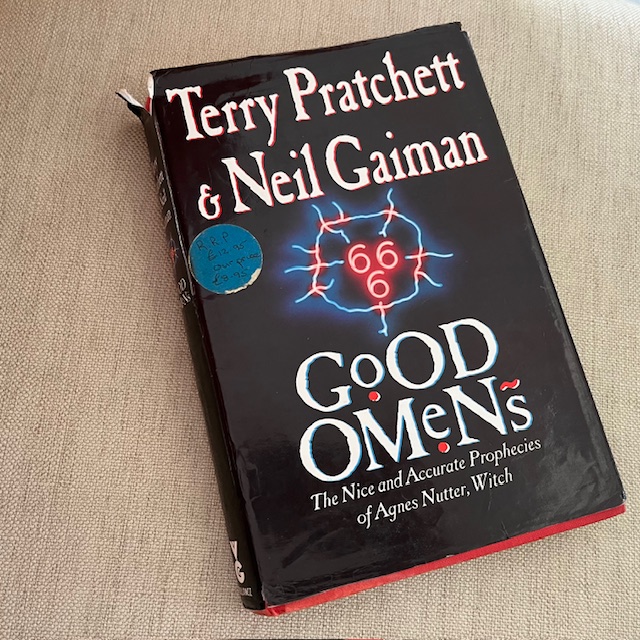
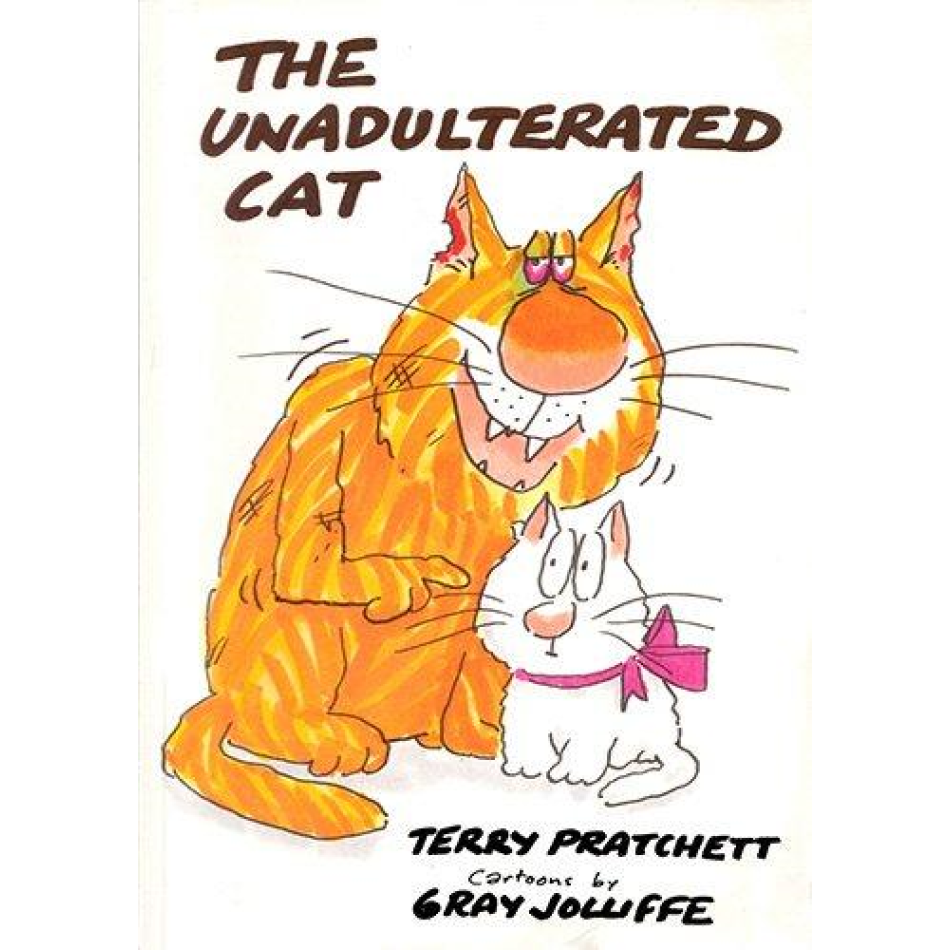
    Anyway, I was a fan of his work and bought the paperbacks when they came out and I could afford them. I also came across The Unadulterated Cat and, by chance, Good Omens in hardback at the irresistible price of £8.95. I was in Quiggin’s in Liverpool, looking for cheap clothes probably, and was astonished to see this for sale.

    I had no idea who this Neil Gaiman person was.

    First edition (I think) Good Omens, bought in Quiggin’s Market, Liverpool.

    Back at Loughborough, I was sharing a house with Simon, a fellow metalhead who was doing English and Drama. As is the nature of Drama types, they tended to congregate as a group. One of the group became friends with Simon’s girlfriend. Over a curry one evening, this friend and I got chatting about books and fantasy. We shared a love of Anne McCaffrey and a growing disdain for high fantasy, but she’d never read Terry Pratchett, could she borrow one?

    By the time she’d borrowed all my books, we realised that we really liked each other. So much so, that we got married, bought more Pratchett books and had two children together. But not before we got to meet him and nearly poison him with a bananana dakry.

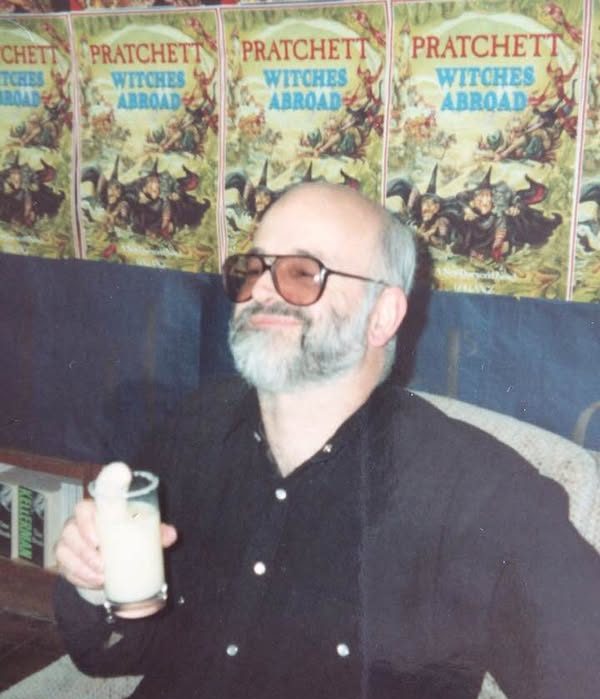
    Pterry at Loughborough University, signing for Witches Abroad in 1992. Our friend Emma and I colluded to get him a bananana dakry which, to his credit, he drank and pretended to enjoy.

    So Pterry meant a lot to us and we were saddened by his death, although we had known it was going to happen. Not as sad as when family have died, but still upset.

    Not long after my dad died, I read “A Life With Footnotes”, Rob Wilkin’s biography of Sir Terry. My dad had had vascular dementia, which stripped him of his memory, his independence and his dignity. Reading the last part of the biography was difficult for me. Not only because of how accurately Rob described his final days and Terry’s decline, but because I was crying while reading it.

    I’m rereading A Life With Footnotes. I keep meaning to do a re-read of all the books, revisit old favourites and maybe, finally read The Shepherd’s Crown.

    But I do need to find a copy of The Unadulterated Cat.

    Original cover of The Unadulterated Cat.