Category: Duolingo

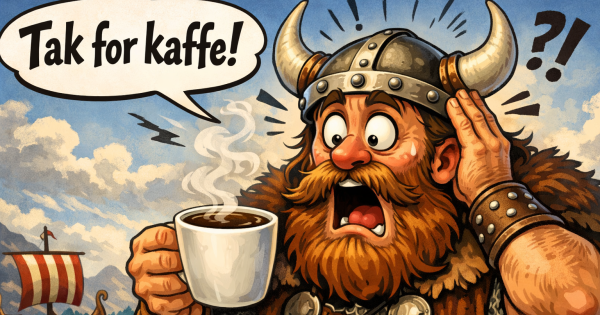
  • Why do the Danes say “Tak for kaffe”?

    Why do the Danes say “Tak for kaffe”?

    I’ve been learning Danish for a few years, mainly through Duolingo. Why? Because I used to work for an Anglo-Danish company and thought it might help. It didn’t, really, but it did help sometimes when I was over there to be able to read signs and notices.

    Like any language there are many idioms, some explicable (det blæser en halv pelikan- it’s blowing half a pelican; it’s very windy) some a bit more specialised (der er en Ko på isen – literally “there’s a cow in the ice” meaning this is a tricky situation).

    One of the odder Danish expressions is “tak for kaffe”, which literally means “thanks for the coffee”, but is also a slightly old-fashioned expression of surprise. Since I heard this I’ve wondered how this came about, and I recently found out.

    Danish hospitality can often mean coffee and cake or biscuits. When you leave a house, saying ‘tak for kaffe’ would be polite. So this came to mean ‘goodbye’.

    It might have ended there, but ‘goodbye’ turned into ‘I’m out of here’ when a situation gets tricky. In Denmark, when the going gets tough, the tough get coffee.

    From there it’s a short step to saying ‘goodbye’ (or ‘tak for kaffe’) when you’re in a situation you don’t want to be in, such as being surprised or frustrated.

    “Get me out of here!” becomes “I want to say goodbye to this!” and so “Tak for Kaffe!”

    There are similar expressions in English. My mum would say “Well, I’ll go to our house,” when she was surprised. This really confused me when I was little, especially when she said it when we were at home. “You’re already in our house,” I’d say. I could be very literally-minded.

    This is similar to “I’ll go to the foot of our stairs”, which I’ve never heard except in a Monty Python sketch set in a language lab. (Michael Palin, an actual Yorkshireman, being given direction from Graham Chapman, from Leicester).

  • Finished German

    The other day I reached a Duolingo rating of 80. This means that, after about five years of concentrating on German, I’ve finished the course.

    From now on there’s a series of daily refresher lessons so I don’t get rusty. And I’m still talking in German with our younger daughter as she completes her A level. And after all that learning I still cannot remember which ‘the’ to use or when I should use ‘ihn’ and ‘euch’. Clearly, a different type of tuition is needed if I am to go further.

    What next? I could revisit Danish, but no I no longer work for an Anglo-Danish company I don’t know if I want to. Or French would make sense since we go to France quite often. Or maybe Scots Gaelic – I grew up hearing this on telly occasionally1, though Thurso wasn’t in the Gàidhealtachd and I have nobody to practice with. I’ll decide soon.

    1. Grampian (north Scotland independent telly) would have a few hours of gaelic programming including the children’s programme ‘Cuir Car’ which showed life in the Islands and songs by Runrig. ↩︎
  • Duo at 2600

    Duo at 2600

    It’s now over seven years since I started my Duolingo steak. Today I hit 2600 days!

    I’ve concentrated on German for the last few years, partly to help our youngest with her German and also as a good intellectual exercise. I’ve also done quite a bit of Danish (hvorfor har du ikke bukser på?) and tried Scots Gaelic, though I struggled a lot with that.

    Am I fluent? No. Can I ask for things in German? Probably. I still struggle with grammar, especially declension, which is usually a guess. I mean, why do they need so many words for ‘the’? How does such a thing even come about? That’s a linguistics question and there’s no Duolingo for that.

Verified by MonsterInsights