Author: Fraser Steele

  • Chicken Basmati rice pilaf

    Chicken Basmati rice pilaf

    Based on a recipe I can’t find for an Iranian dish. It falls under the general category of ‘pilaf’, where rice is cooked with other stuff. Chicken is spatchcocked to (a) reduce cooking time and (b) fit in the roasting tin.

    Timings: Prep: 20 minutes. Cooking: 1 hr to 1 hr 15. Eating: about 10 minutes.

    Ingredients

    Medium roasting chicken (1.8 kg ish)

    250 g basmati rice

    500 ml chicken or veg stock (I used Knorr stock pots)

    One onion

    6 cherry tomatoes or a couple of normal tomatoes

    One carrot (diced) and a handful of raisins

    A teaspoon each of chilli flakes, cumin, oregano, and black pepper (to be more authentically Iranian, sumac should be used. But I didn’t have any. Sue me).

    Method

    Set oven to 180 C (fan). Will need at least one hour, up to 1 hr 15 min.

    Chop the onion into thick slices and scatter on the bottom of a lined roasting dish. Cut the tomatoes and add to the onions.

    Spatchcock the chicken (pictures below). I marinated the chicken overnight – rub the skin with olive oil and salt, put into a big plastic bag and put in the fridge. I try and do this when I do a roast, it tenderises the meat.

    Add the chicken to the roasting tin.
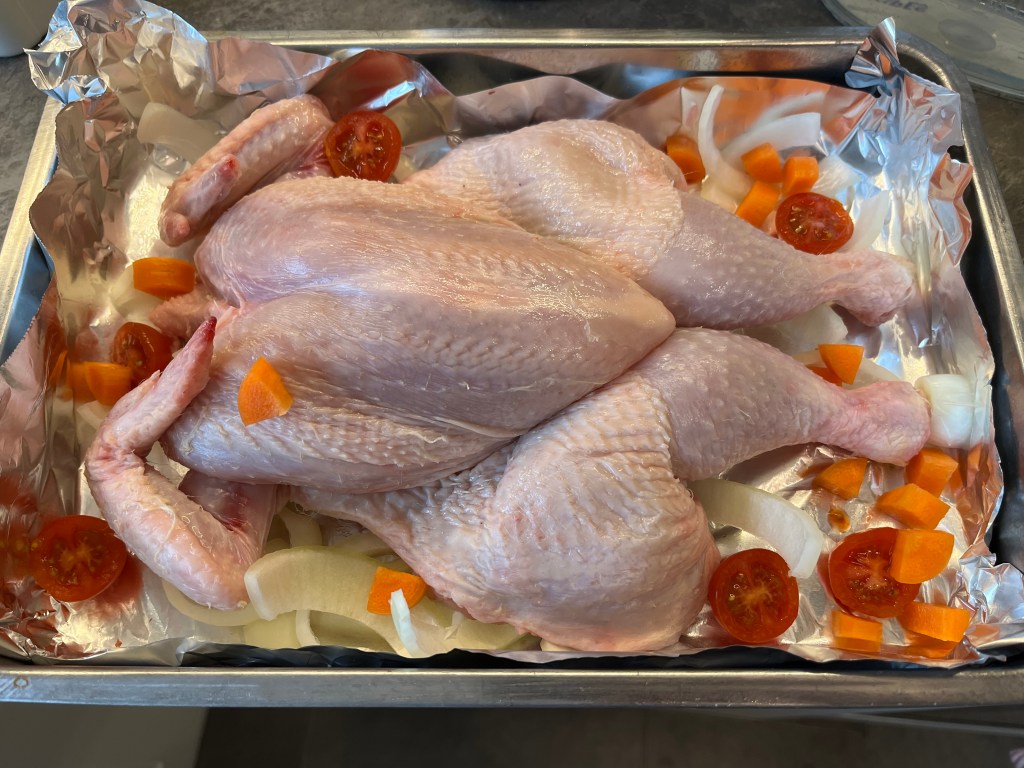
    Raw spatchcocked chicken placed in a roasting dish with sliced onions, cherry tomatoes, and diced carrots on a bed of foil.
    Chicken ready for the rice and stock.

    Add the rice, diced carrots and raisins. Pour over the stock.

    Cover with baking parchment, then foil to seal in the steam as it cooks.
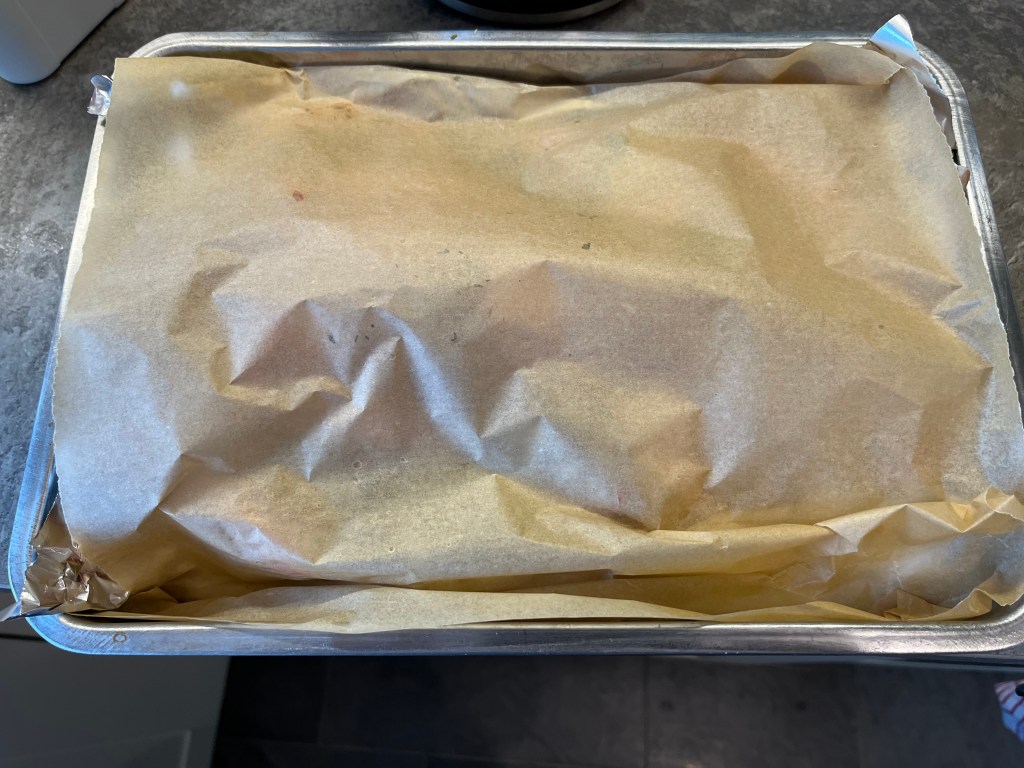
    Bye, bye birdie.

    I used a thermometer to check that the chicken was cooked. After an hour it was nearly done (not yet at 74 C) , but the rice looked a bit dry on top so I added 100 ml water. I gave it another 10 minutes and it was done.
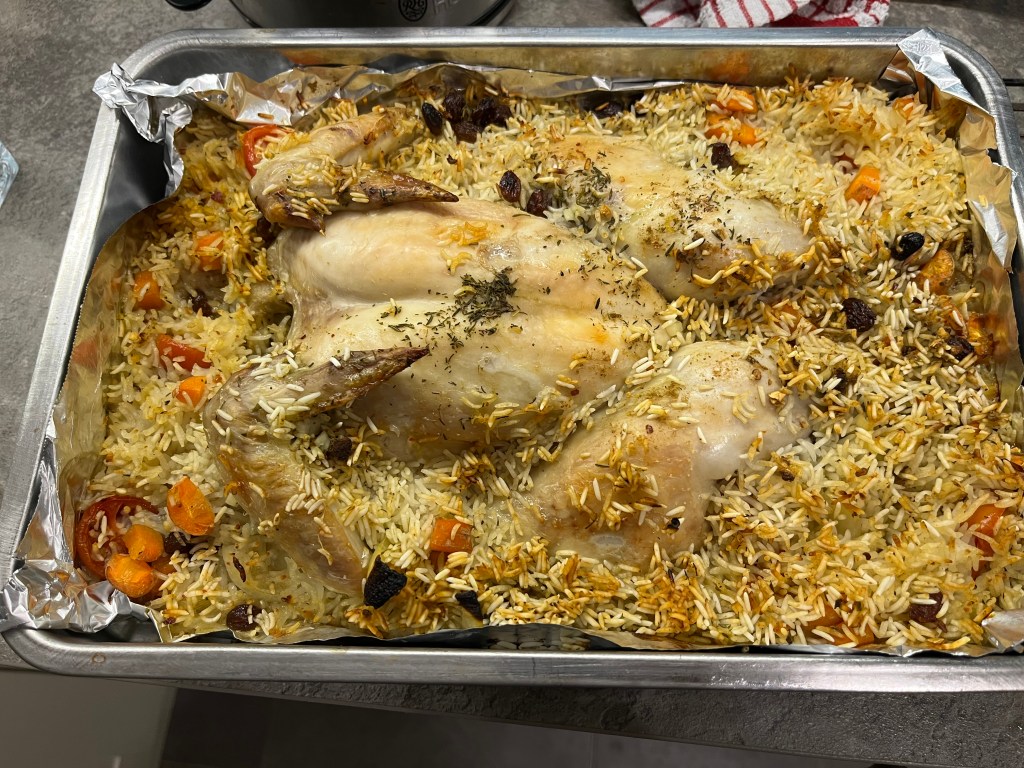
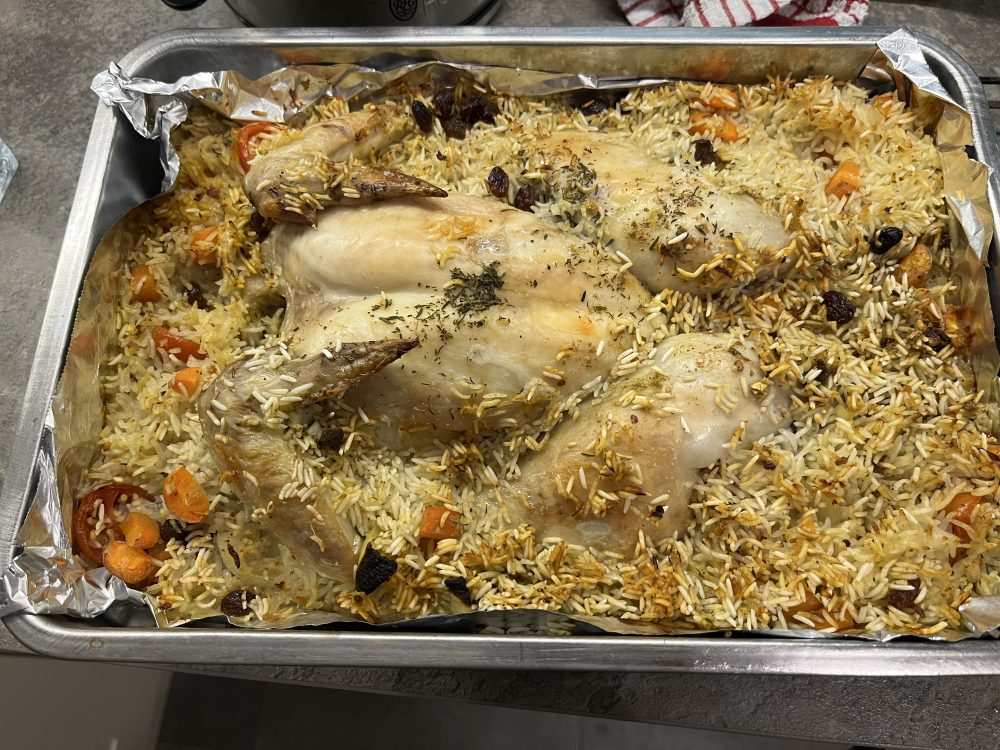
    Finished dish, roast chicken in colourful rice.
    Dinner’s ready!

    There was a nice contrast in textures between the rice at the top and the rice at the bottom, so there was crunch and softness.

    I’d go heavier on the spices next time. Maybe buy sumac, or look into the traditional Turkish method.

    Also some recipes call for grilling the dish before serving to brown the chicken and give extra burned rice. Maybe next time.

    Spatchcocking a chicken

    This is removing the spine of the bird and pressing it flat so it cooks quicker.
    Another Taskmaster reference. Hugh Dennis spatchcocked a camel, which I won’t be doing.

    I bought bone scissors some time ago because doing this without the proper tools hurts and can ruin a normal pair of scissors.
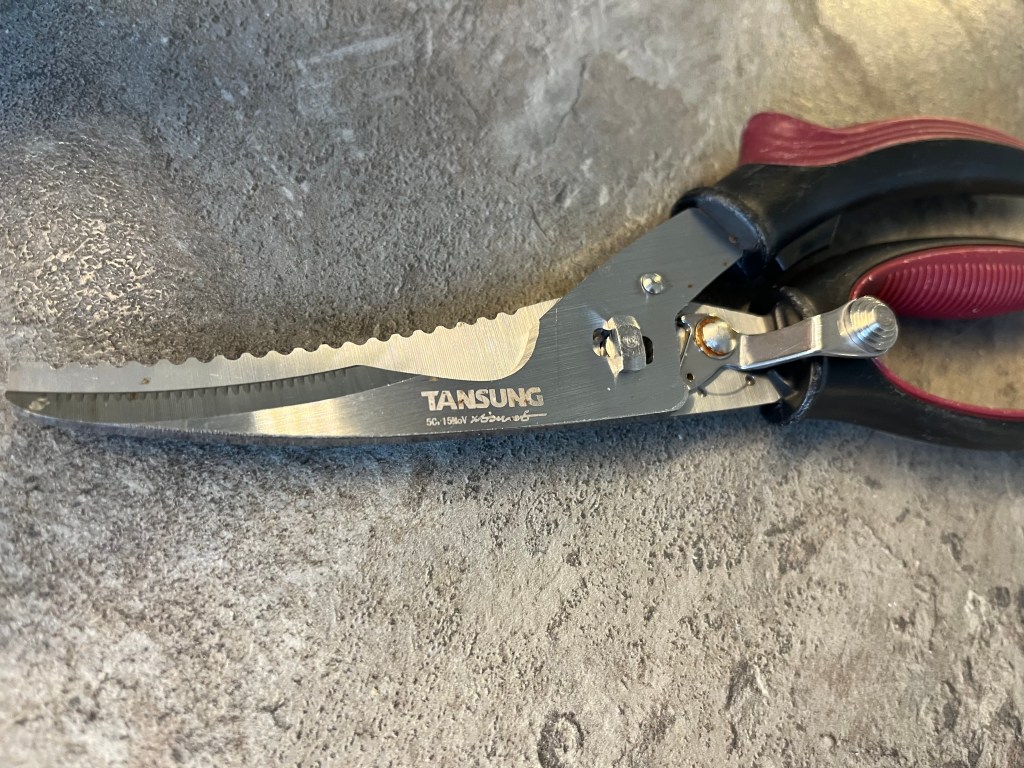
    “You Tansung?” “You asking?” “I’m asking.” “Then I’m Tansung”. A reference for the youth, there.

    I use these to cut the legs off roasted chicken, so they are used at least once a month. And they come apart and are dishwasher safe.

    I chopped off the parson’s nose then cut down one side of the spine. The skin is more difficult to cut properly with these scissors. I removed the spine fully.
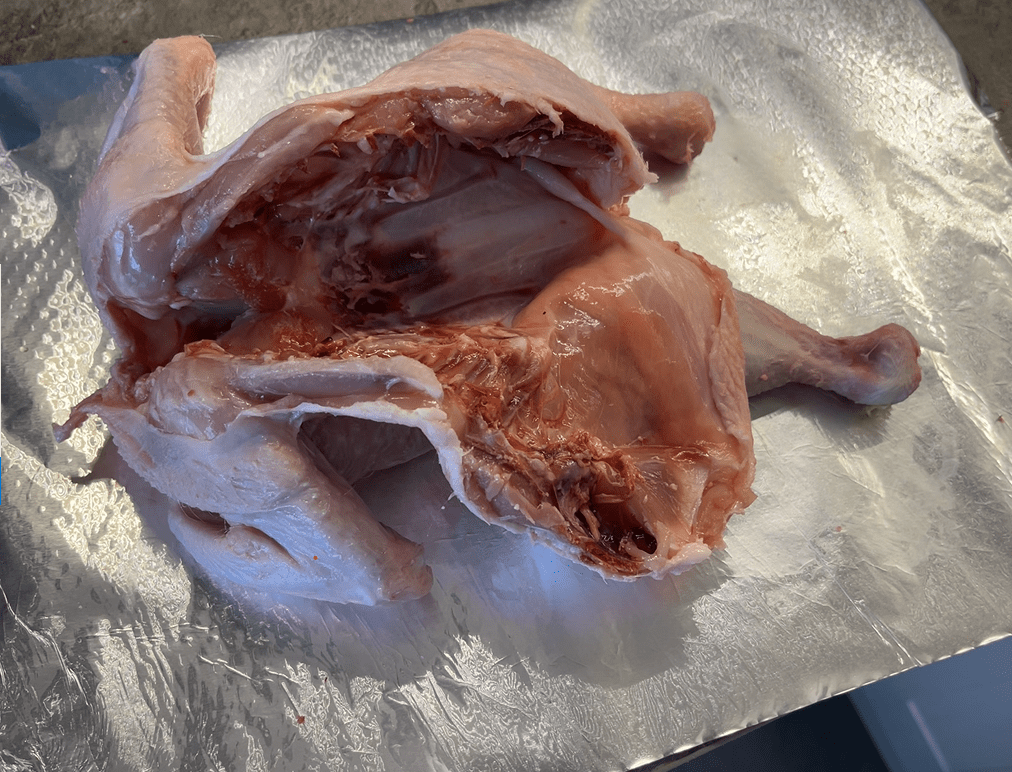
    The world’s most cowardly animal – a spineless chicken!

    I wiped the inside with kitchen towel to get rid of rogue bits from inside. Turn it over and press down to flatten. The wishbone needs to be broken so the bird will lie flat.

    Spatchcocking reduces cooking time by about half.
  • Buckwheat pancakes

    Buckwheat pancakes

    A favourite when we go to France. And it’s pancake day!

    Ingredients (pancakes)

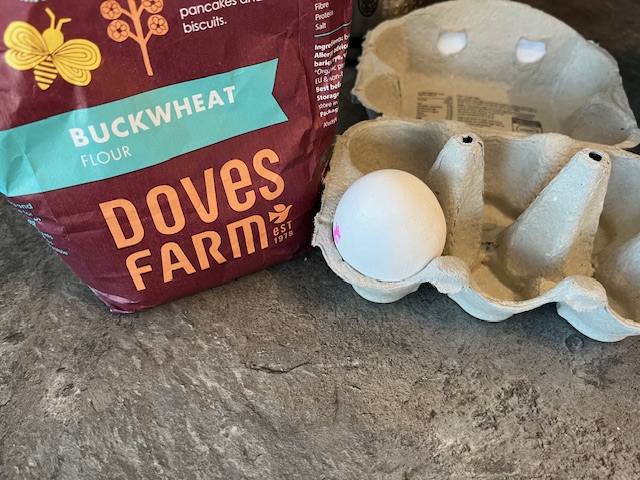
    80g buckwheat flour

    1 egg

    250 ml milk

    pinch of salt

    Mix flour, egg and salt in a bowl. Once mixed, leave to stand for at least 30 minutes. Overnight in a fridge is supposed to be better.

    When it’s time, put a blob of butter in a frying pan. Once it’s bubbling add enough batter to cover the pan and fry until the top is almost solid. Then flip and continue to fry until the bottom is solid.

    We had buckwheat flour left over from youngest daughter’s Food Tech last month. And an egg! Currently a luxury in the USA.
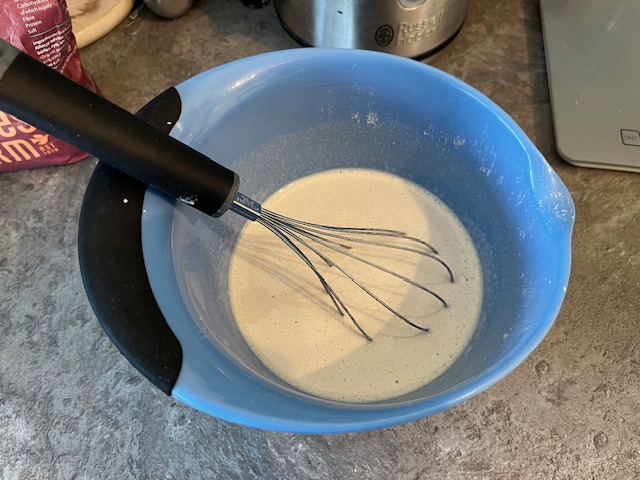
    Quite a thick batter (not that you can tell). If I was working I’d do some rheology and a design of experiments on this and determine the ideal ratio of flour, egg and milk. But I’m not working, which is why I’m doing this nonsense.

    In the end, they were OK. We had them with baked salmon (from frozen – salt, chili flakes and frozen onions, bake 30 minutes at 180 C) and corn on the cob (butter and salt, wrap in foil, bake with the salmon).

  • Blender Part 3

    Blender Part 3

    I’ve spent more time on Grant Abbitt’s course; I’ve been finding out about low poly landscapes and how to add lights and glow.

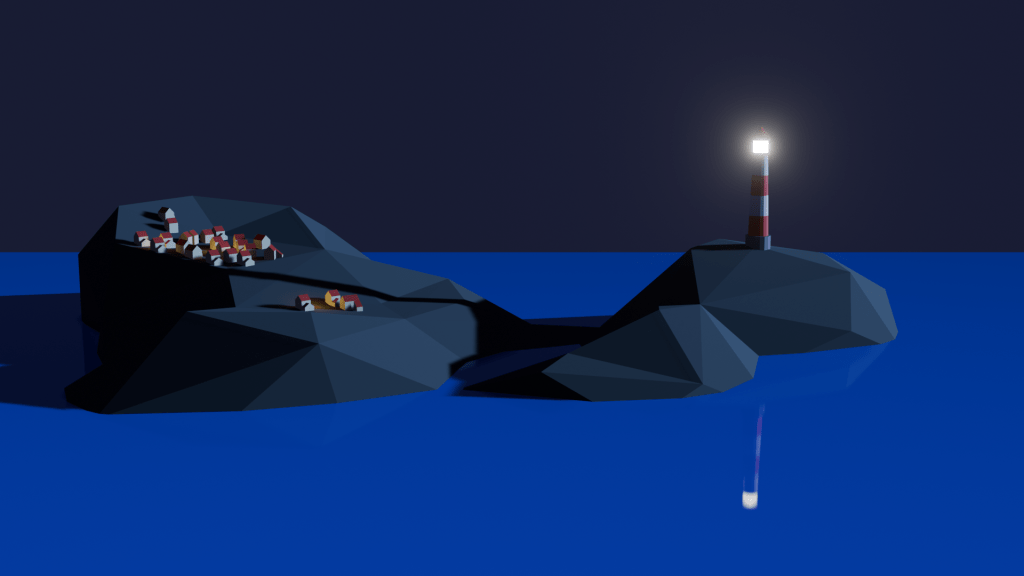
    Finished lighthouse scene. I like the glow from the lighthouse and how it reflects in the sea. Maybe I will learn how to make it flash and post that, too.

    Having more than one colour on a single object, adding street lights of the right colour (the glow by the houses matches the sodium lights I grew up with in the 1970s.) Grant also covered how background affects the scene and where lights go. This is often skipped over in lessons by other presenters.

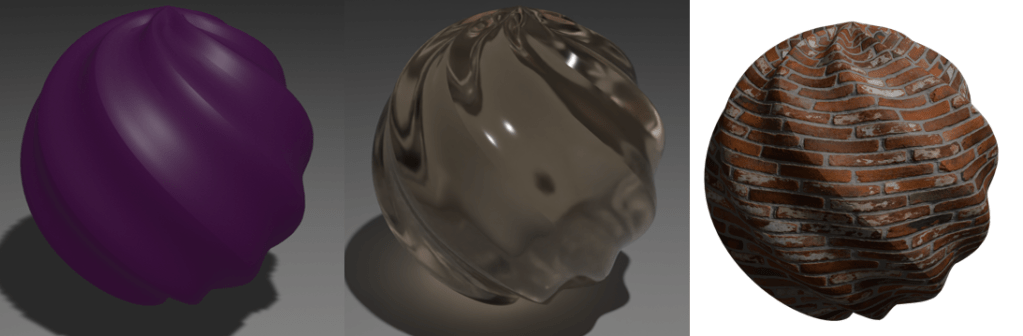
    Besides this course, I’ve had a look at how to make shapes for 3D printing applications. I went through a short vid on how to make a spiralised ball. It was titled ‘how to make a spiral in one minute’, but it took me over half an hour, stopping and starting the video to squint at what the presenter had. done. Maybe I’m being unfair – if he wasn’t intending to make an instructional video, then I shouldn’t have expected one.

    Spiral balls in Blender. These would be interesting to 3D print, maybe adapt for Christmas decorations.

    I’m still a long way from being comfortable with the interface and I doubt I will ever fully know how to use the program. But as long as I have fun and a creative outlet and don’t scare the horses, it’s all good.

  • Blender part 2

    Blender part 2

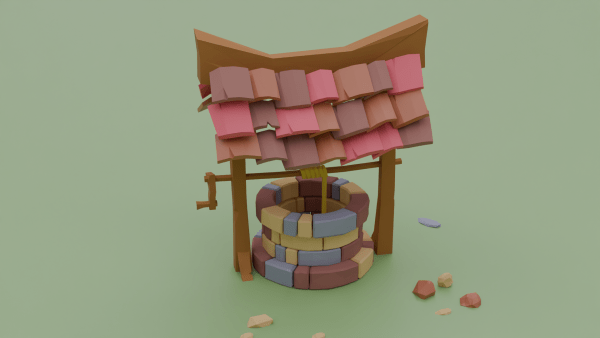
    I started a course and, unusually for me, I paid actual money for it. It’s presented by Grant Abbitt, some of whose free video tutorials I’ve seen. I did finish the low poly well, it took me a few days (no idea how many hours) and I was pleased with the result.

    Not sure where such low poly work would find a home, but it’s good to do something creative that I think will lead to better 3D prints. I just need access to a 3D printer.

    Learned quickly how to change materials and do lighting so that you get these great effects with transparent materials. This was done on the second day of the course, maybe four hours to get this far.

    What’s so good about this course is that Grant takes you through the steps to make a thing. This isn’t unique, but I see a lot of courses that show you how to use tools in Blender and other programs (Excel, for example), but there is no context.

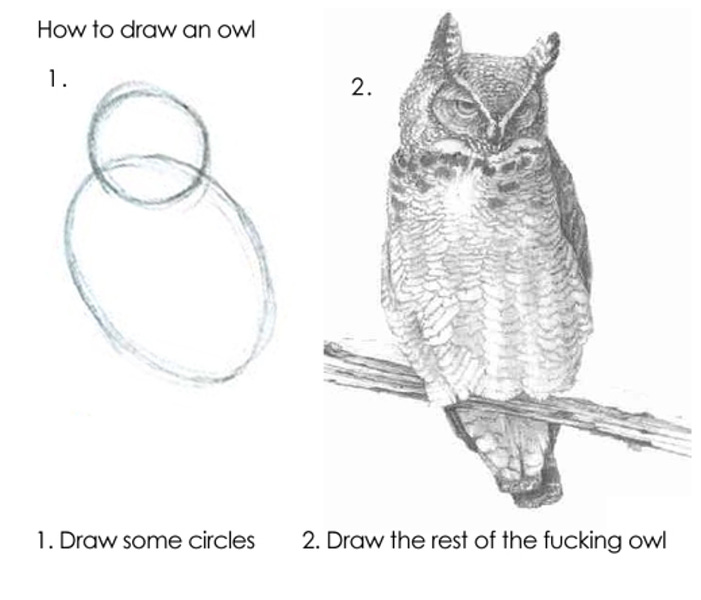
    What he also avoids is the “Draw the rest of the fucking owl” trap that I see so often. You’ll be shown how to design something, then magically it’s all lit with a background, multiple lights and a camera fly-round.

    The original “Draw the rest of the fucking owl” meme. Original artist unknown, but it’s been around since 2010. Which is medieval by internet standards.

    I got the course through Udemy, it may be available elsewhere. It’s called “Complete Blender Creator” and I reckon it’s been worth the £15. If I was making stuff in real life it would cost me at least that much to buy some clay or paper and paints.

    More to follow. There’s a lot to learn, but I’ve got time while I’m on gardening leave. I can’t spend all day looking for work when there’s no suitable jobs.

  • Duolingo

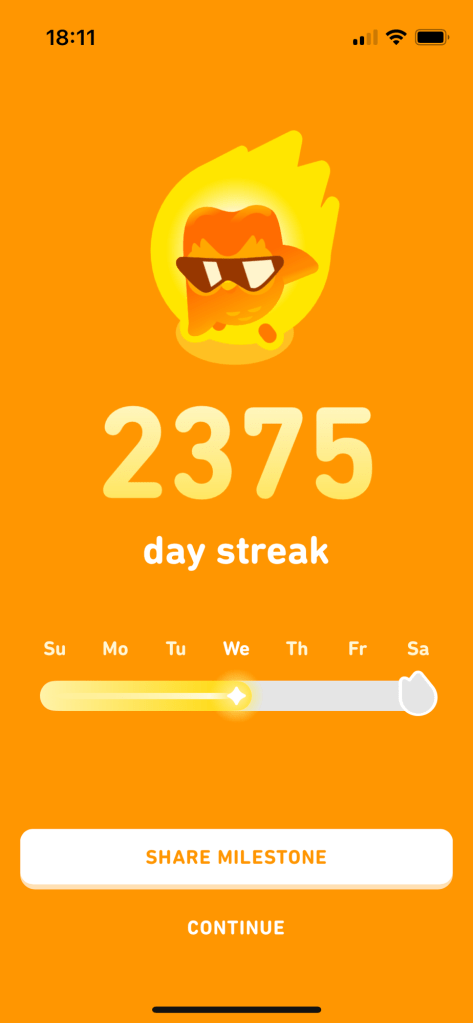
    New streak milestone

    2375 days. That’s six and a half years!

    I started Duolingo a long time ago, and like most people I stopped. But I’ve committed to this for over six years. First Italian to get the basics when we went to Tuscany in 2018, then Danish because I worked for an Anglo-Danish company. I went to Copenhagen twice a year, I did find my basic grasp useful. But I’ve been concentrating on German for the last few years.

    Our youngest started learning German at secondary school, I did an O level back in ‘87, so I thought it would be good to brush up and help her with the language. Like all languages, German has its challenges but Youngest and I can chat in German and annoy Mrs S (whose French is coming along after a few years of Duo).

    I’ve yet to test my German in the wild, I’ve not been since 2019 when I went to Frankfurt for a conference. I’ll keep on going since Youngest is doing German A level and I don’t want to be left behind.

    Still can’t stand that owl, though. Needy, naggy little prick.

  • Blender lessons

    Blender lessons

    Taking 3D design seriously

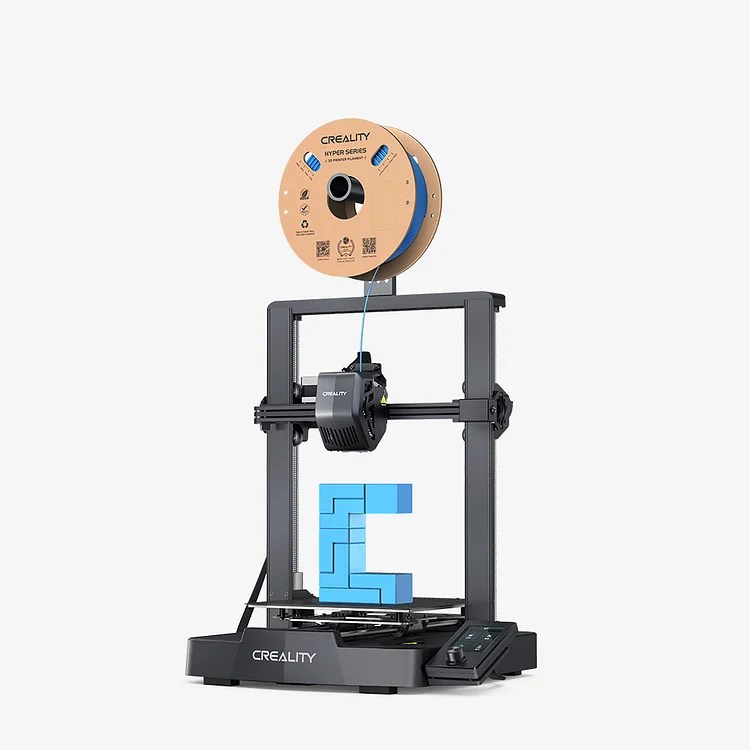
    I’ve been working with 3D design for about two years. As a pharmaceutical scientist, I’ve been keeping track of possibilities in 3D printing tablets and other dosage forms. There’s been some interesting recent work on this and in custom design of arm casts. At my last job, we bought an Ender 3 Pro in early ’23 and set about finding uses for it.

    Ender 3D printer. This isn’t the exact one we bought.

    I used TinkerCad for most of the design work.

    https://www.tinkercad.com/

    We used it to design all sorts of things – new funnels, inserts for spectrophotometers, toroidal propellers and flexible substrates for rheology testing. But I kept seeing Blender being mentioned when I looked on YouTube for help with 3D design. But I thought Blender was scary. Just look at it!

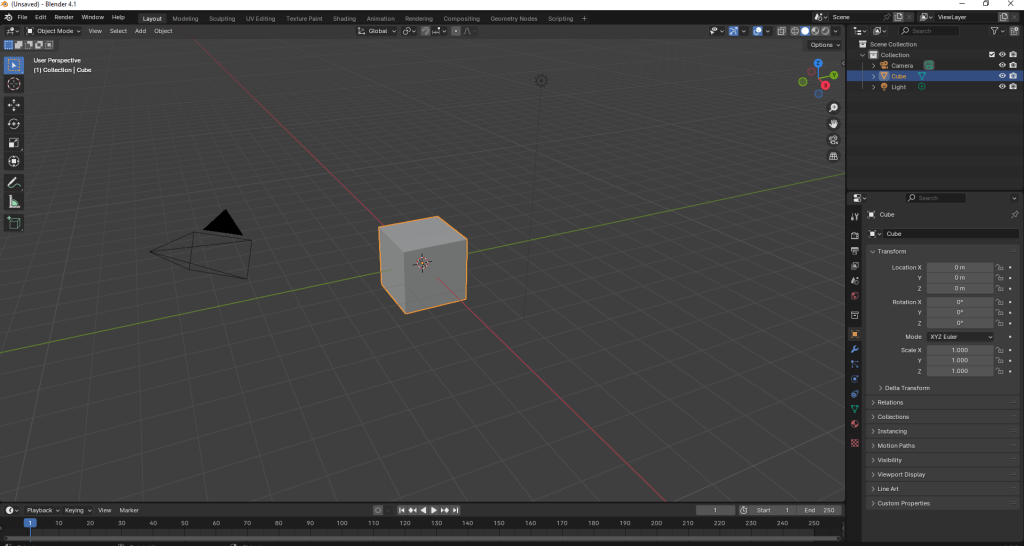
    Blender window as it opens.

    There’s loads of stuff on there! And that’s just one window! Sculpting? UV Editing? Eh?

    But it is supposed to be a good program to learn 3d design, animation and simulations. I’d also had an idea to make a 3d print of a SEM image I took some years ago of a fractured oil droplet.

    SEM image of a fractured oil droplet. I spent over 20 years studying these things.

    This sort of thing was beyond the scope of TinkerCAD, but it turned out it was (relatively) simple in Blender. Well, I followed a tutorial on how to add things at random over a surface. I needed this because other images we took showed that there’s bumps all over the surface of the droplets. So with a knobbly hemisphere generated in Blender, I used TinkerCAD to add the rock-like frozen fractured oil interior. Then it was a matter of slicing and printing.

    Easy.

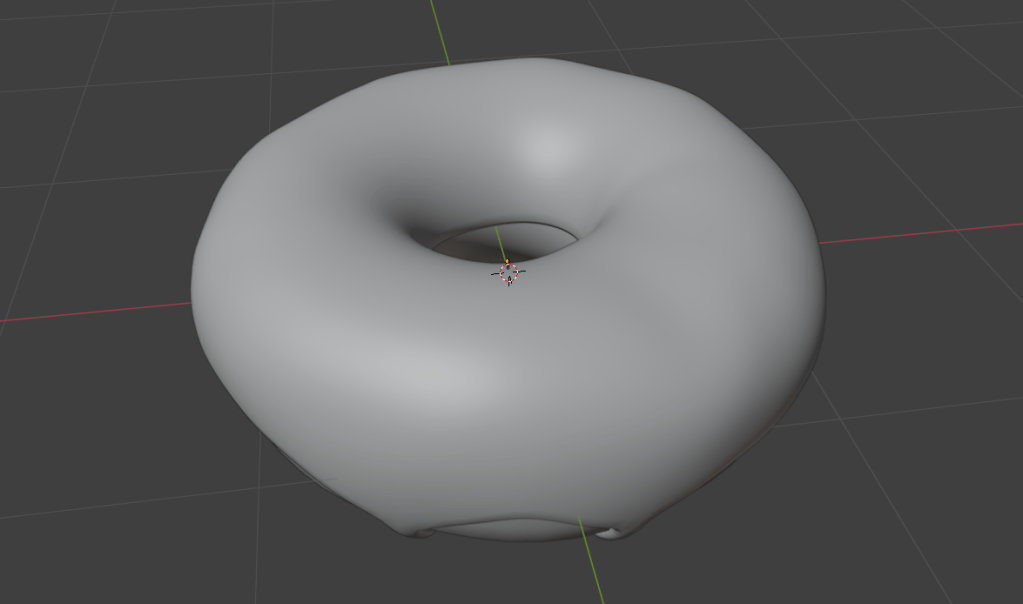
    I’d made a doughnut in September following a YouTube course (see below), which as OK I suppose.

    A doughnut made in Blender. Looks delicious!

    After faffing around a bit, I decided to give Grant Abbitt’s Low Poly Well a try. I chose this because Grant is an excellent tutor. He’s clear, doesn’t skip over bits (no ‘draw the rest of the owl’ nonsense) and has been using Blender for 20 years. He’s also English, so he says ‘zed’, rather than ‘zee’.

    So I’m going to see how the low poly well goes. This will be under ‘Blender’ in this blog.

  • They were very nice about it

    Our CEO and his PA visited the UK site. This wasn’t unusual, though we only had one day warning.

    We’d had a very upbeat meeting three weeks earlier at the main site and I thought we would be asked to start up a few new projects.

    I was stunned to be told that my contract was being terminated.

    The decision had been made to stop all R&D activity. About half the company were being laid off. The focus would now be on one key product (one I’d helped invent!) and some support activities.

    So I was given a letter and three months’ gardening leave plus the promise of redundancy. I get to keep my laptop and phone, but they have no further need for me after 19 years.

    Where now? I’ve not had a job interview in 28 years, having got all my jobs since by word of mouth and recommendation. Set up for myself? I’m too much of a generalist to consult. I’m also 55 – my dad retired at 54, but I don’t think I’m ready financially or mentally for that.

    I could buy a 3D printer and sell stuff. I’ve been learning Blender and Python, though not at a level where these could be my sole sources of income.

    There will be a lot of talk with my wife. We have paid for a holiday to Australia in August, we can’t not go – there’s a wedding and our 25th wedding anniversary while we’re there.

    Let’s see where the next few months takes us.